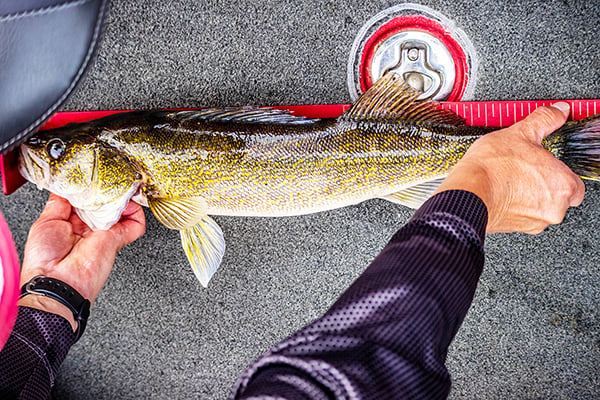
Somewhere in the late 1960s, pretty much about the same time Al and Ron Lindner introduced their famous Lindy Rig to the fishing public, walleye anglers added backtrolling to their bag of tricks. Lindy Rigs instantly produced a lot of walleyes, especially once anglers figured out how to slow the presentation down and keep it vertical.
The best means to do that at the time was to spin your boat around and use the transom as an anchor or brake. The simple Lindy Rig, combined with this new-found backtrolling approach, literally changed the way people fished for walleyes on shallow and deep structure.
Backtrolling became an art, mastered by folks willing to learn how to maximize a tiller boat’s outboard effectiveness with surgeon-like precision along deep structure, breaklines and weed edges. It was the best way to present live bait in its most natural state and keep it front of a walleye’s nose longer.
It became so effective that walleye anglers eventually matched the craft of backtrolling with other presentations such as spinner rigs, crankbaits, and even jigs.
Backtrolling really was an art and those who mastered it put a lot more walleyes in the boat than those who couldn’t figure it out.
But in this modern era of walleye-fishing patterns and techniques, where electronics in its many forms now rule the water, is backtrolling still relevant? Can you still consistently catch walleyes by implementing a solid backtrolling game plan and does anyone even want, or need, to backtroll, especially with all the other tools now at our fingertips?
MORE WALLEYE COVERAGE FROM OUTDOOR NEWS:
Steve Carney: Keys to incredible April walleye fishing on the Missouri River
Wisconsin’s Lac du Flambeau tribe bans all walleye, muskie fishing by non-tribal members
Ron Schara: Somebody has to improve fishing in Minnesota… why not you?
Let’s address the obvious:
Much like backtrolling and live-bait rigs changed the way most people walleye fished back in the day, so too have electronics – side imaging, front-facing sonar, mapping technology, and possibly even more noteworthy, trolling motors with spot-lock and GPS capabilities have changed the way anglers now locate and catch walleyes.
The terms spot-locked and scoping are now thrown around more frequently than anything else in the walleye fishing world, and for good reason. Both options have provided never-before-seen results for walleye anglers of all levels and abilities.
But here’s the truth of the matter: Not everyone wants to “scope” walleyes; some dudes still want to fish – and there is a difference. It’s that group of anglers who still catch plenty of walleyes by implementing what’s now considered old-school techniques, backtrolling included.
In many instances, you now have to have the right conditions to connect on walleyes via backtrolling. As our methods have changed through the years, so has the environment we present them in.
Many lakes now feature some of the clearest water we’ve ever seen, primarily due to the introduction of zebra mussels and other invasive species. Catching walleyes in clear water is generally a tough nut to crack, so backtrolling in this situation probably isn’t the best approach.
Add a good wind and/or some clouds into the mix, and it’s a different scenario. You can now long-line a presentation or sit right on top of a pod of fish and work them vertically by backtrolling, and even more effectively if the wind is really howling and bow-mounted trolling motors just don’t get the job done.
One also could argue that covering weedlines or contours on a specific piece of structure still happens most effectively by backtrolling. This again comes back to the art of the whole deal, the ability to crawl along a defined weed edge or break with pinpoint accuracy, specifically when walleyes are hanging tight to it. Is it now the only way to do that? Nope, but backtrolling still works really well for it.
River systems provide another opportunity to put backtrolling techniques into play. Whether you need to cover water or simply slow down and present a more controlled presentation, in or along current, backtrolling is a very effective approach.
Backtrolling simply allows for better boat control than forward trolling does, even more so when current is involved. Is backtrolling the only way to fish a river effectively for walleyes? Absolutely not, although it’s still going to produce plenty of fish.
Here’s the bottom line: backtrolling, like most other tried and true walleye-catching techniques and presentations, still has its place. It’s not for everyone, and backtrolling might not be as inviting as many of the latest methods and gear at our disposal, but walleyes can still be caught, and rather consistently, by implementing this approach.