





Memphis, Tenn. — Ducks Unlimited on Wednesday announced the passing of acclaimed waterfowling artist David Maass, who died today at the age of 96.
Born Nov. 27, 1929, in Rochester, Minn., Maass rose from humble beginnings as a largely self-taught artist to become one of the most respected and influential figures in nature art. Over a remarkable six-decade career, he built a legacy defined by extraordinary craftsmanship, an unmatched understanding of light, and a deep reverence for the natural world.
Maass’ reputation as one of the foremost wildlife painters did not come overnight. It was earned one painting at a time through years of dedication, discipline and passion. His work captured the true spirit of the outdoors and resonated with collectors, conservationists and art enthusiasts alike.
A pioneer in the field, Maass helped shape the modern landscape of wildlife art. He is widely credited with introducing the concept of the time-limited print edition through his 1974 Federal Duck Stamp, as well as the edition series with his celebrated work Misty Morning.
More than 300 of his images have been reproduced in limited editions, primarily through his longtime publisher, Wild Wings. His artwork also appeared in Brown and Bigelow calendars for more than 46 years, bringing his vision of nature into homes across the country.
In 1997, U.S. ART honored Maass with the prestigious title of Master Artist, further cementing his place among the greats in American art.
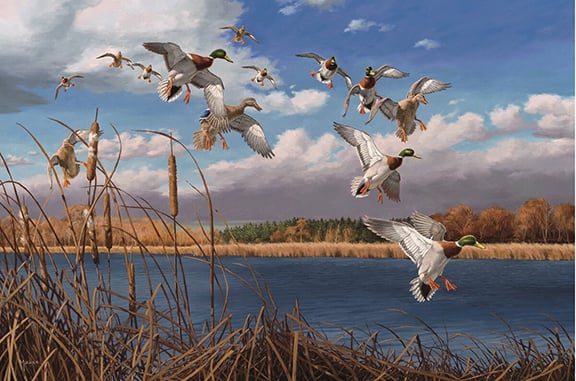
Beyond his artistic achievements, Maass was a passionate conservationist whose work had a lasting impact on wildlife and habitat preservation. He designed 38 duck and conservation stamps, including two Federal Duck Stamp winners. His contributions to conservation organizations were profound, raising millions of dollars through the donation of original works and limited-edition prints.
Maass won the federal duck stamp competition twice (1974-1975 and 1982-1983) as well as more than 35 state duck and conservation stamp contests. He was named DU Artist of the Year five times, in 1974, 1988, 2004, 2013 and 2016, and served as a featured artist at the organization’s Great Outdoors Festival in Memphis.
“David was a true gentleman, a proud veteran of the U.S. Marine Corps, and the best wildlife artist of our time,” said DU Past President John Tomke. “He was passionate about conservation and waterfowl, and he was very generous to Ducks Unlimited. His philanthropy and artistic talent left a legacy for this generation and future generations. He is one of Ducks Unlimited’s legends.”
RELATED COVERAGE FROM OUTDOOR NEWS:
A Minnesotan’s waterfowling life: Remembering legendary wildlife artist David Maass
Maass was an up-and-coming young artist when his oil painting of a flock of bluebills appeared on the cover of Ducks Unlimited’s first modern-format magazine in spring 1963. Since that time, the magazine has featured many other Maass paintings.
Maass’s relationship with DU began in the late 1950s, when he was asked to donate a painting to help support a fundraising dinner in New York City.
“My first painting for DU went to the Waldorf Astoria Hotel in New York in either 1958 or 1959,” Maass said in 2015. “I think that at the time it was one of very few DU banquets in the country. I’ve been told it may have been a black-tie event. The painting was of a canvasback. It went for $600, and they thought that was pretty good. I gave them a painting for two or three more years.”
Through his art and personal appearances, Maass helped extend the conservation message far beyond the hunting community to the broader public.
“David Maass was more than an extraordinary artist. He was a visionary who helped define how we see and appreciate the natural world,” said DU CEO Adam Putnam. “His work not only inspired generations of artists but also played a critical role in advancing conservation. Ducks Unlimited is proud to have called him a friend and partner for so many years.”

Short on walleyes, but long on muskies: Beers Lake in Minnesota’s Otter Tail County
Otter Tail County’s Beers Lake is an excellent walleye fishery – nope. Beers is loaded with good-sized panfish and northern
Minnesota’s Outdoor Calendar
A look at upcoming outdoor-related events from across Minnesota published in the Oct. 23, 2026 edition of Outdoor News.

Minnesota Cuffs & Collars: K9 Molly helps hunter find lost gun
Minnesota cuffs and collars are field reports from DNR conservation officers. These reports are from the Oct. 23, 2026 edition
