




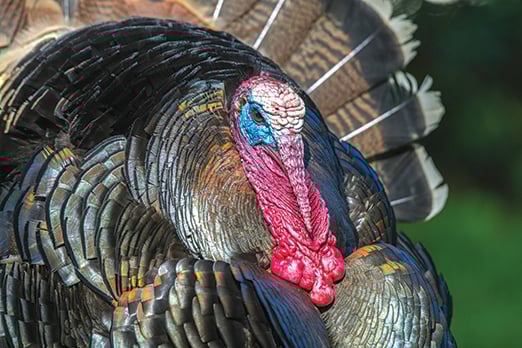
Madison — Turkey hunters took it on the chin once again when they tried to buy a bonus tag for Wisconsin’s spring hunt, only to see their order eliminated by the Department of Natural Resources’ GoWild system.
Plenty of hunters were upset.
Bonus tags went on sale beginning at 10 a.m. March 16 for Zone 1. Hunters who went to their GoWild account were put in a queue to buy a tag.
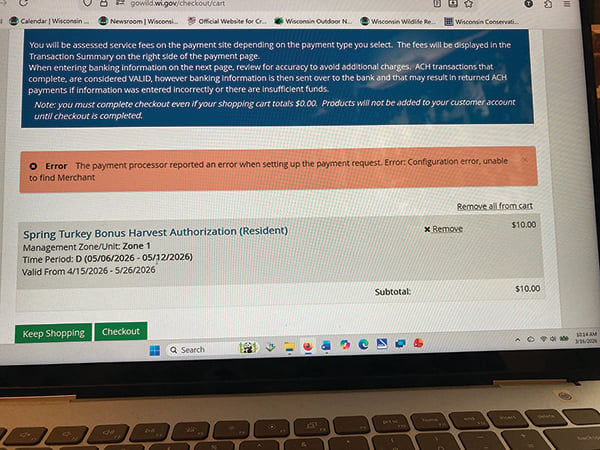
After filling out their selection and providing their credit card, rather than the process concluding with verification of the charge and an authorization number, they were stone-walled with an announcement, “The payment processor reported an error … and was unable to find a merchant.”
Hunters tried and tried again to enter their payment, but were unsuccessful and had to wait until the system was “repaired,” which took until about noon.
To make matters worse, people who thought they still had the permits and time periods they wanted in conjunction with other family members in their “cart,” were wiped clean when they got back into the system. They had to re-apply for what they wanted. Some did not get what they wanted.
‘Everything shut down’
Jeff Craven, of Colorado, was planning on a multi-generational hunt back in Wisconsin with other family members. Each member of his family entered the queue and had numbers as low as 90. They had their three tags all for Period C for himself, his son, and his dad.
“We had all three tags in our carts at 10:05, but when we clicked to confirm our purchase, the wheel started spinning and everything shut down,” Craven said. “We got kicked out.”
When the system eventually came back up, he hoped that they would still have the permits for the same time period in their carts, but it was wiped clean and he then received a queue number in the vicinity of 10,000.
In the end Craven did not get a permit, his son eventually did get one for Period D, and his father got one for Period C.
“I understand glitches can happen, but this was handled poorly and resulted in a whole lot of people screwed over and missing out when we did everything right,” Craven said.
MORE COVERAGE FROM WISCONSIN OUTDOOR NEWS:
Sandhill crane season comes up short in Wisconsin
Ask a fisheries biologist: What research is saying about the impact of forward-facing sonar
Elk tag, longer bow season highlight Wisconsin DNR wildlife questions
If nothing else, to be fair, if the DNR couldn’t resume allowing people to buy what they had in their carts, they could have canceled permits that day and allowed people to start over with Zone 1 on the following Monday, he said.
Brian Buenzow, a retired DNR wildlife employee, experienced the same frustrating event.
“I have had a lot of consternation over customer service with DNR,” Buenzow said. He said a lot of the problem is that the agency does not have enough money to hire adequate staff. “The DNR needs more money as the legislature is choking them off at the knees,” he said.
Buenzow, and his wife, Mary Ann, both were on their computers Monday morning and thought they had bonus tags in Zone 1, but they couldn’t check out and pay.
“I said, ‘Why don’t we just go to DNR and buy them there,’ but when we got there the office was closed due to inclement weather,” Buenzow said. “If you are in the customer service business you need to get your tail to work.”
They ended up going to Farm and Fleet in Janesville, one block away, and bought their bonus turkey tags at the store.
To make matters even worse, on Tuesday, March 17, they were each going to buy a tag for Zone 2. Again they were trying to buy the tags online and he said a similar thing happened.
“Mary Ann was persistent and finally we did get back in and bought the tags, but it was not easy,” Buenzow said.
Buenzow said a friend went to Farm and Fleet when sales started and got his permit right away on Monday, so the online program was where the problem occurred.
Buenzow worked for the DNR from 1981 to 2015 and has concerns about what the DNR is not doing. He used to do habitat work, often funded with pheasant stamp funds. He said now that type of work isn’t being continued and the grasslands are turning over to trees.
He said the DNR had seven years to get a memorandum of agreement between the Rock River Valley Chapter of Pheasants Forever, which he now volunteers with, and the DNR to do habitat improvement work involving burning of grasslands on land that Pheasants Forever donated to the state, but now is hamstrung by the DNR.
MORE TURKEY COVERAGE FROM OUTDOOR NEWS:
Innovative wild turkey research starting in Minnesota
Up your consistency with these turkey decoying tips
Talk of a two-bird limit for Minnesota’s spring turkey season taking place
Online down, vendors up
Curt Pluke, of Wisconsin Rapids and a past volunteer with the Wisconsin Chapter of the National Wild Turkey Federation, said that on the first day of sales he was number 3,674 in the queue hoping to get a third-season tag.
“It (the online system) was a little slow, but I got in within 15 minutes. When I hit checkout it stalled and I got the message that there was an error,” Pluke said. He called the DNR and learned there was a problem, but was told the on-site sales were proceeding so he drove to Walmart and was able to buy his bonus permit there.
Although Pluke was happy to get a permit, he thought it was not fair that the DNR was letting some people buy permits while others could not.
“I felt this just isn’t right. I got a permit there in-person and people online couldn’t get one,” he said.
Pluke’s friend in Oconomowoc, who was 178 in the queue, had a similar problem. By the time the system was back up his friend had to settle for a late-season tag.
“You remember the first time they sold leftover permits it collapsed, but they fixed it and it worked flawlessly. I wondered what could have changed?” he said. “If they tried to say the traffic was too much, that doesn’t wash. It is terribly unfair.”
Dirt Derse, of Hartford, thought he had his permit when he was about number 1,000 in the queue, but when he tried to check out the website kicked him off. When he got back in, he was number 7,700.
“I was irritated. This was not their first rodeo,” he said. “In private business you have to be responsible. I want to know who is responsible for this. Was anyone disciplined?”
Derse said that DNR needs more transparency if it wants to gain people’s trust.
Repeat of 2008
What newer turkey hunters may not realize is that something very similar occurred in 2008, the first year that DNR was selling leftover turkey permits. Many people then felt the DNR was overlooking turkey hunters and had no realization for the amount of traffic that would come to the website.
Following a Natural Resources Board meeting on April 23, 2008, then DNR Secretary Matt Frank said that he was very unhappy with what happened on March 28 when many hunters were substantially inconvenienced by the system’s inability to issue permits in a timely manner.
“We are working very hard to see that it does not happen again. I have ordered an internal review here in the DNR to look at the vendor’s actions in the whole thing, our oversight of the vendor and what our options are,” Frank said.
At that time the DNR had a contract with a vendor, Central Bank in Missouri, to perform appropriate services.
“My staff is working hard on all of the follow-up,” he said. “I have thanked our staff for the work they have done that day. The fault was not theirs, nor was it our third-party vendors who sell through the ALIS system. This was a computer system problem. My goal is that we have a definitive explanation of what happened, that there is accountability for that and it does not happen again.”
DNR response
On March 16, the DNR realized it had a problem and is now trying to make matters right by reaching all of the applicants who did not get the permit they wanted and offering a replacement. Taylor Finger, DNR game bird ecologist in charge of the turkey program, said that a new third-party payment processing vendor, Tyler Technologies, was unable to handle the volume on March 16, and the system crashed.
He said that a total of 1,100 customers were unable to buy permits for the third time period in Zone 1.
“We have made the decision that we will be contacting all 1,100 individuals and identifying if they would like to have a Period C tag,” Finger said. “If they would (like a Period C tag), we will replace the tag they bought with a C Period tag, making it right for those individuals.”
The DNR sent out emails in batches last week to the list of 1,100 hunters, and those who don’t open their emails should receive a follow-up call to be sure they know of the opportunity.
People who went through license vendors or DNR service centers were able to buy tags without interruption. It was the online system that puts applicants into a queue that crashed.
Finger said that the vendor was selected because they provide additional options for making payments. Although the vendor had tested the system prior to the Monday sale, it had not had experience with that high of a volume and was inundated with the volume of requests.
Finger said that the program ran without interruption for the rest of the week, although “at a slower rate to be sure that it didn’t crash.”
The fact that there are good turkey populations across the state right now allows the DNR to issue replacement permits.
Ohio’s Outdoor Calendar
A look at upcoming outdoor-related events from across Ohio published in the Oct. 9, 2026 edition of Outdoor News.

Ohio Cuffs & Collars: K-9 Scout helps bust suspect accused of transporting marijuana for planting
Ohio cuffs and collars are field reports from the Division of Wildlife. These reports are from the Oct. 9, 2026
Seven inducted into Ohio Bass Fishing Hall of Fame
At a ceremony on Sept. 28 at Fisherman’s Central in New Franklin, Ohio, the Ohio Bass Fishing Hall of Fame
