





Meeker, Colo. — After completing this year’s annual classification flights, Colorado Parks and Wildlife (CPW) saw elk in the Bears Ears (E-2) and White River (E-6) areas returning to the population objective range for the first time since the severe winter of 2022-23.
As a result, CPW is proposing an increase in hunting licenses for the 2026 Big Game Hunting season.
During the months of December and January, area biologists completed annual classification flights throughout Colorado, including areas in the Northwest hit hard by the 2022-23 severe winter. These classification flights helped CPW biologists assess recruitment of young animals (how many survive to adulthood) and estimate the male-to-female ratio for each herd. This information is crucial to determining herd health, and shows biologists how close current population metrics are to their management objectives.
“Looking at the landscape today, it’s hard to believe that just three years ago we were experiencing the worst winter we had seen in 70 years,” said CPW Meeker Area Terrestrial Biologist Darby Finley. “That spring we saw some of the lowest survival rates ever recorded by CPW biologists. In some areas elk populations north of Craig were reduced by half. Today, we are seeing a much different picture with elk population numbers.”
In the Bears Ears Herd (E-2), area biologists and staff saw a significant shift in elk distribution due to the unusual lack of snow cover. At lower elevations — including game management units (GMUs) 3, 301, 441, and the western part of GMU 4 — there was almost no snow.
Even at higher elevations, including the eastern part of GMU 4 and in GMU 5, snow levels were much lower than normal. Despite the lack of snow, staff noted several thousand elk had still migrated into the western portion of GMU 3, and even into GMU 2, but a higher number than usual remained on the eastern side of Highway 13.
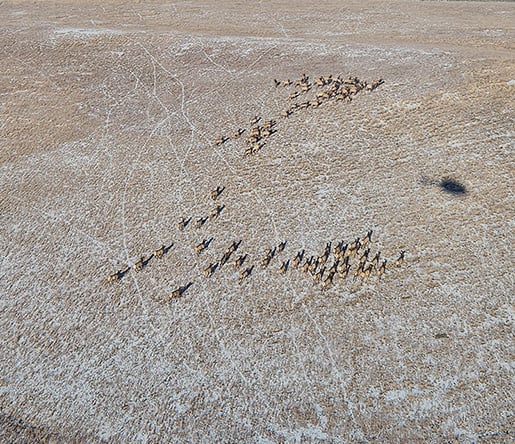
“The lack of snow made it difficult to count elk blending into the sagebrush-covered hills,” said CPW Craig Area Terrestrial Biologist Becca De Vergie. “Despite this challenge, and thanks to a skilled pilot, we were still able to observe and classify thousands of elk in overall good body condition.”
During flights CPW staff classified a total of 10,203 elk, with more observed but difficult to classify given the conditions on the ground. In one group, CPW staff classified 2,578 elk.
MORE BIG GAME COVERAGE FROM OUTDOOR NEWS:
Elk survey shows population rising in northwest Minnesota
Vermont Fish & Wildlife to advocates for mountain lion reintroduction: ‘slow down’
Commentary: Claims of ‘more bears than deer’ rings true for some Michigan hunters
In the White River Herd (E-6), elk numbers were spread across all elevations. During flights in the White River and Williams Fork drainages, over 18,500 elk were observed, marking a slight increase from the previous year and indicating a consistent upward trend in elk populations thanks to mild winter conditions over the past three years.
“Spike bulls (young bulls with antler beams with no tines) serve as important indicators of the previous year’s calf survival,” said Finley. “As we have seen, calf ratios continue to be trending in a positive direction with excellent spike bull ratios in the past two years, indicating high survival and recruitment of calves into the yearling age class.”
In 2023, post-hunt flights indicated a lower spike bull ratio of less than 10 spikes per 100 cows, suggesting lower calf survival during the severe winter. Subsequent flights in 2024 and 2025 showed an encouraging increase in calf survival, with 14 spikes per 100 cows in 2024 and 16 spikes per 100 cows in 2025. These findings indicate far better calf survival and recruitment into the adult population and growth within the herd.
Increase in 2026 big game hunting licenses
“With the Primary Draw application period closing on April 7, we wanted to make sure that we are getting this information out to hunters, especially those who chose to hunt in other areas to help in our efforts to increase the elk population,” said CPW Meeker Area Wildlife Manager Mike Swaro.
Each year, regional staff and area terrestrial biologists meet with local district wildlife managers to establish recommendations for that hunting season’s licenses. These recommendations are made using approved Herd Management Plan (HMP) objectives, harvest data collected from the previous year’s hunting season, classification data collected in the late fall and winter, and survival data collected from deer and elk monitoring areas in select DAUs.
This year, CPW Northwest Region staff will present the Parks and Wildlife Commission with a plan to significantly increase the number of antlerless elk licenses, while bull tags during second and third rifle seasons switch back to over-the-counter.
Hunters, landowners make a difference
Colorado, specifically the northwestern part of the state, is known for the largest elk herds in the nation. Each year, hunters from all over travel there in the hopes of harvesting an elk.
In 2023, CPW recommended significant reductions in hunting licenses within the severe winter zone for the Big Game Hunting season. In most cases, the number of licenses for archery, muzzleloader and rifle seasons was reduced between 60% and 89%, along with a reduction in season dates during the big-game rifle season.
“Reducing license numbers and shortening seasons that year was not an easy decision for us to make,” said Swaro. “We knew that decision and the decision to slowly increase licenses in 2024 and 2025 would not only impact hunters, but also the local economy; however, we have seen nothing but support for these decisions in the last three years.”
Even after CPW began slowly increasing licenses in 2024, many hunters chose to continue to hunt in other locations around the state in an effort to rebuild a sustainable elk population for the Bears Ears and White River herds.
License reductions also impacted landowners, who took crucial steps towards reviving this population.
“Oftentimes the importance of private lands goes unrecognized, but landowners play a critical role in sustaining and recovering the abundant wildlife populations on the habitat they own and manage,” said CPW Habitat Partnership Program Administrative Assistant Kale Watson.
Over the past three years, many landowners who rely on hunting to supplement their agricultural operations have supported CPW in limiting the number of licenses issued. Alongside supporting license reductions, CPW’s Habitat Partnership Program (HPP) has worked closely with landowners on various habitat improvement projects. These projects include seeding, controlling noxious weeds, developing water sources such as solar wells, and upgrading old fence lines with new wildlife-friendly fencing to facilitate wildlife migration.
Throughout the months of March and April, staff from Colorado Parks and Wildlife will continue to meet as they work to finalize license number recommendations for the 2026 Big Game Hunting Season. These numbers will be presented to the Parks and Wildlife Commission during the May meeting in Grand Junction, Colorado.
USFWS announces new duck season framework process
The Department of the Interior recently announced that the U.S. Fish and Wildlife Service (USFWS) is finalizing a streamlined process
Making sense of this year’s waterfowl report for Ohio hunters
For some duck hunters, the early September U.S. Fish and Wildlife Service (USFWS) annual fall waterfowl flight forecast is an

WI Daily Update: State stamp contest winners announced
Three Wisconsin artists have earned a place on the 2027 turkey, pheasant and waterfowl stamps. Here are the winners and
