




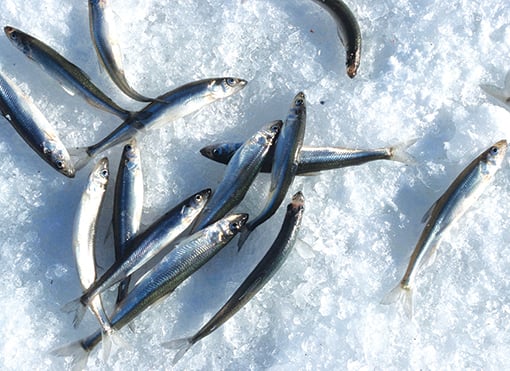
Michigan winters can be long, drawn-out affairs if you don’t find something to keep you busy. One experience Michiganders look forward to is ice fishing for smelt. It’s a winter tradition that many families and individual anglers undertake to pursue these tasty creatures.
The history of smelting in Michigan dates to 1912, when rainbow smelt were stocked in Crystal Lake in Benzie County to provide forage for introduced Atlantic salmon. The smelt migrated into Lake Michigan by 1923 and rapidly spread throughout the Great Lakes.
The conditions in the Great Lakes proved highly favorable for smelt, leading to a population explosion. The lack of natural predators and the decline of lake trout populations due to sea lamprey left a void that smelt quickly filled.
Smelt feed on microscopic zooplankton that were abundant in the Great Lakes back then. When smelt numbers peaked in the mid-20th century, major commercial and sport fisheries developed, yielding a catch of millions of pounds annually.
Word that the smelt were running in the spring caused anglers to cluster along the shorelines and at the mouths of creeks and streams to corral smelt with dip nets and seine nets. Smelt were so abundant then that stories of zealots filling pickup beds or garbage cans with smelt were familiar. Many of the smelt ended up in landfills or the garden, which contributed to their decline.
MORE ICE FISHING COVERAGE FROM OUTDOOR NEWS:
Examining the finer details of tip-up fishing
Patrick Durkin: Homely, but tasty, burbot gaining respect
Jeremy Smith: Perch action thriving again this winter on Minnesota’s Lake Mille Lacs
The crash in smelt numbers in the Great Lakes can be traced to invasive species such as alewives. The alewives competed with smelt for zooplankton and preyed on young smelt. The introduction of Pacific salmon in the Great Lakes placed additional stress on the smelt population. The coup de grâce was the invasion and expansion of dreissenid mussels, including zebra and quagga mussels, which further stressed smelt populations.
With alewife populations now under control and mussel colonies now leveling off, smelt numbers are making a comeback in the Great Lakes. Numerous inland lakes in Michigan support sustainable smelt populations that draw ice anglers each winter.
The 9,711-acre Crystal Lake is a focal point for winter smelting. The sleepy little towns of Beulah and Benzonia are surprisingly active in winter because of ice-fishing.
On Crystal Lake, anglers not only come to try their hand at snaking some tasty smelt through the ice but also target the perch and lake trout that the lake is known for. Browns, rainbows, burbot, and whitefish are a bonus.
Access to the ice can be gained at Lobb Rd, Warren Rd, and in Beulah at the mouth of Cold Creek. For more information on bait ships, guides, and accommodations and amenities in Benzie County, contact the Benzie County CVB at westmichiganguides.com.
How to catch them
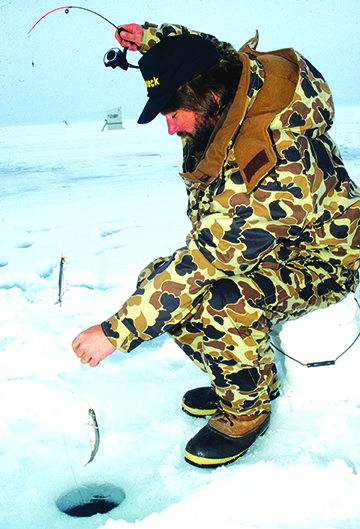
Most target smelt at night when they school – attracted and concentrated by using underwater lights – but you can catch smelt in the daylight hours, too.
Generally, smelt are deeper during daylight hours, but rise near the ice surface when lights attract clouds of zooplankton that the smelt feed on. It’s common to see smelt schools 20 or 30 feet down, or more, before dark, and to catch them rising as night approaches, often ending up only a couple of feet below the ice.
A flasher or graph is paramount for locating the depths the smelt are at and for tracking their movements as the night wears on. A search on the Internet reveals that there are plenty of lights designed to attract fish, especially for ice fishing. Many anglers jerry-rig a light using a car battery – the light aids in drawing numbers of smelt to your location.
Ice fishing for smelt is simple.
You can use your standard panfish rods with good success. Rods with sensitive spring bobbers can help you detect when smelt bite, but the strike is not subtle. The little demons have a mouth loaded with sharp teeth and will shred a wax worm with reckless abandon.
The key: Keep some lines in the water, so the smelt school stays under you. In Michigan, anglers can use three single lines or rods while ice fishing. They can have up to six hooks.
Smelt can be caught on a variety of lures, but a favorite of ice anglers is a Nils Master Hali Jig. The Hali Jig is heavy for its size and gets down quickly – the jig has a short bead chain attached to the hook, which aids in hooking sniping smelt.
You can bait the hook with a spike, a wax worm, or a tiny minnow. It’s been years since I’ve ice fished for smelt, but I’d bet scented plastics or Gulp! would work well on smelt and save on bait.
Look to Duck, Green, and Higgins lakes for additional opportunities to ice fish for smelt. Fishing for smelt is not only fun but they’re also delicious when deep-fried.
Mike Raykovicz: Add purslane to the list of nature’s bounty worth foraging for
Foraging goes back for as long as man has inhabited the earth. I’m a forager of sorts and I’ve searched

USA Bass Team hooks second straight title at World Championship
The USA Bass Team cruised to its second straight gold medal at the 20th World Black Bass Championship, which was

Millecoquins Lake has hungry walleyes, big pike and more in Michigan’s Mackinac County
Millecoquins Lake may not be one of Michigan’s better-known fishing destinations, but anglers who make the trip to eastern Mackinac
