




Outdoor News may earn revenue from products shown on this page by participating in affiliate programs. This comes at no extra cost to you. Click here to learn more.
Tip-ups are a low-tech – but effective – tool for catching pike and walleyes under the ice. What follows are the finer points of these simple setups.
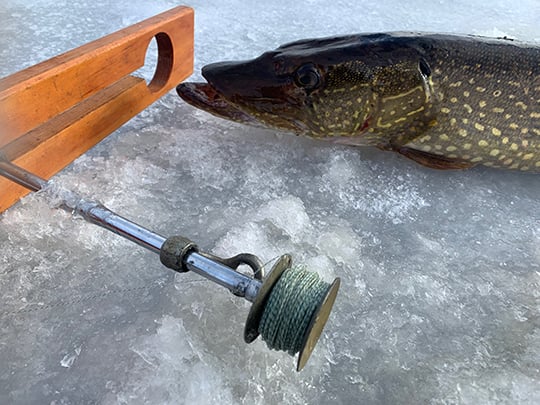
For starters, I like to use modern tip-ups that have an underwater spool and a spindle above water. Nowadays, that’s pretty much a given, but when I started ice fishing, we had those old wooden contraptions with which you had to fold them open to put them on the ice, then bend a spring-steel flag arm around and hook it to the underwater spool.
They worked … for the most part. But if you didn’t set the flag on the spool just right, sometimes the spool could turn without ever tripping the flag.
There also was no above-water spindle, which is a visible indication whether or not the fish is running with hook and bait. With the old-school tip-ups, we had to be right above the tip-up before we could see the spool turning.
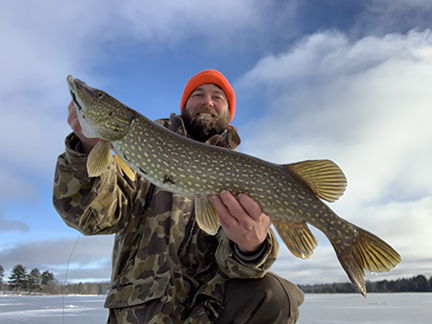
Today’s Arctic Fishermen (Beaver Dam), HT Polar, Frabill Pro Thermal, and the like all feature underwater spools that prevent freezing, coupled with above-water spindles that let you know whether or not the fish is on the run.
When rigging up, I start with 30-pound braided nylon tip-up line. It’s cheap, easy to hang onto with gloves or bare hands, and durable enough you can rip it off your tip-up spool if your line freezes. (Pro tip: bring your tip-ups inside the house to warm up between trips!)
Beaver Dam’s tip-up line goes one better, containing a wax coating that sheds water. There’s also plastic line, similar to what you might use on your duck decoys. While easy to hang onto, it tends to tangle up on your spool. And monofilament is hard to see and grasp.
I always attach a few feet of mono or fluorocarbon to the end of the braided line to lessen the chances of a fish seeing the line. Leader choice really comes down to personal preference.
For years, I used 17-pound Stren Super Tough mono. It’s durable and I caught a lot of pike with it. If I hooked a big fish with the monofilament line, I knew I had to play it gingerly. Even with smaller pike, I did get bitten off sometimes. I still like to use 15- to 17-pound mono leaders for pike fishing.
MORE ICE FISHING COVERAGE FROM OUTDOOR NEWS:
Patrick Durkin: Homely, but tasty, burbot gaining respect
Jeremy Smith: Perch action thriving again this winter on Minnesota’s Lake Mille Lacs
How to crack January’s mid-season walleye code
Using a wire leader is an option, too. You’re pretty much guaranteed not to get bitten off, but the heavy wire could spook fish. The trouble is, there’s no way to know for sure how many pike may have scrutinized your offering and passed.
Likewise, how many more bites could you have gotten by using mono?
Who knows?
Nowadays, with the popularity of fluorocarbon, that has become a good option. It’s abrasion-resistant and clear. In the end, ultimately, the decision is yours.
For walleyes, I prefer 8-pound fluoro, which is thin and difficult for fish to see. I rig it with either a single No. 6 Octopus hook or a No. 6 treble. I even use this setup for perch sometimes, but I’ll downsize to a No. 14 treble, if I can find them.
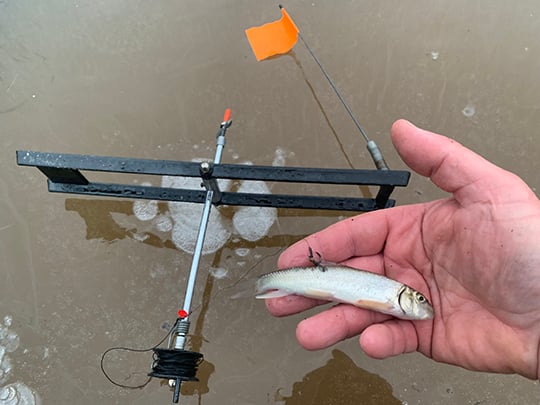
Most of the time, I simply attach a No. 2 or No. 4 treble hook to the end of my leader when pike fishing. I like to hook my shiner or sucker far back, between the dorsal fin and the tail. The idea is that pike swallow the minnow head-first, so the farther back the hook, the easier it is to remove.
However, sometimes fish still swallow it really deep. If it’s a fish I don’t intend to keep, I usually cut the line if the fish is hooked deeply. Other times, a deep hook job influences my decision to ultimately keep the fish, if it’s legal. I have not experimented with circle hooks, but they might be just the ticket for hooking fish without them swallowing the hook. Giving them a try on my tip-ups is on my to-do list this winter.
Two-hook quick-strike rigs set the hook immediately, thereby reducing the chance of a fish swallowing the hook. Sometimes it helps; sometimes it doesn’t. Some quick-strike rigs are made with a separate wire leader leading to each hook. That just seems like a lot of extra tackle to spook fish.
If I’m going to use a leader, I like Beaver Dam’s Liquid Steel leaders. They are thin in diameter and quite flexible. They have a relatively light breaking strength, so you can’t horse on a 40-incher, but for average-sized pike, they work fine.
One thing I like to do with my tip-ups is tie a barrel swivel to the end of the braided line. Then I attach the leader to a snap swivel so I can change from a heavier pike setup to a lighter walleye setup quickly.
When setting up for pike, I prefer golden shiners if I can get them, but they’re kind of expensive and somewhat hard to keep alive. Suckers are cheaper and hardier. I like to set them above the weeds so they’re more visible to passing pike.
For walleyes, shiners get the nod, but I may use fatheads if that’s all I can find. I keep walleye minnows about a foot off bottom. For perch, I use small fatheads a foot off bottom.
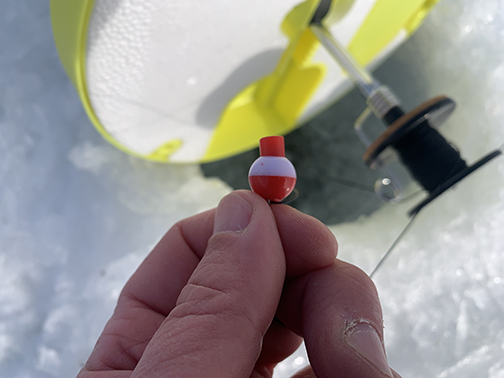
Save yourself trouble in resetting lines by placing a small bobber on the line right where it comes off the tip-up spool once you’ve measured out the line and have it set the correct depth. Then it’s just a matter of resetting to the depth of the bobber, rather than measuring line again after every fish.
When do you set the hook?
That’s a question for the ages. For northerns, I was always taught that you let them run, let them stop to mouth the bait, then hit them on their second run. That has usually worked, but it gives the fish the chance to swallow the bait, which is fine if you plan to keep it, but not great if you release it.
With quick-strike rigs, you can usually set the hook right away. These days, that’s what I usually do.
There seem to be days when even pike are a bit finicky and they just play with the bait or don’t take it as readily as usual. If I miss a fish or two early on, I will let them take it longer. But if I’m hooking up, I hit them fast and give them less chance to swallow the bait.
For walleyes and perch, I usually set the hook right away.
Put a little thought into your setup and consider using interchangeable leaders on snap swivels to make them easily adaptable to different situations.
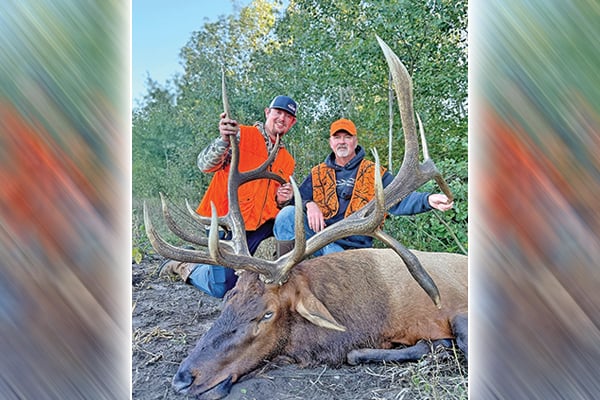
Minnesota’s 2026 elk harvest reaches nearly half of allocated tags during early season
As the first half of the elk season winds down in northwestern Minnesota, nearly half the tags have been filled

Upper Herring Lake offers western Michigan bass anglers a legitimate fall option
Bass can be widely distributed through the vegetation, but cooling water often triggers more active feeding.
Michigan’s Outdoor Calendar
A look at upcoming outdoor-related events from across Michigan published in the Sept. 25, 2026 edition of Outdoor News.
