




Home » Home Page News » Michigan’s Upper Peninsula bear harvest exceeds predicted kill for fifth year
Michigan’s Upper Peninsula bear harvest exceeds predicted kill for fifth year
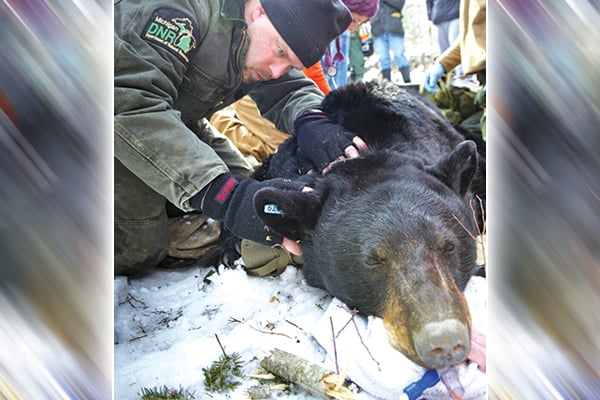
Lansing — For at least the fifth year in a row, bear registrations in the Upper Peninsula have exceeded the Michigan DNR’s predicted harvest. This time, the difference between the two numbers is the second highest it has been.
The difference between the two numbers previously was highest in 2024. The reason for that is numbers for the desired harvest have not kept pace with the increasing bear population in the region.
The desired bear harvest for 2025 seasons in the UP was 1,244 and 1,522 bruins were registered there, a difference of 278. It’s important to note, however, that the desired UP bear harvest for 2025 isn’t much different than the number for 2020, which was 1,180.
That’s only a difference of 64 bears. Over those five years, the UP bear population has increased enough that the desired harvest should be much higher and bear registrations confirm that, especially since the DNR’s goal is to “stabilize” the population.
Based on an email DNR bear specialist Cody Norton sent to Bear Forum members with preliminary bear registration numbers for 2025, he seems to agree with increasing numbers for the desired harvest in the UP:
“Hunters in the UP had a phenomenal season, with increased success (resulting in harvest above target) in every BMU,” Norton wrote, “and heavier weights were reported coming through check stations. This is likely due to a growing bear population, paired with really good natural food production and bears reaching older age classes. For example, the three check stations managed by the Escanaba office reported eight bears that were 500+ pounds, and 20 bears that were 400+ pounds! Remember that our goal for the next regulations cycle is to stabilize the bear population in the UP, and we’ll be able to account for the increasing success rate when setting quotas.”
RELATED STORY:
It’s also important to explain that the preliminary UP bear harvest for 2025 was 278 animals higher than anticipated even though the number of bear licenses issued by the state for the region were reduced by 300 from the previous two years. The UP bear license quota during 2025 was 5,103 compared to 5,406 in 2023 and 2024. The DNR continues to reduce license quotas even though bear numbers are increasing.
The reason license numbers continue to go down is license quotas are tied to hunting success and numbers chosen for the desired harvest. Average hunting success from the three most recent seasons is used to calculate how many licenses should be issued to achieve the desired harvest.
Higher hunting success results in the issuance of fewer tags. Due to the presence of more bears, however, success will continue to increase and licenses decrease, unless desired harvest numbers are increased significantly.
MORE COVERAGE FROM MICHIGAN OUTDOOR NEWS:
How has a one-buck limit impacted the deer herd on Michigan’s Drummond Island?
Michigan’s 2026 Black Lake sturgeon season ends in 48 minutes
Officers, civilian recognized for rescue of Michigan ice fisherman
In 2020, the UP bear license quota was 6,010. A total of 1,255 bears were registered for the region that year compared to a desired harvest of 1,180. Registrations only exceeded the desired harvest by 75.
The following year, UP bear license quotas were reduced to 5,771, yet 1,351 bear were registered compared to a desired harvest of 1,185 (five more than 2020), a difference of 166. License quotas remained the same in 2022 and preliminary registrations came in at 10 higher than the year before (1,361), for a difference of 176.
By 2023, the UP bear license quota was reduced to 5,406, but more bears were registered than the previous two years (1,410). The desired harvest went up by six that year (1,196), for a difference of 214. License quotas and desired harvest remained the same for 2024, but preliminary registrations went up by close to 100, resulting in the highest difference between the two at 291.
Some people refer to the difference between the desired and actual harvests of bears for the UP as an overharvest. It’s actually the opposite. Numbers for the desired harvest are determined by DNR wildlife biologists based on what they think they should be after considering population estimates, hunter success, hunter input and nuisance complaints. But decisions about desired harvests are only as accurate as the information that’s considered.
The accuracy of DNR bear population estimate are questionable for several reasons. Those estimates are always at least one year behind what is present on the landscape and they only project the number of bears that are at least a year old. In other words, they don’t include cubs, so they are not designed to estimate the total number of bears that are present.
Since 1995, sows with cubs and their cubs have been protected from hunters by law. That regulation has increased the number of adult females in the population, which insures plenty of cub production for the future. After being in effect for 30 years, that law is responsible for increasing the number of cubs produced on an annual basis along with the number of yearlings added to the population. DNR estimates don’t reflect that since they don’t include cubs.
DNR population estimates for the UP rely solely on the sex and ages of bears registered by hunters that are plugged into a computer model, but not all bears bagged by hunters are registered even though it’s mandatory, further reducing the accuracy of estimates. During 2024, for example, state licensed hunters registered 2,026 bears. An additional 95 were taken under tribal licenses, for a total of 2,121. A DNR survey of bear hunters estimated the statewide bear harvest of 2,272 bears, a difference of 151.
Hunter success is also variable, depending upon the availability of natural foods, weather conditions and the experience level of hunters during any given year.
The ages of UP bears bagged by hunters is another excellent clue that UP bears are not being overharvested, which the DNR’s Norton mentioned. Every year, multiple bears that are over 20 years old are registered from the UP. Some of those animals have been close to 30 years old.
Hair snare surveys have also been conducted by the DNR in the LP to help verify accuracy of bear population estimates in that region. Hare snares consist of barbed wire surrounding bait that’s attractive to bears. Clumps of bear hair are snagged by the barbed wire as the animals step over the wire. DNA is extracted from the hair that’s collected to determine how many bears visited the snares and if any of those animals show up in the harvest.
DNR’s population estimate of bears that are at least a year old for the LP based on harvest data combined with results from hair snares as of September 1, 2024 is 2,106 compared to an estimate of 1,742 for 2023, an increase of 364 bears.
DNR estimates for the UP during 2023 and 2024 show that the number of bears that are at least a year old has declined even though hunting success and harvest have increased. The DNR estimated there were 10,969 bears that were at least a year old in the UP during 2023. Their estimate was down to 10,353 for 2024, a difference of 616. Based on Cody Norton’s comments, he doesn’t think the UP bear population declined between 2023 and 2024.
SUBSCRIBER CONTENT
Read this article now.
Create a free Outdoor News account.
Create a free account below to get instant access to this article, thousands of Outdoor News stories, and our digital editions. Your 1-month trial starts the moment you sign up.
No credit card required
No credit card required
Subscriber? Login Here.
Share on Social
Hand-Picked For You
New York Fishing Report – September 18, 2026
Lake of the Woods Fishing Report – September 22, 2026
Minnesota’s 2026 elk harvest reaches nearly half of allocated tags during early season
Northern Wisconsin Fishing Report – September 17, 2026 – video
Have a game plan – video
Metro Area Fishing Report – September 20, 2026
Related Articles
Minnesota’s 2026 elk harvest reaches nearly half of allocated tags during early season
As the first half of the elk season winds down in northwestern Minnesota, nearly half the tags have been filled

Upper Herring Lake offers western Michigan bass anglers a legitimate fall option
Bass can be widely distributed through the vegetation, but cooling water often triggers more active feeding.
Michigan’s Outdoor Calendar
A look at upcoming outdoor-related events from across Michigan published in the Sept. 25, 2026 edition of Outdoor News.
