




The weather provocateurs on the local TV news were giddy with anticipation last week, beating the drums like over-caffeinated jazz percussionists about the prospects of a second snowstorm in roughly a week.
A “long-duration winter system” had begun to settle in southern Minnesota, a wintry event that would eventually move north into the Twin Cities, ushering in periods of heavy snow, blustery winds, and “the coldest air of the season.”
One TV weather wag wondered aloud when we’d start seeing “arctic sea smoke” billowing from Lake Superior. Another, in a duh-moment of levity, said “parents with children” should make sure they’re “bundled up,” because, well, when it’s cold and windy outside, those little urchins need their hats, mittens, and winter coats to stay warm. Still another assured the huddled masses we’d be “making ice soon” – an endorphin blast to Vexilar-wielding ice anglers across the state.
In my hierarchy of outdoor pursuits when the weather turns cold and angry, ice fishing is an activity of last resort.
Sitting in a portable fish house is just not my game.
But if you’re like me and are indifferent to hard-water angling, fear not! We have a frosty ace in the hole for December and even January days afield.
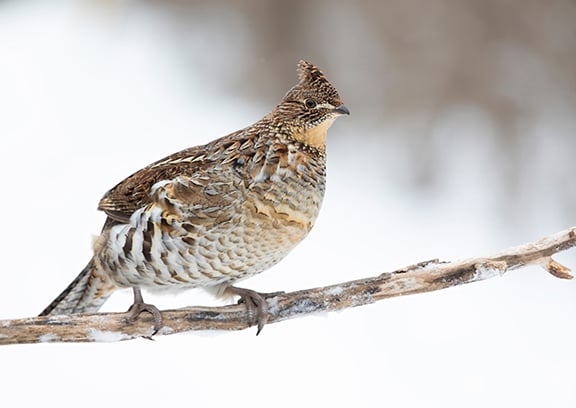
The small-game season is alive and well and open for business. The season for squirrels and rabbits, two of my favorite wild proteins, runs through February. Pheasant and ruffed grouse seasons are open through Jan. 4. While the duck season in the southern zone ended at sundown Dec. 7, waterfowlers may still chase Canada geese into January.

Memories made in bad weather
Indeed, some of my most endearing of memories hunting small game – particularly squirrels, pheasants, and waterfowl – unraveled in various combinations of inclement weather.
There’s just a deep satisfaction about hunting in nasty, unpredictable, and even dangerous weather – weather that requires fortitude and a plan to succeed, or least just dumb luck – that evokes such vivid memories that one can lean on and replay as tall tales forever.
A case in point: A late October duck hunt during my senior year of high school. A Broadway producer couldn’t have choreographed the late-season foray with my close friend any better. I grew up in Shakopee, and we were hunting one of the shallow lakes on the popular Minnesota Valley National Wildlife Refuge.
Back in the day, the federal refuge was the place for local waterfowl hunters, a storied area nestled along the Minnesota River that was home to at least one exclusive duck club. The hunting, at least historically, could be that good.
MORE UPLAND BIRD COVERAGE FROM OUTDOOR NEWS:
Late-season pheasants are fun to hunt, but be careful out there with your dogs
Minnesota pheasant opener largely typical with crops, heat playing a part
To err is human, but avoiding these mistakes will bag you more pheasants
Our desire to hunt ducks in those days bordered on the pathological. We knew less than nothing, but that only seemed to embolden us.
Our imaginations were hijacked by the era’s hunting and fishing periodicals, and I was particularly infatuated with the waterfowling adventure tales of snow, ice, gale-force winds, listing decoys, and ducks backpedaling with cupped wings. As I’ve written before, I wanted to live inside a Les Kouba painting.
What stands out today about that hunt is it was the first time we skipped school to go, and that we actually looked at the weather forecast to ascertain how it might impact the migration.
Long story short: The weather that morning morphed from light rain to ice and snow even before shooting time. An icy veneer covered everything: our duck coats and other gear, our 12-foot john boat, our decoys, and the marsh itself – a bizarre, otherworldly sight that screamed science fiction.
We were cold, to be sure, but I don’t remember caring. The inclement weather (including a brisk northwest wind) jumpstarted the year’s final push of ducks into the Minnesota River Valley and we were its giddy, lone beneficiaries.
That morning was the first time I watched mallards staircase from the heavens into a decoy spread. Our shotguns barked and for a minute we felt like real men. It was glorious moment and one that’s impossible to forget.

Most of my late-season hunts revolved around chasing pheasants, first as a youngster without a dog and later with my handsome, barrel-chested British Labrador. Buddy was a lion in winter. He had a heavy coat and a fine nose and an insatiable prey drive.
He was equally adept at retrieving ducks and geese in icy waters as he was excavating pheasants from the snowy, frozen bowels of thickest, nastiest cattail slough. His cocksure body language revealed an undeniable truth: that he took great pleasure in both endeavors.
Buddy grew up in South Dakota in the early 2000s. We hunted a lot. His enthusiasm was infectious, and his willingness to hunt in subzero weather was unsurpassed. How could I pull the pin on a hunt, even when I was frigid to the bone, when Buddy was so eager to stay? I rarely did.
Take that, Belinda Jensen.
Some late-season hunting memories are bittersweet. I have one that will never leave me: my grandfather’s last pheasant hunt. Here’s the scene: Buckeye’s pink lips, blood-red cheeks, and crimson ears bore the expression of an unhappy man. Call it frozen exasperation.
My late grandfather, whom I called Buckeye, was in his late 70s, and the S.D. prairie that early December morning on our annual trip was particularly cold. Buckeye and I were blocking a large shelterbelt – and it was teeming with pheasants.
The prairie wind that morning was earsplitting. You couldn’t hear the birds break the thick cover and catch air.
Unless a rooster exploded at your feet, your peripheral vision caught only wisps of copper waving adios – ringnecks as prairie rockets.
Buckeye, a lethal wingshooter back in the day who mostly shot a single-shot .410, didn’t stand a chance. He missed rooster after rooster as shell casings amassed near his feet. His old rusting bones memories close. I’m glad I was and flagging reflexes wouldn’t there for his pheasant-hunting allow him to catch up to those wind-propelled ringnecks.
After one final miss, he walked to the truck, unloaded his shotgun, and said he was done. He never hunted again. I hunted a lot with my grandfather over the years when I was young.
Along with my uncle, we had a marvelous time together, and I hold those swan song, however hard it was to witness. Some memories must be endured.
If (when) you go
Minnesota is blessed with public lands. The state’s Walk-In Access program boasts 28,000 acres over 250 areas in western and south-central Minnesota.
Ruffed grouse management areas in the north-central and northern Minnesota provide excellent late-season access opportunities for ruffed grouse and squirrels.
Minnesota has 1,440 wild management areas totaling 1.29 million acres, and many are laden with cattail sloughs and shelterbelts that are late-season magnets for pheasants.
But the best thing about December/January hunting is that getting permission to hunt private land is far more likely than it was earlier in the year.
Take advantage of that.
The good news is that the weather provocateurs on local TV news are forecasting well-below-freezing temperature for the foreseeable future, meaning lakes and other waterways across the state will be rapidly “making ice.”
That means fewer hunters afield and more sitting on buckets in fish houses while sipping brown liquor. That’s good for them and even better for us.
Reach McCormick at: torimccormick33@gmail.com
Minnesota’s 2026 elk harvest reaches nearly half of allocated tags during early season
As the first half of the elk season winds down in northwestern Minnesota, nearly half the tags have been filled

Upper Herring Lake offers western Michigan bass anglers a legitimate fall option
Bass can be widely distributed through the vegetation, but cooling water often triggers more active feeding.
Michigan’s Outdoor Calendar
A look at upcoming outdoor-related events from across Michigan published in the Sept. 25, 2026 edition of Outdoor News.
