




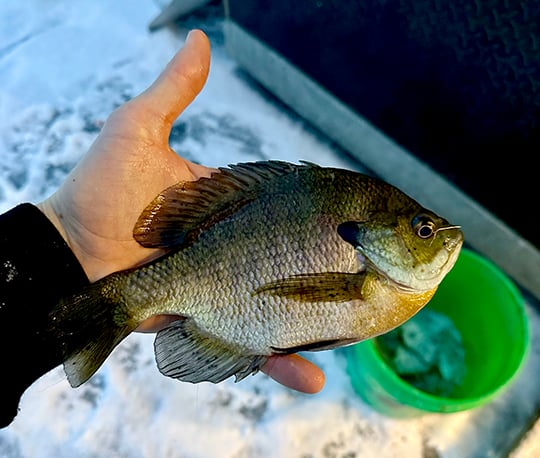
Like most fish species, panfish – we’re talking bluegills, crappies, and even jumbo perch here – are all usually super active during the early ice period. Those first few weeks of hard water are a simple extension of their fall feeding binge. That means fewer challenges for anglers… if you know where to look.
Everyone knows that weeds hold panfish, especially during the winter. Green weeds, cabbage or coontail preferably, provide food, oxygen, and cover – everything crappies and bluegills need to survive under ice.
With light still allowed to penetrate through the first sheet of walkable ice, green weeds are usually standing tall. In the perfect scenario, they’re adjacent to deeper structure, where they’ll suspend once the vegetation dies.
Before that happens, they’ll relate not just to green weeds, but subtle turns, points, or pockets within them. Look for anything that might act as a holding area or something you can lock in on as an angler, especially if you’re dealing with an über-weedy area.
Often, these will be shallow weeds, less than 10 feet, which typically thrive with activity early and late each day. If water clarity allows, it’s a great opportunity for sight-fishing.

Mid-depth weeds, somewhere in the 10- to 15-foot range, are the next best option if shallow vegetation doesn’t exist. More times than not, these slightly deeper areas provide thinner weeds where bluegills and crappies must relate to since it’s likely the only cover and food source they can frequent.
If weeds are limited, or in lakes where quality vegetation doesn’t exist, locate other early season spots. Again, try autumn areas that held panfish during open water.
Mud flats, sand grass, rocks, and sunken wood also provide cover and ambush points for pods of crappies and bluegills at first ice. These areas also tend to be productive a bit longer into the ice fishing season.
MORE ICE FISHING COVERAGE FROM OUTDOOR NEWS:
Top new gear for your 2025-26 ice-angling campaign
Minnesota’s Upper Red Lake walleye regulations announced for winter season
Ice-fishing weather forecasts appear promising in Ohio
Overlooked locations include hard-stem bulrushes, channels between lakes, and boat harbors. If any of them have some depth, there’s a solid chance they held panfish in the fall and still will under first ice.
These areas can be clutch on bigger, deep lakes that hold quality panfish, but don’t necessarily have that reputation. Think large basin-type water bodies with walleye notoriety, but they likely contain respectable panfish. They’ll use these shallower areas for food and cover as well.
Panfish may suspend over deep water at first ice, especially in water bodies thin on structure. Rarely do you need to chase these roaming schools of fish during the early season. And of course, they might not be accessible thanks to thinner ice than exists over shallow water areas. So be careful targeting deep, early panfish.
Small, shallow lakes and bays off big water obviously lock up earliest and provide not just the safest first-ice option, but the only option.
Wind-protected lakes or those tucked into wooded areas also lock up with walkable ice early. Many hard-to-reach lakes see minimal fishing pressure and can be loaded with quality bluegills and crappies, so keep them in your back pocket.
If your end game is to locate and catch magnum bluegills and hubcap-sized crappies at first ice, do your research.
While it’s easy to catch panfish on most lakes, many don’t even have the ability to produce big bluegills or crappies.
Those that do are worth finding, so investigate and explore those first, before the masses hit the ice.
Pennsylvania’s hunting license sales down so far this year
Hunting license sales are down nearly 4.5% at the end of August, although Pennsylvania Game Commission officials believe there is
Origin of road-killed armadillo in southwest Ohio a mystery
An armadillo found as roadkill in southwest Ohio has researchers scratching their collective heads wondering from where the non-native mammal
Bowhunt gets started in Ohio with additional opportunity in CWD surveillance area
Hunters in Ohio’s chronic wasting disease (CWD) surveillance area have additional dates this season to pursue white-tailed deer. The Ohio
