




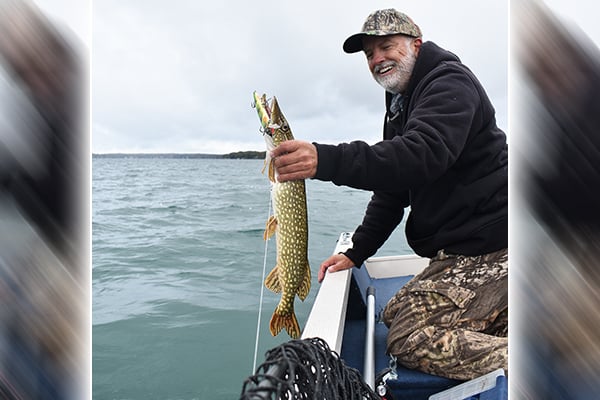
The problem with autumn is there isn’t enough of it. So much to do, so few days.
Many (most?) of us are so preoccupied with hunting seasons that we forget about our other passion: fishing. And angling can be anywhere from pretty good to outstanding during the fall.
 I was reminded of this one late October day when I met up with Joe Bednar for a short day of pike fishing on Gull Lake in southwestern Michigan. Gull Lake is noted for a number of its fisheries: bass, perch, crappie, and, at one time, many years ago, Atlantic salmon.
But it was northern pike that drew Bednar (and, hence, me) to the 2,030-acre lake in Kalamazoo and Barry counties.
What attracted Bednar to Gull Lake is the slot limit; on Gull (and about 10 other lakes in Michigan) all pike between 24 and 36 inches must be immediately released. Bednar, who is certainly Michigan’s biggest cheerleader for pike, thinks the protected slot dramatically will improve the size structure of the pike population.
Fall is a great time to fish for pike because the water has cooled enough that the fish are no longer restricted to the deeper, cooler water where the oxygen content can sustain them. Pike are at least cool- to cold-water fish. You regularly catch them in streams that support trout.
So, we started out trolling along the outside of weed lines, pulling long twitch baits and spoons. The depth of the water wasn’t important, just as long as we were deep enough to keep from fouling the baits with vegetation. Within minutes, we were in the plus column.
“This technique is a consistent producer,” Bednar said.
“Once the water temperatures are down, the big pike can be anywhere they want. And because they can take such big prey, they don’t have to run around and chase it – they can just lay there and wait for it.”
MORE FISHING FEATURES FROM OUTDOOR NEWS:
Whitefish and the old ways: Maintaining a North Country tradition in Minnesota
Al Lindner: Anglers located and caught a lot of lunker fish during open water 2025
November is trophy muskie time
We could cast for them, which we often do, but by trolling we were covering so much more water that the odds that we’d run into some good ones were good, Bednar said.
“It’s just a matter of sheer exposure,” he said. “You’re not going to match that by casting. On most good-sized lakes, you’re going to have the most exposure by trolling the weed lines. Catch enough pike and, hopefully, you’ll eventually catch a big one.”
It didn’t work out that way for us; in the five hours we spent on a miserable, rainy, windy day, we caught 20 pike (and three largemouths, to boot). All were from 21 to 27 inches. But the bulk of them were solid, thick fish, not the skinny snakes that you often find in lakes with stunted pike populations. Had we been of mind to keep some, we could have easily brought home our limit (two apiece) of 23- or 24-inch fish for the table.
“The great thing with pike is you can still eat some,” Bednar said. “It’s not like muskie, where the limit is one per year. Pike are more prolific and more widespread and most of the males don’t grow much larger than 24 inches, anyway, so you’re not impacting the population.”
Bednar is campaigning to increase the number of protected slot lakes, because he’s convinced that’s the best way to improve the size structure. The basic pike limit – two fish, a minimum of 24 inches – hasn’t worked, nor has the alternative that’s on lakes with stunted pike populations (no minimum size, five fish daily, but no more than one more than 24 inches).
But the slot limit lakes have produced. On lakes that have had slot limits on them for a while (the Department of Natural Resources started doing this about a decade ago) where the fish poohbahs had decent before and active surveys, and the results have been positive.
Bednar said he’d like to see the protected slot limit on pike expanded to the Great Lakes and connecting waters. Those waters have better growth rates than most inland waters and there’s no problem with reproduction.
That’ll be a tough sell as there’s a lot of resistance to the idea. A recent proposal to enact protected slot limits for walleyes on 10 Upper Peninsula lakes was winnowed down to just two lakes by the Natural Resources Commission.
“Michigan’s pike resources are great enough to make it a pike destination state,” Bednar said. “Pike have just kind of gotten forgotten over the years. That’s understandable with all the Great Lakes salmon and trout, the great smallmouth fisheries, the muskies – it’s no wonder they’ve been forgotten.
“But you can manage for big pike without spending a penny on it. They’re not like muskies that cost a lot to raise. That’s kind of a significant factor right now when people don’t want to spend two more dollars for a fishing license.”
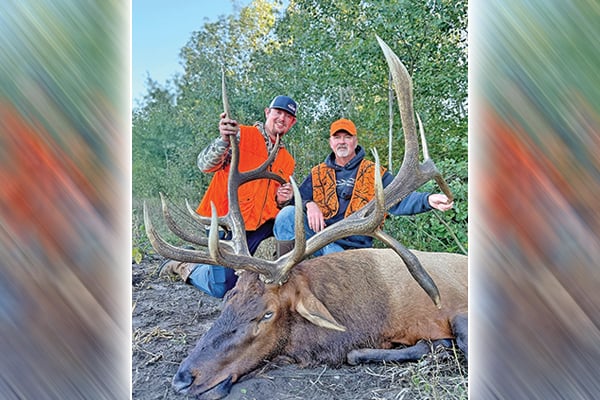
Minnesota’s 2026 elk harvest reaches nearly half of allocated tags during early season
As the first half of the elk season winds down in northwestern Minnesota, nearly half the tags have been filled

Upper Herring Lake offers western Michigan bass anglers a legitimate fall option
Bass can be widely distributed through the vegetation, but cooling water often triggers more active feeding.
Michigan’s Outdoor Calendar
A look at upcoming outdoor-related events from across Michigan published in the Sept. 25, 2026 edition of Outdoor News.
