




With the new hunting season upon us, it brings hopes of perfect hunting days that close with memories made to last a lifetime. Some of those memories will be nothing more than a laugh with a group of friends, yet others will encompass celebratory handshakes from friends and family.
So what can you do to increase your odds of making one of those latter memories this fall?
Although trail-cams have been around for a few decades, many people still don’t create a good plan for using them every year. Like any successful entrepreneur, the hunter who uses trail-cams to help fill a tag regularly always draws up plans to achieve a goal, whether that goal is to kill a mature buck or any buck.
This can be a daunting task in the backcountry, especially in some of the roadless tracts of timber found across the Adirondacks. Most backcountry hunters tend to do the same things from one year to the next, and this can be advantageous in the realm of understanding what trail-camera images actually tell us.
It doesn’t matter whether you hunt for weeks at a time out of a remote tent camp or if you just park on the side of the road and march into your favorite spot for a morning sit every weekend, the easiest way to stack the odds in your favor is to use past history.
HUNTING FEATURES FROM OUTDOOR NEWS:
Ryan Rothstein: Three mast crops to focus on for early-season whitetails
Four reasons you aren’t having the bowhunting success you want
Hunting in comfort: Is a box blind the best option for your top deer spot?
Get organized
Since most of us aren’t new to the trail-cam game, we need to learn how to better organize and analyze the pictures we get every year. The pictures should be organized by location, dates and times. After organizing them according to that data, it’s time to look a little deeper into what is going on in the pictures.
Does that activity begin at a specific camera sight at the same time every year? Are there deer there regularly? Does one camera get one buck that shows up out of nowhere every year and never returns? Are there a lot of does in the area? Are there multiple family groups of does and small bucks? Does the same buck show up on multiple cameras or the same camera (location) every year? Do any cameras have a lot of daytime pictures, while others only have nighttime pictures?
Although this can be a tedious task, the results can be eye-opening when you close the book after reading all the pages you have written in the past. Far too many of us get our pictures and don’t do anything other than look at them and fantasize about killing the bucks we’re looking at.
Repeat offenders
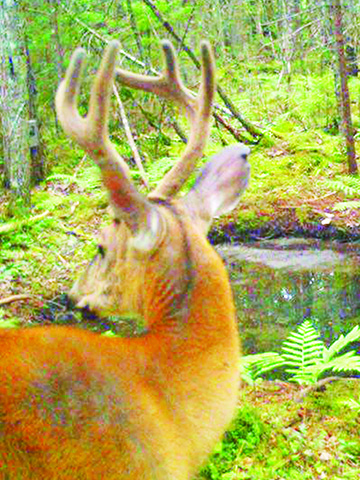 In my years of collecting and analyzing trail-cam data in the backcountry, I’ve been able to make predictions that can be used to consistently kill backcountry bucks. If you get pictures of nice bucks or multiple bucks around Halloween every year, there’s a high likelihood, those cameras will capture the same deer at the same time for consecutive years.
Why does this happen?
When bucks begin showing up around Halloween and repeat the process every year, it’s usually associated with a doe or a few does coming into heat early. The does will attract every local buck that wants to get some early action before the woods become chaotic near the end of the first week and beginning of the second week of November.
While all areas in big woods will not be productive around Halloween, trail-camera data can tell us which ones will increase our odds of filling our tags. Unfortunately, we must catch it while we can because, like anything, nothing lasts forever.
When the doe that comes into heat early every year dies, the area will most likely become far less active with big bucks at that time of year. Paying attention to what your cameras are telling you will help you determine where to head when the ghosts of the forest are in search of love.
Scrape watch
Although Halloween pictures can help us find places to increase our odds in the early season, there are many other factors that can be gained by using trail-cameras throughout the fall.
Cameras on scrapes will give you a pretty good inventory on deer that are living in the area, as many bucks tend to visit certain scrapes. Finding a good primary scrape where you can place a camera can be made easier if you search for licking branches and dug out areas beneath them.
There will always be a few of these scrapes that are better than all others. Double scrapes, which are two scrapes that are side by side, with licking branches above them signify a lot of use and great places to set up.
Bucks usually begin showing up in this type of scrape in the third week of October and will often keep returning until the end of the season. This type of scrape will attract most local deer as well as nomads that travel long distances in search of does.
If you place cameras on these scrapes, you need to pay attention when bucks begin showing up. You can use in-season scouting to capitalize, especially if deer begin appearing in the daylight.
Even if you’re getting pictures of does, the bucks will show up. They have only one thing on their minds, so the does will lead the bucks past you. Hunting over scrapes is made much easier if you use the data received from your trail-cameras. You will know whether there’s more activity in the morning, evening or middle of the day, then you can map out a plan to achieve your goals.
Water
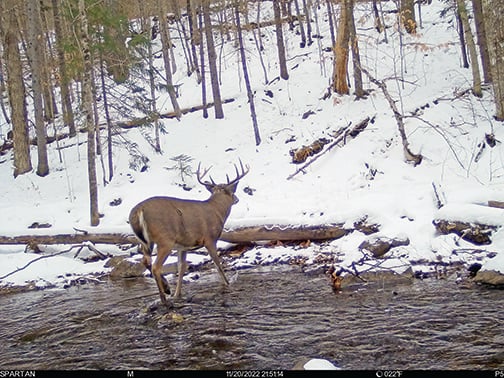
Placing trail-cameras on creek crossings can lead to yearlong action, but paying attention to the streams in your hunting area is essential to getting the cameras in the right place.
There will always be one place on a stream or river where deer cross more than all others. The water may be shallower in the area, or the terrain features may give no other option to get from one side of the water to the other.
If you place a few cameras on runways that cross streams or rivers, you can gain in-depth knowledge about the immediate area, the deer that live in it, and the entire surrounding area. The pictures will tell you how often the deer are on each side of the body of water, and it will tell you if they go back and forth regularly. It will also show you if the deer come to the water for drinks throughout the week.
While many people think trail-cameras are a waste of time in big woods, they can be game changers if used properly to gain data and create a portfolio that you can store and study every year. Eventually, you will learn a lot about the deer that call your area home, and you will learn how often nomads make the trip through your spots. As the season begins, enjoy the pictures you get but make sure you pay attention to what they’re telling you. Those pictures can put you in the passing lane and help you get to the finish line faster than other hunters.
Minnesota’s 2026 elk harvest reaches nearly half of allocated tags during early season
As the first half of the elk season winds down in northwestern Minnesota, nearly half the tags have been filled

Upper Herring Lake offers western Michigan bass anglers a legitimate fall option
Bass can be widely distributed through the vegetation, but cooling water often triggers more active feeding.
Michigan’s Outdoor Calendar
A look at upcoming outdoor-related events from across Michigan published in the Sept. 25, 2026 edition of Outdoor News.
