





Madison — The alphabet soup of chemical pollutants (DDT, CWD, VHS, HPA, PFAS) just expanded with the release of a consumption advisory for mallards and wood ducks harvested from Green Bay due to the contamination of per- and polyfluoroalkyl substances (PFAS).
The Wisconsin Department of Natural Resources (DNR) and the Department of Health Services (DHS) issued consumption advisories for two different areas of Green Bay:
• Lower Green Bay from Longtail Point across to Point au Sable and south to the mouth of the Fox River, where it is suggested duck hunters not eat any mallards from this area;
• Green Bay from Marinette across to Sturgeon Bay and south to Longtail Point. Hunters should limit a meal of mallards to one meal per month and wood ducks one meal per week.
Waterfowl were collected from Green Bay in 2022 to evaluate the level of polychlorinated biphenyls (PCB) in birds due to a consumption advisory in lower Green Bay. A check of the amount of PFAS concentrations in breast muscle tissue also was included, and then in 2023 and 2024 additional duck breast muscle samples were collected.
All of the testing took place during July and August, increasing the likelihood that the birds were local breeding ducks.
According to the agencies, the results showed elevated levels of PFOS in the breast muscle of the sampled ducks. Adult and juvenile ducks in lower Green Bay had higher concentrations of PFAS than in the northern portion of the bay.
By following these cautions, hunters can help to avoid accumulation of these chemicals in their body, according to a press release issued by the DNR.
MORE COVERAGE FROM WISCONSIN OUTDOOR NEWS:
Persistence, big bucktails, and the right window can turn September into trophy muskie season
Lone star tick expanding its range; here’s what hunters should know
What is PFAS?
PFAS are a group of human-made chemicals that have been used for decades in various products, such as non-stick cookware, fast food wrappers, stain-resistant sprays and certain types of firefighting foams.
These contaminants have made their way into the environment in a variety of ways, including spills of PFAS materials, discharges of PFAS-containing wastewater to treatment plants and the use of certain types of firefighting foams.
Human health risks may increase when fish and wildlife with high levels of PFAS are consumed. These can include increased cholesterol levels, decreased immune response and decreased fertility in women, among other health effects.
Sean Strom, DNR fish and wildlife toxicologist in Appleton, explained that there has been a waterfowl consumption advisory existing on lower Green Bay for about 40 years due to PCBs. While the DNR continued testing duck meat for PCBs, they added tests to look for PFAS.
“Lo and behold, they (PFAS) came back with pretty high levels,” Strom said.
The waterfowl hunting regulation pamphlet has previously cautioned that from the lower Fox River from the De Pere dam to the river’s mouth at Green Bay, and lower Green Bay south of a line from Point Sauble west to the west shore of Green Bay, the consumption of dabbling ducks should be limited to one meal per week for children and women of child-bearing years.
Other PCB advisories for waterfowl hunters exist for the Sheboygan River, the Milwaukee harbor, and the waters of the city of Cedarburg, Whitewater Lake, and Rice Lake in Walworth County.
Strom said they wanted to have the most confidence in local conditions, and so they strictly focused on resident birds thinking that the contamination was coming from a local source.
Rae-Ann Eifert, DNR Lake Michigan sediment and monitoring coordinator, said they were able to determine that mallards are likely exposed to PFAS in the area between Cat Island and the Ken Euers shoreline.
“However, we do not know the source of the PFAS to this area. The sampling indicated multiple profiles for PFAS, which indicates more than one source,” Eifert said.
The DNR will be collecting more samples from ducks around Green Bay this fall. The DNR may collect birds from around the state in future years.
Taylor Finger, DNR gamebird ecologist, confirmed that he has reached out to several people whom he knows hunt Green Bay. Those hunters will be providing samples from different duck species this fall.
“We’d like to get an idea if there are spatial differences, differences by species, and differences by time of migration,” Finger said, who cautions this is just an advisory. He said it is up to hunters to make their own decisions, but they should know that PFAS levels are significant.
Finger said field staff will be working with the DNR’s Office of Applied Science to develop a sampling strategy across the state for future years.
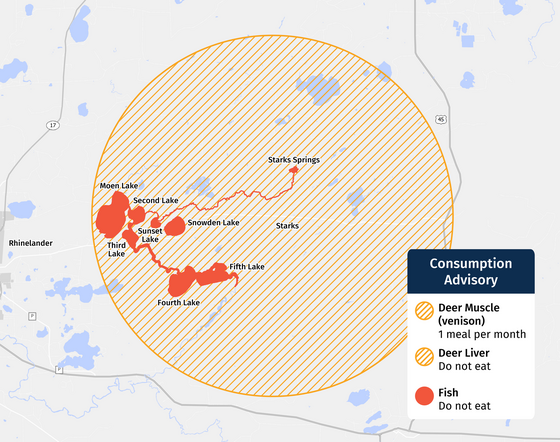
Oneida County advisory
Deer hunters should also be aware that DNR has a “do not eat” advisory for consumption of deer around the town of Stella in Oneida County, where PFOS has been found in groundwater.
The Stella advisory also applies to all fish species from the Moen Chain of Lakes (including Moen Lake, Second Lake, Third Lake, Fourth Lake, Fifth Lake), Sunset Lake, Starks Creek (upstream to and including Starks Spring) and Snowden Lake.
Currently, there are no PFAS advisories on other game species, but Finger said Maine has an advisory for turkeys on PFOS, and Minnesota found PFOS in spruce grouse, which indicates it could be in many other species.
“This could be just the tip of the iceberg,” Finger said.
Strom said that it might be possible the birds can excrete the chemical from their bodies; however, if they are in a contaminated area the chemical exposure can continue building up.
A complete list of consumption advisories is posted on the DNR website.
Wisconsin’s early teal hunting season opened Sept. 1, the youth waterfowl season opens on Sept. 20, and the regular duck seasons open Sept. 27 in the north and
Oct. 4 in the south.

Best time to target that big buck? Don’t wait for the rut
Rut-crazed bucks may be easier to encounter, but for a specific buck, early season may be better.
There’s no
What’s in a fish’s name? A lot, it turns out
Fisheries biologists and other naturalist for centuries have subscribed to one of two camps – splitters and lumpers. It is
Kristin Ojaniemi: Story of a rare color-phase bear from Michigan’s Upper Peninsula
It’s not too often you hear of a bear with fur other than black being seen or even harvested here
