





Muskie – the fish of 10,000 casts. With a pseudonym as such, one can only assume that it’s difficult to catch. In fact, they’re often revered as the most challenging fish to catch in freshwater. For many, muskie fishing is a labor of love.
 The anglers, themselves, are in a class of their own, unlike the vast majority of the angling community. They’re persistent, obsessive, and patient – determined to gain a competitive edge on their targets. No matter the time, the weather, or the conditions, they’ll do whatever it takes – willing to risk it for a chance at the fish of lifetime. In terms of attitude, they’re far more similar to big game hunters than traditional fishermen.
Successful muskie anglers recognize how important it can be to be in the right place at the right time. In many instances, it’s all about capitalizing on prime opportunities. Specific seasons, conditions, and other factors can stack the deck in the angler’s favor. These peak periods are important windows for many anglers.
For many fishermen, the fall period is an important window, which generally kicks off in the month of September. While the calendar can be an indicator, water temperature is the ultimate decider.
Take the last few seasons, for example. We’ve seen warmer, more summer-like weather hold on much later into the Fall, resulting in a delayed start for this peak period. In my observations, that first string of cold nights typically kicks things into high gear, especially as water temperatures fall to the high 50s to low 60s.
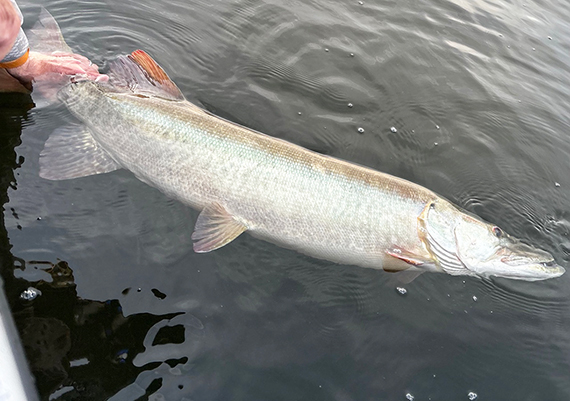
The first areas I look to throughout this timeframe are generally shallow. Specifically, I focus on expansive sand flats, inside weed lines, bulrush beds, and rocks.
In my observations, those calm, sunny, stable days will generally keep fish around weeds, while cloudy, gray, overcast days will drive them to more rock-like structure. Regardless of location, electronics are extremely important during this period, especially side imaging. Not only is it ideal for locating specific cover and structure, it’s also very efficient for tracking down fish.
MORE MUSKIE COVERAGE FROM OUTDOOR NEWS:
Study of Minnesota’s Leech Lake muskies: All about movement in year one, with mortality data to come
Military veterans find the muskies on Minnesota’s Lake Vermilion at ‘Madness’ event
Musky Clubs Alliance bolsters Wisconsin DNR’s stocking
Earlier in the fall, a lot of classic muskie presentations come into play. For shallow fish, it’s hard to beat topwater and bucktails, specifically those in the No. 9 and 10 class. For deeper fish, rubber baits, crankbaits, and tubes are at the top of many anglers’ most-used lists.
As the season progresses, big bucktails, like those No. 12s and 13s, are one of your best bets for picking up a trophy. They move a lot of water and can be slow rolled effectively when you need to get down to that 6- to 8-foot range.
Fishing with big bucktails isn’t for everyone – it’s hard work. But, with the right gear, you can fish them for a full day without too much trouble. In my opinion, it’s important to avoid a rod that’s too soft, as it can be very difficult to execute on figure eights.
Heavy-powered rods and slower gear ratios are a necessity. The all-new Mojo Muskie 10-foot Heavy Power, Fast Action was tailormade for these scenarios. When paired with a Daiwa Prorex 5.3:1, it makes an incredible combination.
While factors like moon phases can make a difference in muskie fishing, my personal experience has proven that nothing beats time on the water. In my eyes, the secret to catching big muskies is just simply grinding. There’s no better way to put it than “cast your butt off.”
The fall timeframe is a great opportunity for trophy muskies. There’s a reason so many anglers prefer it. Fishing for muskies isn’t easy. But, with the right tools and the right determination, a successful day is entirely possible.

Findlay Reservoirs support walleyes and saugeyes in northwest Ohio
An angler could do much worse than the pair of reservoirs at Findlay in northwest Ohio.
The latest offering
Ohio’s Outdoor Calendar
A look at upcoming outdoor-related events from across Ohio published in the Sept. 22, 2026 edition of Outdoor News.

Ohio Cuffs & Collars: Stolen black walnut tree from Wallace O’Dowd Wildlife Area
Ohio cuffs and collars are field reports from the Division of Wildlife. These reports are from the Sept. 25, 2026
