





The upland hunt in the early 2000s unraveled in a postcard-perfect setting: along the rolling hills of small grain and grassland near Lemmon, S.D., just west of the walleye-rich Missouri River, where Lewis and Clark paddled and explored many moons ago.
It included three dogs – all pointers – and four hunters, all of whom were from southern states and new to the northern Great Plains and its upland hunting traditions. The September hunt, on a sprawling cattle ranch, was primarily focused on one bird: the sharp-tailed grouse, the native Lord of the Prairie.
The warm, humid morning – the temperature hit 80 degrees by mid-afternoon – started slow, with all three dogs occasionally looking birdy. But the sharpies, already wary and wild nearly two weeks into the season, wouldn’t hold, as they flushed well outside of shotgun range.
Then it happened: an explosion of wingbeats from an alfalfa field.
Brrrrrr!
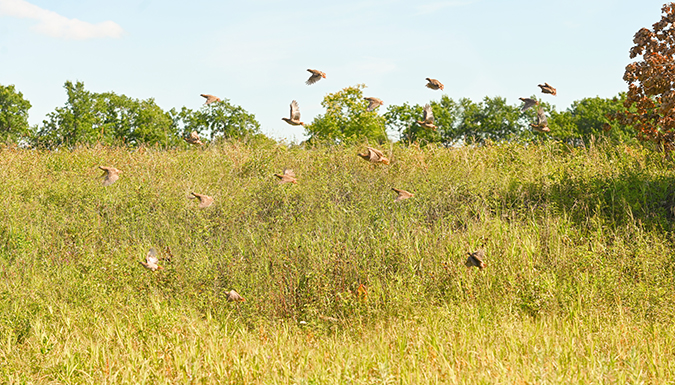
More than a dozen birds – not sharpies, but Hungarian partridge, with their distinguishing rusty colored face and dark belly patch – broke cover, caught wind and bobbed and weaved as shotguns barked. While most made it over the next rise, two crumpled to the ground.
MORE UPLAND BIRD COVERAGE FROM OUTDOOR NEWS:
High-volume, low-regulation, big fun… we’re talking pigeon hunting
2025 Great Lakes Region ruffed grouse forecast
Patrick Durkin: Unpacking what Wisconsin grouse, pheasant numbers look like by region
A covey bird that some hunters affectionately call the quail of the North Country, Hungarian partridge are an under-the-radar yet highly sporting grassland gamebird respected by hardcore upland hunters. In shorthand, they’re called “Huns” or “gray partridge.”
Most hunters consider Huns a bonus bird, shot incidentally to chasing sharp-tailed grouse or pheasants. They weigh a little less than a pound and have 21-inch wingspans. They have a yen for flushing wild. Their winged acrobatics can make even polished wing-shooters look pedestrian.
“Hungarian partridge are quail proxies for the most part in the Upper Midwest,” said Nate Huck, resident gamebird consultant for the Minnesota DNR. “They’re a covey bird, which I appreciate when I’m hunting pheasants or sharptails. They’re a cool bird to come across, especially if you’ve never hunted a covey bird.”
Like America’s Chinese import, the ring-necked pheasant, Hungarian partridge are non-native birds, too. They were imported into the U.S. and Canada, mostly from Czechoslovakia and Hungary, beginning in the late 1800s.
Where to hunt
The Hungarian’s range extends as far east as Wisconsin and as far west as Oregon and Washington. Populations in those east-west states are considered spotty at best. Huns can be found as far south as the central parts of Nevada, in northern Missouri and Nebraska.
What states have a more widespread range and perhaps better hunting, according to hunters and state officials interviewed for this story? Nebraska, Wyoming, Utah, Idaho, South Dakota, North Dakota, and Montana. And don’t sleep on prairie Canada, they say, because bird abundance is solid in roughly the southern half of Alberta, Saskatchewan, and Manitoba.
Unlike pheasants and even sharp-tailed grouse, locating the Hungarian partridge population in any given state or province is tough. Simply put, they’re difficult birds for wildlife managers to locate on annual spring and late-summer roadside counts.
“Pheasants crow, sharptails gather at leks to dance, but partridge only pair up – they don’t have a conspicuous enough of a display to make themselves easy to survey,” said avid upland hunter and upland game management supervisor, Jesse Kolar, of the North Dakota Game and Fish in Dickinson.
Still, year in and year out, North Dakota is regarded as one of the best states to chase Huns, even though the population is still well below pheasants and sharptails.
“Partridge have reached recent peaks in North Dakota according to our late summer roadside counts in 2023 and 2024, 36.6 and 28.6 partridge per 100 miles, respectively,” Kolar said. “To put that number into context, from 2014 the density of partridge on those surveys has ranged from 4.1 to 11.8, barring the past two years. Also, to set hunter expectations, 35.6 partridge per 100 miles equates to 2.4 coveys, so the rate you can expect to see partridge is still somewhat low compared to pheasants or sharpies.”
Kolar said the state’s partridge harvest over the past decade hovers around 50,000. The past two years harvest has been up a bit – about 67,000 birds.
“But that’s nothing compared to 200,000 in 2003 or 250,000 in 1993, even though hunter numbers have remained in the low 20,000s over the past 30 years,” Kolar said.
One possible reason for the decrease is access – that is, less access to private land. Private land in North Dakota that’s not posted is open to public hunting. For years, landowners rarely posted their land.
But that’s changed dramatically. In fact, most private acres are posted. “Another reason might be fewer trips per hunter,” Kolar said. “We can’t say for sure why the discrepancy, despite current high numbers.”
Interestingly, Kolar and other managers say Huns do better and sometimes thrive during periods of drought. “That’s not the case with pheasants and sharptails,” Kolar said.
Huns and dogs
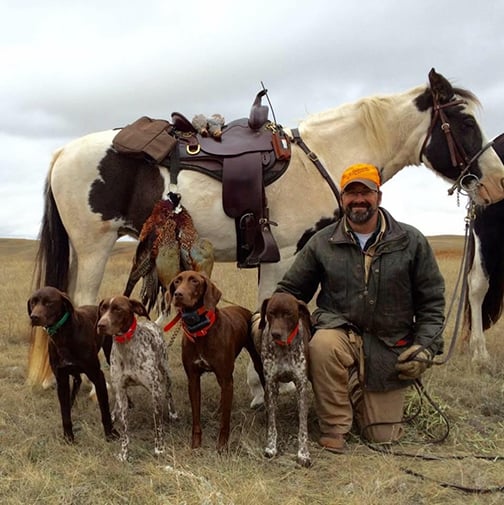
John Zeman, 63, of Zimmerman, Minn., has traveled to Montana every September since 2008 to hunt sharp-tailed grouse and, given the opportunity, Huns. He hunts from horseback and typically follows German short-haired pointers.
Most upland bird hunters regard Huns as a maddening bird to chase with either a pointer or a flusher – they often, as many will tell you, flush wild and out of shotgun range. While they do hold tighter early in the season, Huns have earned their reputation as wary birds.
But Zeman, a longtime dog trainer and avid uplander, believes many hunters pass right over them, even in thin cover. Zeman believes they’re harder to scent than other gamebirds, and blend in their environment extremely well.
“It’s special treat when you do get a covey to rise – and they will hold tight to a point,” Zeman said. “That explosion is something special to see and hear. They’re fun, small birds.”
Keep in mind, Huns love to eat waste grain from agricultural fields. Wheat, barley, oats and corn are a big part of their diet. They also eat seeds from wild plants, like sunflower, foxtail and others, as well as insects. Consequently, Huns are often found in heavily cropped agricultural areas with adjacent grasslands (native prairie and even overgrazed rangeland). Plenty of hunters target the seam between the cover and the food.
“They tend to be in sparse cover, and you tend to find them in the same areas year after year,” Zeman said.
With experience, Zeman said Huns are “relatively easy” to shoot. Focus on one bird when a covey – which can range from four to as many as 20 birds – flushes. The covey rise can be exhilarating, he said. Compose yourself before you pull the trigger. Make the first shot count; you may not get a second.
“Don’t flock shoot, either. That’s when you miss,” Zeman said. “You also want to mark a downed bird very quickly. Dogs will have trouble finding them. And, as I said, they blend into cover quite well. I’ve seen dogs run right over the top of them multiple times before they caught wind of it.”
In the end, while Zeman, Kolar and others don’t specifically target Hungarian partridge, they love when they make their dramatic aerial entrance – a drama worth savoring, regardless of the state or province you’re hunting them.
“They sure get your heart racing,” said Kolar, who said they also make fine table fare. They’re mild-tasting, relatively easy to pluck, and are delicious roasted. And don’t forget to accompany them with a nice Cumberland sauce.
Said Zeman of Huns: “They’re good. They’re not as dark as a sharptail and not as light as a pheasant. I like them.”

Wisconsin Mixed Bag: DNR’s Madison service center to close
The Wisconsin Department of Natural Resources (DNR) announced that with the sale of the GEF2 building on Webster Street in
Wisconsin’s Buena Vista Grasslands and its prairie chickens entice handlers, pointing dogs
As far as John Mathys is concerned, there’s nowhere he rather be than with his dogs and horses in a
Solar farm pact protects prairie chickens in Wisconsin’s Buena Vista Wildlife Area
A large solar farm under construction in Portage County’s town of Grant isn’t expected have a significant effect on Wisconsin’s
