




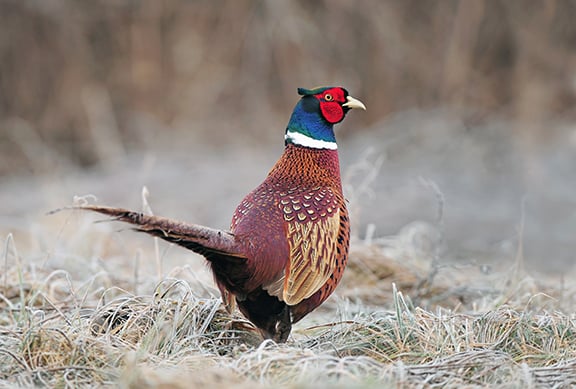
St. Paul — Pheasant numbers in the 2025 Minnesota August Roadside Survey were up nearly 50% from 2024 and 21% above the 10-year average, the Minnesota DNR announced Tuesday.
“The increase in pheasant numbers across the state and all regions is great news,” said Steven Woodley, acting upland game research scientist. “Our milder winter likely helped the overwinter survival of hens, and the drier and warmer spring created better conditions for nesting and brood-rearing relative to last year.”
This year’s statewide pheasant index was 75 birds per 100 miles of roads driven, compared with 51 in 2024. Pheasant numbers increased in every region. Compared with 2024, pheasant numbers increased the most in the southeast region (189%), followed by the southwest (86%), east-central (82%), south-central (40%), central (33%), and west-central (19%) regions.
MORE COVERAGE FROM OUTDOOR NEWS:
USFWS survey shows duck numbers hold steady despite dry conditions
Survey shows Iowa’s pheasant population at 20 year high, ‘banner’ hunting season expected
Four reasons you aren’t having the bowhunting success you want
Pheasant numbers are also above their 10-year averages in every region within the pheasant range. The regions with the highest indices include the southwest (152 birds per 100 miles), south-central (82 birds per 100 miles), and west-central (76 birds per 100 miles), followed by the central region (59 birds per 100 miles).
There were four chicks per brood, the same as in 2024. However, there were 81 broods per 100 hens, an increase from 77 broods per 100 hens in 2024.
“The increase in brood numbers is welcome after their decline last year due to wet spring conditions,” Woodley said.
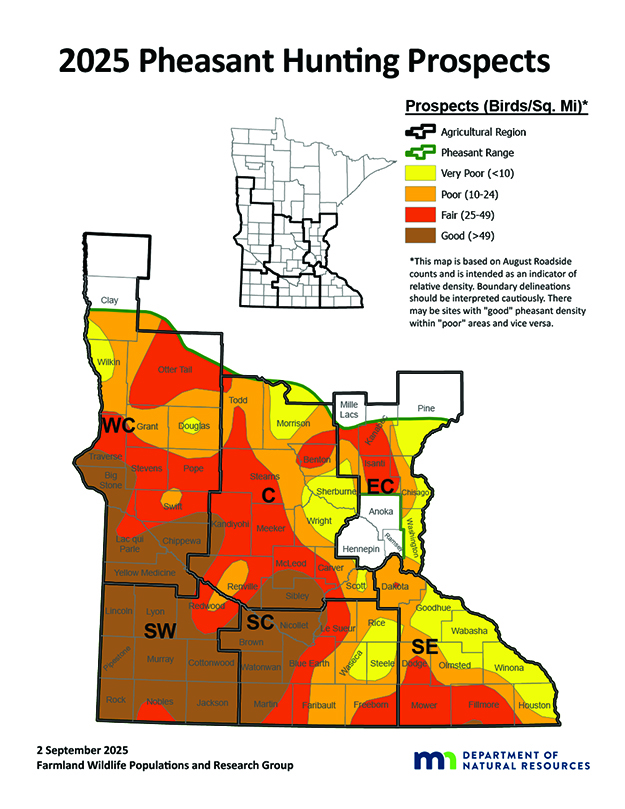
Weather and habitat are the main influences on Minnesota’s pheasant population trends. Weather causes annual fluctuations in pheasant numbers, while habitat drives long-term population trends.
Winter weather conditions were favorable for adult pheasant populations. And with little snow cover and warmer spring conditions, early nests and young broods before June rains probably did well, while nests that hatched during the rainy period in June likely suffered.
Additionally, this year’s later hatch date indicates that some nests hatched after the June rain, which may have helped boost the population by allowing them to avoid the worst weather. Long term, there is nothing to suggest that some areas’ increase in pheasant numbers will continue as a trend.
The Minnesota pheasant hunting season opens at 9 a.m. on Saturday, Oct. 11.
In related news, the DNR’s small game survey indicated the following: 77,135 pheasant stamps were sold in 2024, 2% below 2023 sales and about 2% greater than the 10-year average of 75,962 stamps; an estimated 50,935 hunters went afield, which was 6% lower than the 10-year average of 53,931 hunters; and about 235,000 roosters were harvested, which was 17% more than the 10-year average of 200,937 roosters.

Cottontail numbers way up
The cottontail rabbit index (15 rabbits per 100 miles) increased from 2024 (nine rabbits per 100 miles) and exceeds the 10-year average (six rabbits per 100 miles) and the long-term average (six rabbits per 100 miles).
The report and information about hunting seasons are available on the Minnesota DNR pheasant hunting web page.
Read more about the roadside survey and the small-game hunter survey in next week’s Outdoor News.
Minnesota’s 2026 elk harvest reaches nearly half of allocated tags during early season
As the first half of the elk season winds down in northwestern Minnesota, nearly half the tags have been filled

Upper Herring Lake offers western Michigan bass anglers a legitimate fall option
Bass can be widely distributed through the vegetation, but cooling water often triggers more active feeding.
Michigan’s Outdoor Calendar
A look at upcoming outdoor-related events from across Michigan published in the Sept. 25, 2026 edition of Outdoor News.
