





Memphis, Tenn. — Ducks Unlimited reported in a press statement Tuesday the release of the U.S. Fish and Wildlife Service’s 2025 Waterfowl Population Status Report, which indicated overall duck numbers largely were unchanged from a year ago across the traditional survey area.
The report includes the results of surveys and population estimates from both the USFWS and the Canadian Wildlife Service, as well as from several states and provinces. It’s vital to the frameworks of duck-hunting seasons in 2026.
(The release arrived near Outdoor News deadline; a more comprehensive report including the outlook for future hunts will appear in next week’s edition.)
According to DU, “The estimate for total breeding ducks in the traditional survey area was 34 million, unchanged from the 2024 estimate, and 4% below the long-term average (since 1955). Mallards were estimated at 6.6 million, similar to 2024, and 17% below the long-term average.
“Pintails were estimated at 2.2 million, 13% above 2024, but 41% below the long-term average. Under the new USFWS interim pintail harvest strategy, hunters in all four flyways are expected to have a three-pintail daily bag limit option for next year’s 2026-27 season based on this year’s breeding population results.”
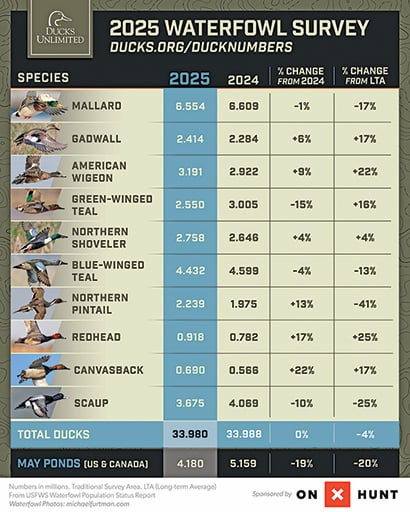
Meanwhile, the federal report estimated May ponds at 4.2 million, a 19% decrease from 2024’s 5.2 million ponds. The count this year was 20% below the long-term average and is the lowest estimate since 2004, according to DU. The count was down to a greater extent in the prairie region.
“Waterfowl again demonstrated their adaptability to changing water conditions despite overall dry conditions in 2024, as late-nesting species capitalized on spring rains in the prairies and those that settled in the Boreal held their own,” Dr. Steve Adair, DU’s chief scientist, said in the release. “These flexible breeding strategies and use of continental habitat resources in 2024 appear to have contributed to decent production last year, which carried over to a similar breeding population this spring.”
MORE WATERFOWL COVERAGE FROM OUTDOOR NEWS:
Commentary: What to do about declining North American duck populations
From backwaters to oxbows, here’s how to hunt waterfowl on the mighty Mississippi
Are you as good at identifying ducks as you should be? Here are ways to learn
According to the companion Adaptive Harvest Management report, the USFWS is expected to recommend liberal frameworks for the 2026-2027 duck season across all four flyways, the DU release said.
According to the report, blue-winged teal estimates in the traditional survey area were 4.4 million, a 4% decrease from 2024, which, DU states, “is expected to keep hunters in the Central, Mississippi, and Atlantic flyways at a nine-day (optional) early teal season for 2026–27.”
The DU release also notes that the boreal forest and other northern survey areas saw generally drier, but variable, habitat conditions. Yet an early spring coupled with prairie drought resulted in another year of an above-average number of breeding ducks settling in the boreal.
Canvasbacks (up 22%) and redheads (up 17%) saw notable increases from 2024, per the federal report and DU’s release.
Pond numbers
According to DU, “The prairies have now faced several consecutive years of drought, among the longest stretches in recent memory. In early spring of 2025, the prairies were once again dry, but timely rainfall in mid-May recharged wetlands in portions of North Dakota, southeastern Saskatchewan, and southwestern Manitoba. These rains should benefit later-nesting ducks, though they came after many early-nesters like pintails and mallards had already moved through.
“Pond numbers in the U.S. prairies declined 34% from 2024. Timely rains in 2024 fell prior to the survey being conducted, which contributed to the elevated pond counts last year. However, spring rains in 2025 came after the surveys were flown, and when coupled with the effects of a dry winter, contributed to the lowest U.S. pond estimate in seven years.”
View the full 2025 Waterfowl Population Status Report here.

Short on walleyes, but long on muskies: Beers Lake in Minnesota’s Otter Tail County
Otter Tail County’s Beers Lake is an excellent walleye fishery – nope. Beers is loaded with good-sized panfish and northern
Minnesota’s Outdoor Calendar
A look at upcoming outdoor-related events from across Minnesota published in the Oct. 23, 2026 edition of Outdoor News.

Minnesota Cuffs & Collars: K9 Molly helps hunter find lost gun
Minnesota cuffs and collars are field reports from DNR conservation officers. These reports are from the Oct. 23, 2026 edition
