


Dr. Bronson Strickland sees firsthand how difficult it is for some students to know exactly what it is they want to do with their professional lives once they reach college.
Strickland, the St. John Family endowed professor of wildlife management at Mississippi State University, did not experience the stress of that unknown himself. He was in junior high when a friend told him about another friend whose dad was a deer biologist.
“When I heard that, my question to my friend was, ‘There’s a job where you can be a deer biologist’” Strickland said. “I knew from that point on. What is really cool about the story is the very man that my friend was referring to ended up being my advisor when I was an undergraduate at the University of Georgia. I kind of feel like it was meant to be.”
Strickland, along with his students and colleagues at the Mississippi State University Deer Laboratory, have led some of the most well-known whitetail research in the country that benefits hunters, land managers, and state wildlife agencies.
Technology has changed the game for most professions, and it’s no different in whitetail research. Strickland, who started working in whitetail research almost 30 years ago, said the development of GPS collars, game cameras, and AI technology has helped them look at data on a much finer scale than they used to be able to. That means the ability to obtain deeper answers to a wider range of questions about deer.
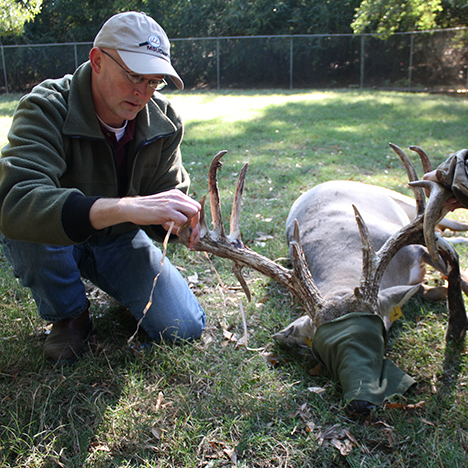
Outdoor News caught up with Strickland, who lives in Starkville, Miss., to talk about the most recent whitetail research and how it can benefit hunters.
Outdoor News: I know every study has its own unique purpose, but in general when you look at whitetail research you and your colleagues conduct, what are often some of the primary things you hope hunters can take from it?
Strickland: We really go into a lot of our scientific questions because we work so closely with our state wildlife agency – the Mississippi Department of Wildlife, Fisheries and Parks. That organization is interacting with landowners and hunters 24/7, 365. They really get their finger on the pulse of what are land management issues. What are hunters saying?
When there’s enough of a voice there and enough of a question saying we really should look into this, the state wildlife agency will work with us and we’ll design a research project to test some of those theories. That is how two of our biggest projects came about.
One of them was what we call our environment versus genetics project. That came from hunters and landowners essentially saying, why do those people in that part of the state have bigger deer than we have? As such, why can’t we just translocate deer from the big-antler region to the small-antler region?
That’s what we call our Delta Region, which is our agricultural zone. Because of all the agriculture, the deer in both body and antler size are 25% bigger.
READ MORE ‘QUICK CHAT’ FEATURES FROM OUTDOOR NEWS:
A quick chat with wildgame chef Andrew Zimmern
A quick chat with Jon Steigerwaldt of the Ruffed Grouse Society/American Woodcock Society
A quick chat with Scott Hed, a man front and center in battle over Alaska’s Bristol Bay
Your hunter, they think that has to be genetically derived. So why doesn’t the state wildlife agency just capture some deer from the Delta and take them down here to the southern part of the state and turn them loose so we have big deer as well?
That was about a 10-year project of taking fawns from the Delta region and fawns from our forest region and giving them the exact same diet. We did that for two generations of deer, and by the second generation from deer with those “bad genetics” we were able to grow deer just as big as those from our agricultural region.
The other study is what you have probably seen on social media recently analyzing buck movement. That was people reaching out who had the same question over and over, which was essentially, where do the bucks go?
So they worked with us, and we put GPS collars on bucks. Some of them swim the Mississippi River and some of them are right under your nose and you just don’t see them.
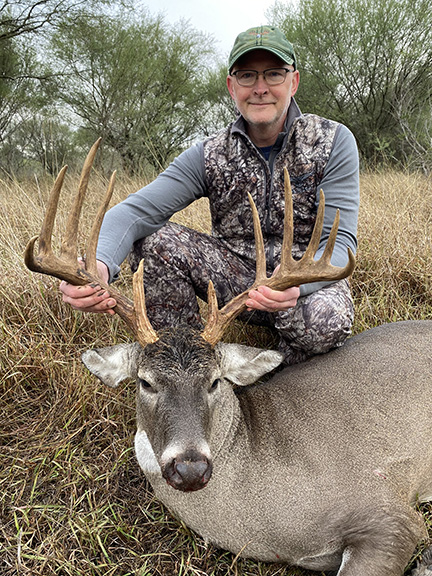
ON: Yeah, I wanted to talk about that buck study from the Big Black River Region of Mississippi. Researchers captured and collared 60 bucks 2.5 years of age and older and looked at their bedding and movement habits across the entire hunting season from Oct. 1 through Jan. 31.
One takeaway was that a buck on average used 31 unique bedding areas across the season. What stood out to you about the findings from that study?
Strickland: It was very meaningful to me because just like everyone else when I was young and before I was a deer biologist, I read hunting articles. One of the names of an article that resonated with me was called, “The buck’s bedroom.” It made it sound like every buck has one or two of these places (that they bed).
That wasn’t even the focus of the buck movement project, but we just got to talking about it and said we’ve got a real opportunity here. We were getting a (GPS) location every 15 minutes, we’re going to be able to tell where these bucks were bedded, how long they’re bedded and how many beds they have on the landscape throughout the hunting season.
What we found in our environment, and we need to qualify that, we are in what I call a cover-rich, food-poor environment. If you are in the Midwest, you’re in a food-rich, cover-poor environment. So the circumstances are 180-degrees opposite.
Down in the south we have so much forest land and pasture land, there’s so many places a buck can bed. That is precisely what we found in our landscape context is that these bucks are using a great number of beds and it’s going to be very difficult to isolate where he is going to be.
ON: I have seen in those landscapes that are more food-rich and cover-poor that specific beds will get used over and over again year after year, likely by a number of different bucks each year. Is it safe to say that in those areas of limited cover you have better opportunities to find beds like that that are being used more and more throughout the year?
Strickland: Not only do I agree with you, but I would bet a great sum of money that what you are describing is exactly what is going on. I can’t prove it, but to me it’s very biologically reasonable that when deer have fewer choices on the landscape to make, it automatically forces them to bed in places at a greater frequency. I would fully expect year after year and then throughout the year they will bed in those places more often.
ON: The study found that there was not that much of a difference between overall time that bucks spend bedding between daytime and nighttime hours.
On average, their total time bedded was about 3.5 hours during the day and 3.2 hours at night. (Editor’s note: For the study, there had to be at least four consecutive GPS points, so at least an hour’s worth of time, where those four GPS points were within a 20-yard radius of each other. This was done so researchers could confidently say a buck was bedded, but the total time spent bedded by bucks is likely a conservative average based on missing shorter bedding bouts).
Do you anticipate that the number of hours spent bedding would be something that is fairly consistent across most landscapes and regions?
Strickland: My hunch, and that’s all it would be is my biological hunch, is that it would be pretty consistent. The 50,000-acre area we did the research on, it was hunted, but the hunter density was probably not near what you would see on public land that got a lot of hunting pressure.
I have no data to prove this, but in that scenario I could see where maybe a buck might hunker down a little bit longer if they are sensing much more human activity on the landscape. But I would say in a similar scenario where it’s private land that is hunted but maybe not equivalent to public land, I would think the results would be very similar.
ON: Obviously the rut gets bucks on their feet more as they seek breeding opportunities, but during those time frames outside of the rut, do you think it’s that need to feed and browse at multiple times of the day that gets them on their feet?
Strickland: I think that’s precisely what is going on. I just use the analogy of a meal versus a snack. I call it a rumen-filling meal, a movement bout, when that is over they bed down in the morning. You will then see after a couple hours of being in the bed, some subtle movements. They’re not doing this long distance movement, but they are doing what appears to be snacking, foraging a little bit. Then they’ll bed back down.
ON: Did you see some consistency in terms of time periods where they get up and on their feet more during daylight?
Strickland: The most consistency, and this is not going to be a big shocker at all, but it’s just the rut. I always have to say this, but bucks are like humans in that they’re individuals. We have this sample of 40, 50, 60 where we have to calculate an average. There’s some individuals that just go against the tide. They do their own thing and we can’t explain it.
But when we look at an average, depending on where you are at in the year relative to the rut you might have anywhere from three beds during the day. They may bed a little earlier, get up, move around, have a midday bedding, get up, move around and move again. Then all the way to during the peak of the rut we very distinctly see just one bedding event during the day. That makes perfect sense when they’re on their feet more.
ON: Shifting gears here a little bit to the most talked-about topic in whitetail hunting: Where are we at with the research in terms of if a cold front impacts daylight movement?
Strickland: We are literally crunching the numbers right now on that. We are finding an effect. We need to double-check our math so to speak and make sure we understand, but here’s what I think is different. I have been one of those people over the years who has said there is very little, if any, effect of cold fronts on deer movement. But what I have learned is you have to be so careful on how you measure movement.
What we would do (in the past) is look at daily movement rates. I can go from 6 a.m. day one to 6 a.m. day two and calculate the distance the buck moved. I could line up every single day and go, yep, they’re still moving 3,000 yards a day. One could very well conclude based on the way you analyzed the data there’s really no big impact.
Well, we decided in this most recent analysis to look at a finer scale. Instead of looking at the total movement pattern for 24 hours, let’s look at only during hunting hours during daylight and let’s look at the number of minutes they spend in a bed based on weather.
Then when they’re on their feet until sunset, let’s look at the amount of ground they cover before sunset. To this point, we are seeing a signal there related to the cold front. We are seeing that it is stimulating a movement response.
ON: When do you anticipate that information will be ready for the public?
Strickland: We have three big topics and our goal is to get them out on podcast and video podcast on YouTube before Christmas. The first one we are planning to record is the most exhaustive analysis relative to the moon. Every way you can possibly slice it, we have sliced it.
Then we’re going to look at what we call inter-annual site fidelity. That’s a complicated way of saying when you have a buck in a particular area at a particular time in year one, what is the likelihood that buck will be in that area at that particular time in year two?
From a hunting perspective, we found some very, very good news about if you see him in a particular place in year one, remember that day or that week. There’s a very good chance he’s going to be back in that area in year two. For a small property owner, that’s really good news.
Then the last thing, because we’re still really crunching the numbers on this, we’re going to do a weather and wind analysis.
Outdoor News: Where should people go to find everything you are doing at the MSU Deer Lab?
Strickland: The MSU Deer Lab website is one where we have a repository of information, but really the best place to find the latest stuff we’re doing is to go to either our Instagram or Facebook on social media, and then our podcast, Deer University.
Within the podcast there is the traditional audio version, but then go to our YouTube channel — MSU Deer Lab TV — and we put everything up there. I think the YouTube channel is now more useful for people than our website because we have so much video content there.
Great Lakes Aquarium-raised sturgeon released into St. Louis River in Duluth
The Great Lakes Aquarium in Duluth is now rearing lake sturgeon alongside the DNR and Fond du Lac Band, and
Meet the new Minnesota DNR Fisheries leader: Shannon Fisher
Fisher is a Minnesota native who grew up on a dairy farm in Plummer, where he often took trips to
Signs suggest big year for Minnesota deer hunters as firearms season arrives
Corn and soybean harvest nearly complete
