




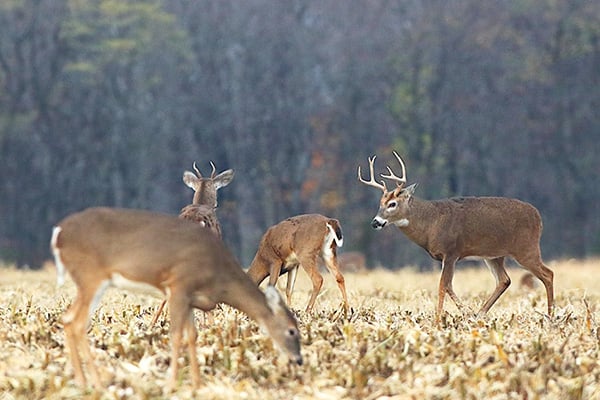
You have heard about chronic wasting disease, or CWD, and probably wondered what causes it, who is affected, and what is happening to the white-tailed deer in Illinois.
Here, we will decode CWD and discuss common and confusing myths about prion diseases, particularly CWD.
What is CWD?
Prion diseases affect mammals and are characterized by progressive neurological degeneration, driving physical and behavioral changes that ultimately lead to death. Prion diseases are caused by a highly infectious protein (PrPSc), whose name derives from the abbreviation of Scrapie, the first reported prion disease that affected sheep and goats.
From the group of prion diseases, CWD affects members of the Cervidae family – which includes mule deer, white-tailed deer, North American elk or Wapiti, European red deer, sika deer, reindeer, axis deer, roe deer, fallow deer, muntjac deer, moose, and caribou.
MORE COVERAGE FROM ILLINOIS OUTDOOR NEWS:
2024 Illinois Firearms Deer Preview: Will rifle harvest climb this year?
Pheasant hunt in Illinois has dodged pellets over the years to remain going
Illinois DNR’s approach to managing CWD will change in 2025
For propagation, the CWD pathogen (PrPSc) hijacks the animals’ cell surface proteins (PrPC) found throughout the body, especially the nervous and lymphatic systems. It misfolds the cellular protein PrPC and transforms it into a new PrPSc capable of hijacking another PrPC, initiating a PrPSc production or chain reaction that increases PrPSc in the infected vertebrate.

While PrPC is susceptible to degradation, the misfolded PrPSc forms insoluble aggregates and becomes resistant to degradation. The formation of aggregates destroys cells and creates cavities or tiny holes. These changes, though slow, are progressive, and irreversible, culminating in neurological damage, behavioral alterations, and a slow, inevitable death. To date, no cure or treatment has been found for prion diseases.
Therefore, CWD is always fatal.
Prion diseases are rare compared to diseases caused by other agents. They can affect humans and animals; some may develop spontaneously, others may be inherited, and sometimes prion diseases can be acquired, and the disease can be transmitted to humans and other animal species via infected meat products.
For instance, Creutzfeldt-Jakob Disease (CJD) develops spontaneously in humans. However, Variant Creutzfeldt-Jakob Disease (vCJD) develops in humans after ingesting cattle meat infected with bovine spongiform encephalopathy (a.k.a Mad Cow disease). In addition, Creutzfeldt-Jakob Disease can be transmitted through medical procedures (e.g., blood transfusions, organ transplants, contaminated surgical instruments), and in this case it is known as iatrogenic Creutzfeldt-Jakob Disease (ICJD).

How does CWD infect deer?
CWD is a unique and complicated prion disease. The highly infectious protein that causes CWD (PrPSc) can be transmitted via direct contact (or indirectly via a CWD-contaminated environment).
Direct contact can occur when a CWD-infected deer participates in social behaviors (such as grooming, mating or raising a fawn) and in utero from an infected female deer to the fetus. PrPSc can linger for years on inanimate objects.
Therefore, indirect transmission involves animals eating grass, plants, or soil contaminated with PrPSc or inhaling infectious prions in the soil. In addition, wood, rocks, cement, and glass can be contaminated with infectious PrPSc proteins and may serve as an additional risk of CWD exposure.
What are the signs of the disease?
Infected animals may look healthy at the beginning of the infection, showing no evidence or signs of physical or neurological deterioration.
However, with disease progression, the accumulation PrPSc in the host leads to brain deterioration, and the animals always suffer a slow progressive wasting process till death. Some signs are more evident during the advanced stages of the disease after brain damage starts to appear.
Signs that develop with advanced infection include excessive salivation, thirst, and urination, accompanied by difficulty in eating and progressive irreversible weight loss. Behavioral changes associated with neurological damage include lack of fear, appearing lost, walking with the head down, lack of coordination, difficulty moving, and losing balance while walking.
These behavioral changes make them more vulnerable to hunting, predation and accidents. After the signs of disease are evident, animals last 6 to 18 months suffering from a slow and painful death. The progress of CWD can be affected by the animal’s genetics and the species of cervid affected, but all CWD-infected animals die from the disease.
Diagnosis of CWD in deer, and what are the most infective tissues?
The accumulation of infectious protein is greater in the lymphatic and central nervous systems (brain and spinal cord). Therefore, when animals become infected, the brainstem (obex) and retropharyngeal lymph nodes are the first tissues that show accumulation of the infectious protein and are used for early detection of CWD.
The tests used to diagnose CWD are Immunohistochemical (IHC) and enzyme-linked immunosorbent assay (ELISA).
The USDA approved these two diagnostic tools for CWD surveillance. Overall, the levels of the infectious PrPSc vary among tissues, and as the disease advances, more PrPSc is produced through the host. Eventually, different tissues and body fluids become infected, and animals that have survived longer infections become a more significant source of environmental CWD contamination, as do the carcasses of animals that die due to CWD.
Can cooking inactivate CWD prions?
Only incineration temperatures of 1832° F will inactivate prions. Therefore, boiling will not inactivate CWD prions, and even cooking your venison until “well done” (160° F to 165° F) will not inactivate CWD.
Methods such as alcohol, acids, antibiotics and radiation are traditionally used to inactivate or destroy pathogens like viruses, bacteria, protozoa and fungi. However, prions are different; they do not have DNA or RNA, and none of these methods work.
Is CWD a risk for humans?
CWD is the most infectious prion disease known to date. No records of CWD transmission to humans have been reported. However, as explained above, one animal prion disease, BSE or “mad cow disease,” jumped from cattle to humans.
Science has not ruled out CWD transmission to humans: “The jury is out for CWD.”
“Zombie Deer Disease?”
Calling a disease with a catchy name, such as “Zombie deer disease,” gets public attention. However, people can associate CWD with fiction and not reality, minimizing the impact of this disease on cervids.
When was CWD first identified?
CWD was first discovered in North America in 1967. The first CWD case in wild white-tailed deer in Illinois was identified in 2002 in Boone County.
The same year, CWD was detected in Wisconsin. Over the past two decades, CWD expanded geographically, and by March 2024, CWD was in 19 Illinois counties; and in the USA, it was in captive and wild cervids (34 and 19 states, respectively) and in 5 Canadian provinces. Globally, CWD cases occur in Finland, Norway, Sweden (in wild cervids) and South Korea.
Why do we care about CWD?
We care because CWD causes progressive, long and chronic animal suffering until death. The disease is spreading among cervids and expanding geographically.
New strains of CWD are emerging, affecting biochemical and neuropathological properties and potentially changing the risk of CWD breaking the species barrier. Therefore, disease prevention is key. Reducing the prion load in the herd reduces prion load in the environment and supports healthy populations.
Hunting as a tool
Currently, localized deer population control in CWD-infected areas is our only tool to manage CWD. However, regulated ethical hunting also helps as it keeps the deer population from overabundance and reduces the opportunity for deer-to-deer contact (the leading mechanism of disease transmission), lowering losses of deer to CWD.
Regulated hunting also protects food and cover for other species.
This article originally appeared in the Outdoor Illinois Journal.
Dr. Nelda Rivera is a member of the Wildlife Veterinary Epidemiology Laboratory at the University of Illinois and the Novakofski & Mateus Chronic Wasting Disease Collaborative Labs.
Dr. Nohra Mateus-Pinilla is a veterinary Epidemiologist at the Illinois Natural History Survey and University of Illinois.
Minnesota duck hunters await fresh birds as warm weather lingers
If you spoke with enough waterfowlers and waterfowl managers across Minnesota in the last handful of days, the message you
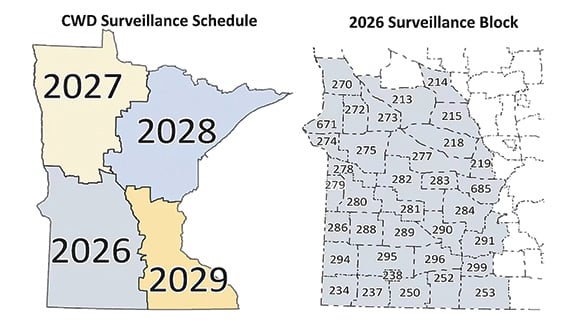
Minnesota DNR reminds firearms deer hunters to prepare for CWD sampling
Sampling is mandatory for southwest Minnesota the opening weekend of firearms deer season Nov. 7-8

Short on walleyes, but long on muskies: Beers Lake in Minnesota’s Otter Tail County
Otter Tail County’s Beers Lake is an excellent walleye fishery – nope. Beers is loaded with good-sized panfish and northern
