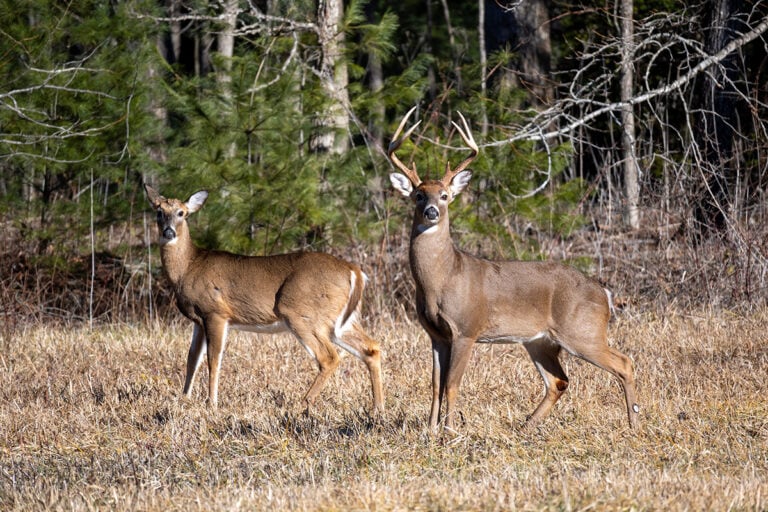
More than 400,000 deer hunters are preparing for the firearms deer season, which opens Saturday, Nov. 4. The season offers opportunities to spend time outdoors with friends and family, find adventure, and put venison in the freezer.
Deer hunting is the primary tool used to manage deer populations, and hunters help keep deer numbers in line with population goals across the state. Managing deer populations contributes to the overall health of Minnesota’s landscapes, natural systems, and economy.
The Minnesota DNR’s wildlife managers report that there should be good opportunities to harvest deer in most areas.
Hunters should know the deer permit area number for where they plan to hunt prior to buying a license and ensure they understand chronic wasting disease regulations and sampling options for that area. Hunters can find these details by using the DPA lookup tool at: mndnr.gov/deerhunt
Deer hunters are required to have deer 1 year or older sampled for CWD in all CWD management and surveillance zones during the opening weekend of the firearms A season, Saturday, Nov. 4, and Sunday, Nov. 5, and during late CWD hunts slated for Friday, Dec. 15, through Sunday, Dec. 17. Additional information about CWD requirements and sampling options can be found on the DNR’s CWD webpage.
Southern deer report
Deer populations are increasing in southern Minnesota, and deer fared well during the winter.
River floodplains offer some of the best deer habitat and deer hunting in southern areas of the state. Following several years without a major flood, vegetation in these floodplains has grown to the point of offering excellent cover for deer – which bodes well for deer hunters. Large areas of grass with embedded wetlands are also prime deer habitat, and if water levels stay low, hunters will have easier access to this type of habitat.
RELATED STORIES FROM OUTDOOR NEWS:
Minnesota’s firearms deer forecast: Many factors will affect how hunters fare
Rule the rut: Six tips to make this your best November ever
Want a chance at great prizes? Take part in Outdoor News’ annual Best Buck Contest
Hunters in the southern part of the state will have increased opportunities to harvest deer, following the 2021 public deer population goal-setting process. The goal-setting process increased harvest opportunities in response to growing deer populations in southern areas.
Central deer report
Deer populations remain robust and highly productive in central Minnesota, and deer also fared well during the winter.
Deer have been feeding on a bumper acorn crop this year. If dry conditions persist, hunters will continue to have easier access to wetland habitat.
Hunters may harvest as many as three deer in many DPAs in central Minnesota, and as many as five deer in CWD management zones. To help manage deer populations, wildlife managers encourage hunters to take advantage of opportunities to harvest antlerless deer.
Hunters also should be aware that DPA 344 was redesignated as DPA 644 after CWD was detected last year on private land near the Whitewater Wildlife Management Area. Additionally, DPA 643 near Rochester has expanded to include DPA 343 after CWD was detected in the area.
Northeastern deer report
Deer populations in many northern areas of Minnesota are still struggling to recover, following back-to-back severe winters.
During severe winters, thermal cover and forage availability become more important. In deep snow, deer have more difficulty moving around and become more susceptible to predation. The best deer harvest opportunities in the northeast part of the state will be in the southern portion of this region, where deer numbers are higher and not affected by winter weather to the same extent as permit areas farther north.
The highest deer numbers are expected in areas of mixed habitat of open fields and forest. Scouting for local pockets of deer will improve hunter success. Hunters in far northern areas will again have fewer opportunities to harvest antlerless deer, and in some areas will be allowed to harvest only bucks. This will give local deer populations in these northern areas a chance to grow where their numbers are below goals established in the public deer population goal-setting process.
DPAs 604 and 679 are CWD management zones where hunters must follow mandatory CWD testing requirements the opening weekend of firearms A season, Nov. 4-5, and carcass movement restrictions. The city of Grand Rapids hunts also have mandatory sampling of all deer 1 year of age or older taken in any season.
Northwestern deer report
Deer populations are mostly stable in northwestern Minnesota. While last winter was moderate to severe in some areas, especially around and north of Bemidji, the deer population fared well during the winter throughout most of the northwestern part of the state.
Deer have been feeding on a bumper acorn crop this year. In low-lying areas, if dry conditions persist, hunters will have easier access to ditches and wetlands.
Many DPAs in northwestern Minnesota have two- or three-deer harvest limits, and in DPAs 111 and 203, hunters are allowed to harvest only bucks. Some DPAs have lower harvest limits because of concerns about the past two winters’ effect on local deer populations, and the lower deer limits will give deer populations a chance to grow in these areas.
Hunters should also know that CWD sampling will be mandatory during the opening weekend of the regular firearms deer-hunting season in parts of three areas of the region, including the East Grand Forks-Crookston-Climax area in DPA 661, as well as the Bemidji area in DPA 684.
This year, mandatory CWD sampling will also occur in northwestern Minnesota’s elk range in parts of Kittson, Marshall, and Roseau counties. Although CWD has not been detected in these areas, the DNR is sampling there to assess the risk of disease in local deer and elk.
More deer-hunting information is available on the Minnesota DNR’s deer-hunting webpage.