




Outdoor News may earn revenue from products shown on this page by participating in affiliate programs. This comes at no extra cost to you. Click here to learn more.
After several pairs of binocular lenses, I started to wonder if I should buy a monocular. My interest stemmed from wanting to supplement my brush gun, which has a 4X scope.
Hikers like to carry a monocular. I can see the benefit of having one in a kayak to identify birds in the tree canopy or animals dipping in and out on the bank, such as migrating warblers or a mink.
The problem I have with binocs is the weight on my neck. Even with the newer, lighter models and a wide strap, I find myself not hanging it on my neck.
Using a chest pack would alleviate this, but does not change the basic design – two tubes connected by a bridge. Aligning the tubes with each eye and then sharpening the focus of each tube offsets the difference in vision of my left eye to the right. It can be fine-tuned with a bit of effort.
If dragging binocs out of a backpack and dialing in stereo focus is an issue, a monocular could be the answer. Seeking outside opinion, Outdoor News contacted Richard Moncrief with Zeiss and Cameron Derr with Hawke Optics for the industry perspective.
MORE GEAR COVERAGE FROM OUTDOOR NEWS:
Eric Morken: Gear that stood out from the 2025 hunting season
Better understand your hunting optics to get better performance
Try these three ‘topwater titans’ for river smallmouths
According to Moncrief, a monocular has some desirable advantages, but of course some limitations as well. Fairly compact and easy to work with, these are advantages for someone looking for an optical aid, but it is not the primary tool for what they are doing, such as hunting, hiking, or boating.
In general, the real utility of a monocular is space and weight considerations. Moncrief takes frequent rails-to-trails journeys. On these adventures, due to weight and space restrictions, he prefers to carry a smaller monocular for the times he wants to stop intermittently to look at birds or other nature views. It’s a benefit for those times when the higher performance of binocs is not necessary.
As with binocs, a monocular comes in all sorts of magnifications and objective sizes. Many monoculars are basically just half the optic and the housing.
The limitation of using one optic is having two eyes. The image you are sending to your brain is not given the full advantage of the two optical systems in a binocular.
Another advantage of a binocular is the ergonomics – being able to steady with two hands. This can sometimes be a little awkward with a monocular.
To sum it up, a quality monocular will still yield a useful image and has a place in the outdoors. The priority depends on the job that the end user wants. Like any working tool you consider, size up your use to decide what you need.
Most of what Derr said agreed with Moncrief, including their parallel comments about giving up stereoscopic vision and some of the finer details in your depth of field. I agree, in principle, but do not accept this concern at face value; it is not as bad as it sounds.
A monocular is like looking through a rifle scope or a spotting scope. Loss of finer details in the depth of field has never crossed my mind. Those purchasing a monocular do so to gain a lighter, smaller, quicker means to glass quarry with the same aperture and magnification benefits of a binocular. It’s a perk for anyone having to distance-carry all that they need afield or while traveling in aircraft with weight or size limits.
Options to choose from
To help you decide if a monocular will benefit your next adventure, here are a few general-purpose models:
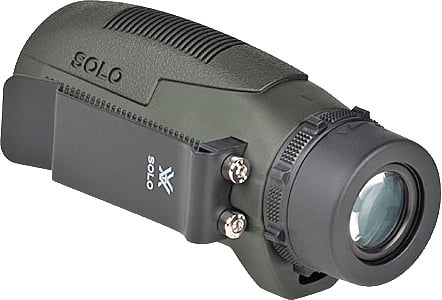
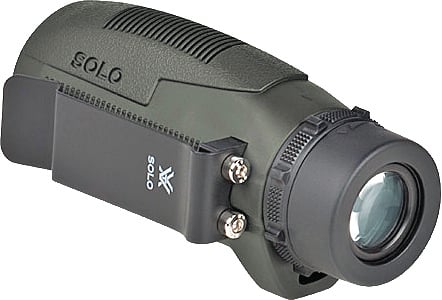
Vortex Solo
Starting with perhaps the most popular model through sales and reviews, the Solo represents a straightforward means to look through a magnified lens.
Magnification 10x
Objective lens 36mm
Field of view 325 feet @ 1,000 yards
Length 4.9 inches
Weight 9.3 oz
MSRP $189.99
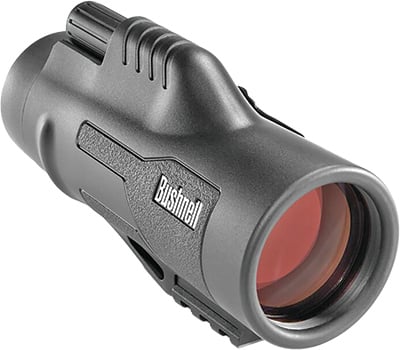
Bushnell Legend Ultra
The Legend Ultra has a focus wheel on top for index finger adjustment and a ¼-20 adapter for tripods or a window mount.
Magnification 10x
Objective lens 42mm
Field of view 340 feet @ 1,000 yds
Length 5.4 inches
Weight 13.2 oz
MSRP $199.95
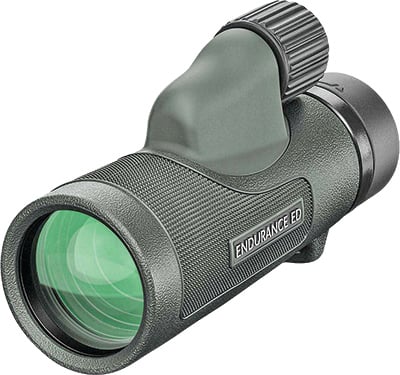
Hawke Endurance ED
Another option with high grip, wheel adjustment above, coated lens, tripod compatible, and rubber coated exterior.
Magnification 10x
Objective lens 42mm
Field of view 304 feet @ 1,000 yds
Length 5.6 inches
Weight 11.5 oz
MSRP $164.00
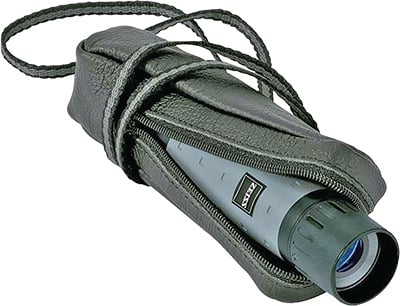
Zeiss Mono 10×25 T*
Not only one of the lightest, the Mono is designed to double as a magnifying lens that can be attached to a binocular tube, turning the binocular into a spotting scope. The T* represents the proprietary lens coating for brilliance and contrast. The diopter adjustment is +/- 4 diopters.
Magnification 10x
Objective lens 25mm
Field of view 264 feet @ 1,000 yds
Length 4.7 inches
Weight 2.7 oz
MSRP $399.99

Is this the year that Minnesota deer harvest pushes past 200,000?
When it comes to the state of the whitetail herd in Minnesota, winter is always a top topic of conversation.

That’s no grouse: Minnesota hunter’s Brittany points an emu afield
Autumn for hunters means scouting for deer and flushing birds, but some Minnesota hunters unexpectedly found something a bit more
Commentary: Minnesota Duck group responds to column about Citizen’s Conservation Advisory Council
Commissioner Sarah Strommen’s recent column in Outdoor News is worth reading carefully – not because it argues against the Citizens’
