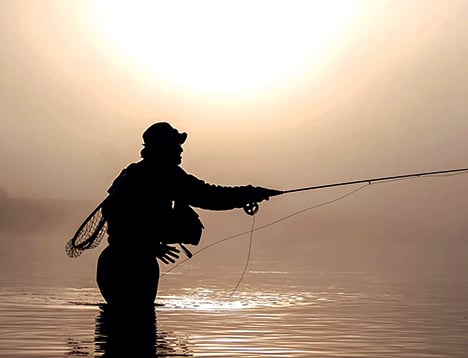
The first few warm days of the year are enough to get me out on the water with a fly rod. It almost never works out as I hope, most likely because of my own impatience.
Early spring is a season of contradiction for warm-water fly anglers. The air softens, days lengthen, and the urge to fish returns – but beneath the surface, species like largemouth bass, smallmouth bass, and bluegill are still governed by winter’s inertia.
Success in this period belongs not to those who fish harder, but to those who fish slower, deeper, and more deliberately, matching both the biology of the fish and the limited food web available to them.
Water temperature is the central driver. Even after several warm days, lakes and rivers – especially in a state like Michigan – retain cold from winter. In these conditions, warm-water species experience reduced metabolic rates. They do not need to feed often, nor are they inclined to chase prey. Instead, they position themselves in deeper water, along drop-offs, near submerged timber, or in darker-bottomed areas that absorb heat.
The angler who continues to fish shallow weed beds or employs fast, aggressive retrieves is often casting over inactive fish or presenting offerings that demand more energy than fish are willing to expend.
The early spring food web reinforces this lethargy.
FISHING FEATURES FROM OUTDOOR NEWS:
Inside the Bassmaster Classic: Five days at the ‘Super Bowl’ of bass fishing
Steve Carney: Keys to incredible April walleye fishing on the Missouri River
Fish the ‘pocket’ water: Where overlooked runs hold big trout potential
Aquatic insect activity is minimal, baitfish are sluggish, and amphibians are largely absent. What remains are a handful of cold-tolerant prey: leeches, overwintering minnows, dormant crayfish, and large nymphal forms such as dragonfly larvae. Consequently, the most effective fly patterns are those that imitate these organisms – not in their peak activity, but in their slowest, most vulnerable states.
Among all patterns, the Woolly Bugger stands as the most versatile and productive early-season fly. Its suggestive profile can represent a leech, a small baitfish, or even a crayfish, depending on how it is presented. In black, olive, or brown, and tied in sizes No. 6-10, it excels when fished slowly along the bottom with long pauses. The key is not motion, but suggestion; the fly should appear alive, yet barely so.
Leech patterns, particularly those tied with marabou or rabbit strips, are equally effective and perhaps even more faithful to early-season conditions. Leeches remain active in cold water and provide a high-protein, slow-moving target. Patterns such as bunny leeches or mohair leeches should be fished with minimal movement – often little more than the natural undulation imparted by the water itself.
Where baitfish are present, the Clouser Minnow is a reliable option, especially in white/chartreuse or olive/white. However, its effectiveness depends entirely on restraint. In warmer months, anglers might strip this fly aggressively, but in early spring it should be allowed to sink deep and retrieved with subtle twitches and extended pauses, mimicking a lethargic or dying minnow.
One of the most underutilized yet deadly approaches in this season is the use of balanced flies – balanced leeches or minnows suspended beneath an indicator. This technique allows the fly to hover horizontally in the strike zone, requiring almost no movement from the fish. In cold water, where even a short chase may be too much effort, this static presentation can outperform more traditional retrieves.
Bottom-oriented prey also plays a critical role. Crayfish patterns in rust, olive, or brown can be effective when crawled slowly along the substrate. Although crayfish are not highly active in cold water, they remain an energy-rich target, and fish will opportunistically feed on them when the presentation is slow and close to the bottom.
Similarly, dragonfly nymph patterns – large, bulky, and slow – offer a substantial meal that appeals to fish looking to maximize caloric intake while minimizing effort.
There are days, particularly following cold fronts or during prolonged chilly periods, when even these offerings may seem too large or too active. In such conditions, downsizing becomes essential. Traditional trout nymphs – Hare’s Ear, Pheasant Tail, or soft hackles in sizes No. 10-14 – can be surprisingly effective for bass and panfish. Fished under an indicator or with a slow hand-twist retrieve, they imitate the small, sparse food sources available and can entice otherwise inactive fish.
Only as water temperatures begin to climb into the upper 50s does the possibility of more aggressive feeding emerge.
During these narrow windows – often in the late afternoon on sunny days – small streamers or even modest topwater patterns may produce. Yet even then, restraint remains critical. A popper left motionless for 10 or 20 seconds between subtle twitches can outperform one fished with constant action.
Ultimately, early spring warm-water fly fishing is an exercise in patience and observation. It demands that anglers abandon the rhythms of summer and adopt a slower, more methodical approach.
Fly selection is less about matching a hatch and more about matching a mood – one defined by cold water, limited energy, and opportunistic feeding.
Those who succeed are those who understand that in early spring, the best fly is not merely the most realistic, but the one presented with the greatest restraint.