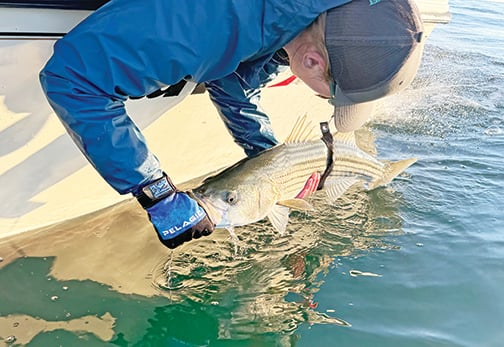
Amherst, Mass. — While there are only four official seasons in the year, anglers in the Northeast recognize a fifth: striper season, the months from May to November when striped bass, which can grow up to 100 pounds and are renowned for their fight once hooked, migrate along the coastal waters between the Chesapeake and Canadian Maritimes within range of thousands of fishing lures.
But the fishery, which generated approximately $13 billion in economic activity along the Eastern seaboard in 2016, is crashing, despite the fact that the vast majority of bass caught by recreational anglers are released back into the ocean.
A pair of recent papers, led by biologists at the University of Massachusetts Amherst and published in Fisheries Research and Marine and Coastal Fisheries, sought to comprehensively pinpoint which catch-and-release fishing practices pose a considerable risk to striped bass, and to show that there’s a mismatch between what anglers know about catch-and-release best practices and how this knowledge translates into action once on the water.
“Striped bass are one of, if not the most sought-after species of fish in New England and the Eastern seaboard,” said Grace Casselberry, a postdoctoral researcher at UMass Amherst and one of the principal authors of the two recent studies. “Especially in Cape Cod, where we conducted the majority of our research, stripers are an integral part of the local industry and culture.”
MORE FISHING COVERAGE FROM OUTDOOR NEWS:
Three in running for Pennsylvania’s River of the Year designation
What to know if heading south for winter angling
Grayling stocking gets a boost from Michigan DNR and partners
Despite their popularity, “many orders of magnitude more stripers are caught by recreational anglers than commercial fishers,” said Andy Danylchuk, professor of fish conservation at UMass Amherst and the paper’s senior author. And because of conservation and management measures meant to maintain or even rebuild striper stocks, not all that are caught are kept.
Although a growing proportion of stripers are thrown back by anglers, the fishery is in danger of collapse. To determine the reasons, the UMass team sought to examine not only the effect of catch-and-release fishing on the stripers, but also get a detailed look at how anglers handle the fish.
Teaming up with guides, fishing clubs and fishing tournament contestants – “research anglers,” Danylchuk calls these rod-toting community scientists – lead author Olivia Dinkelacker, who completed this research as part of her master’s research at UMass Amherst, Casselberry, Danylchuk, and their coauthors caught 521 striped bass over two years using a variety of conventional equipment and lures, from flies and flyrods to surfcasting rigs and long, fishlike lures dangling with three-pronged treble hooks.
The team measured how long it took to reel the striper in once it was hooked. Once landed, they gave it a quick set of reflex tests – a good prediction of fish stress and potential mortality – which would be repeated just before release. The stripers were divided into groups that remained out of the water for 0, 10, 30, 60, and 120 seconds before being thrown back.
This was the first time that air exposure was scientifically and systematically tested to see its effects on striped bass.
A subset of 37 fish were fitted with a “triaxial accelerometer biologger” velcroed to them and attached to fishing line. They were allowed to swim free for 20 minutes, then the team would retrieve the loggers and record the data, such as the fish’s acceleration and distance it swam.
They discovered that air exposure was the most significant factor influencing striped bass stress and post-release swimming activity. Higher water temperatures, fighting for longer periods of time, and getting hooked somewhere other than in the jaw all increased their recovery time.
Fish released immediately or after only 10 seconds retained most of their reflexes and recovered quickly.