





Gary Huber has seen it many times. Actually, he’s heard it many times when he answers his phone and on the other end of the line is a hunter, often desperate, in need of his licensed leashed tracking dog services.
Huber’s nonprofit group, Deer Search of WNY, Inc. is a 100% volunteer organization dedicated to helping hunters recover wounded big game, deer or bear, with the use of leashed tracking dogs. He and the approximately 20 handlers that comprise his group are all licensed through New York State.
Loving what they do, and doing so with their dogs, they’re often ready to go afield and help hunters in need of their expertise. At the same time, however, Huber says there is a growing trend among hunters to perhaps act in haste, and in a number of unnecessary ways.
First, hunters often pursue wounded big game animals too quickly, rather than practicing patience. Next, they turn to people like Huber and his tracking dogs without giving it their own best effort. Huber said he would like to see hunters simply become better at blood trailing.
“They’re not using their blood-tracking skills that you’re supposed to develop,” Huber said. “I call it ‘completing the circle.’ If you’re a hunter, you should know how to blood track, because that’s the tail end of it. You need to know how to do it.”
Huber and his Deer Search cohorts put their money where their mouth is, offering to train hunters on blood trailing in an effort to not only help them find animals they’ve shot on their own, but to do so in the proper manner.
“We’d like to educate hunters first before they call us,” Huber said. “So we like to call ourselves ‘the agency of the last resort’ because you have to understand, we’re volunteers.”
MORE WHITETAIL COVERAGE FROM OUTDOOR NEWS:
Video: Scouting for whitetails after storm alters years of intel
Should you shoot single-bevel broadheads? Here’s what to consider
Don’t push them
Huber believes many hunters get on the track too quickly, especially with white-tailed bucks.
“One of the number one things you don’t want to do is push your deer. When in doubt, back the hell out,” he said. “That seems to be the most common mistake hunters make.”
Huber advocates that, weather permitting, time is on the hunter’s side and offers some advice to hunters who may be on the fence about leaving a deer overnight because it could be lost to coyotes.
“Once you push that deer out – this is what happens – and I get a lot of guys, they’re like in tears. They got this magnificent buck they shot. ‘You’ve got to come out tonight because of the coyotes, please come tonight. They’re gonna tear this deer up,’” Huber said of the calls.
“You know, and they probably will,” he added of coyotes. “I mean? 20 years ago I didn’t even talk about coyotes. Now, I feel sorry for these guys, but I tell them ‘if I come in there too soon and I jump your buck in its bed, what do you think is going to happen?’ Now the deer has got a scent trail that’s three, four, maybe five times longer for the coyotes to find.”
Hair and blood
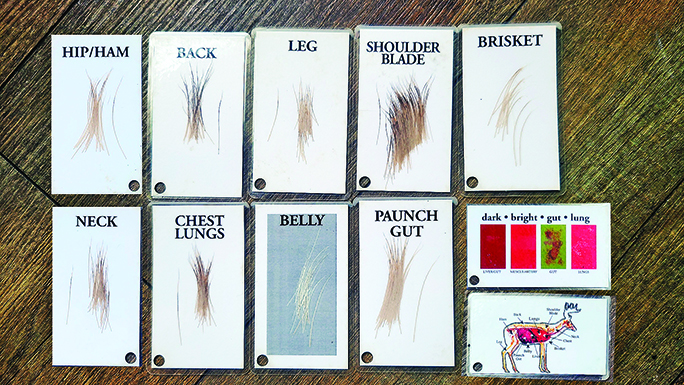
Next, Huber says hunters need to learn how to read sign such as blood and hair identification. One of his personal tools for this is hair samples and blood photos he’s organized on matted key chains that can be taken afield (see accompanying photo above).
“Know the different colors, of blood, know deer hair,” he said. “Everybody thinks that deer hair is brown and it’s not. When you take hair from different parts of a white-tailed deer, you’ll see that. If I find the hair, I can say ‘this is where you hit the deer.’ Within a couple of inches anyway.”
Bear tracking
Huber said the dogs owned by the handlers in Deer Search are quite capable of finding bears as well. But some things are a little different when it comes to bruins.
“If you watch real close, and when you take a new dog and you put them on a bear for the very first time, I’ve noticed the same reaction,” Hubert said. “Every dog that I’ve owned and trained, and other handlers have told me the same thing, is the first time they’re introduced to a bear, it seems like they’re very cautious and a lot of times you’ll see the hackles on their back come up. But then all of a sudden they understand what you want out of them to do.”
Huber said bears actually are more odiferous to a dog than deer, making them easier to find, but they can cover some ground.
“They go farther,” he said. “I can tell you, they’ll go miles before they die. Where deer only go a certain distance before they take a bed, bear seem to go a lot further.”
Education
Deer Search is hosting a blood-tracking seminar Saturday, Aug. 30 at the Springville Field and Stream Club, in Erie County, N.Y. The program will teach hunters how to handle situations after the shot is taken and will feature an in-depth look at the process of finding big game without a dog.
Hunter education instructors are encouraged to take part. For more information, call 716-648-4355.
To learn more about Deer Search of WNY, Inc., including what’s involved in becoming a licensed leashed tracking dog handler, visit here.
Illinois bow season opens Oct. 1 with few changes
The DNR has floated the idea of establishing additional Restricted Archery Zones in other parts of the state, but this

Dan Small Outdoors Radio: Show 2139
Lake of the Woods fall fishing is on fire. Prepare now to bowhunt the rut. Expert tips for recovering a
$10,000 bond set for Wisconsin deputy in shooting that injured turkey hunters
Bond was set at $10,000 for the Racine County Sheriff’s Department deputy who faces four felony charges after his 3-year-old
