




Madison — Wisconsin’s hunters, trappers, and anglers will likely have mixed reactions to the new state budget that was hurriedly put together by the Legislature’s Joint Finance Committee (JFC) and signed by Gov. Tony Evers on July 3.
Quick action and signing were necessary for the state to receive more than $1 billion in federal Medicaid that would have been lost if the state budget were signed after the new federal budget was signed the following day.
In Wisconsin’s new budget, outdoor enthusiasts did not get a requested increase in fees for hunting, trapping and fishing licenses, nor did they get a continuation of the Knowles/Nelson Stewardship Program. The original budget proposed by Evers included increases in all licenses, most in groups of $10, $20, and $40 amounts for different licenses to address an existing structural deficit in the DNR’s Fish and Wildlife Account.
Evers wrote that the increases would “ensure critical conservation and habitat management projects can continue.”
The JFC did not include license increases in the final budget, but instead transferred $30 million from the DNR forestry account to the fish and wildlife account over the biennium to make up for absence of a fee increase.
JFC members wrote that the transfer was intended to stabilize the fish and wildlife account through the new biennium.
Cody Kamrowski, Wisconsin Wildlife Federation executive director, said he understood that the legislature is waiting for an audit of the DNR’s fish and wildlife account to come out before settling on license fee hikes.
“Our organization is happy with the temporary funding of the shortfall which allows the DNR to continue doing the work that needs to be done,” Kamrowski said.
MORE COVERAGE FROM WISCONSIN OUTDOOR NEWS:
Victim in stable condition as Wisconsin DNR continues investigation of black bear attack
Should you shoot single-bevel broadheads? Here’s what to consider
Important features to look for when buying a gun safe

However, the extra funding from the DNR forestry account is temporary. Kamrowski said people are champing at the bit to focus on long-term sustainable funding. Kamrowski will reconvene a committee of outdoors groups to study the audit report and work with legislators to come up with recommendations.
Evers had included renewal of the Warren Knowles/Gaylord Nelson Stewardship Program. Evers’ proposal was for 10 years from 2026-27 through 2035-36 with an annual allocation of $100 million of bonding authority.
The JFC eliminated the program from Evers’ proposed budget. It will end in 2026 unless a new bill is passed that might renew it for a shorter period.
Specific programs
According to the DNR, specific financing for fisheries, wildlife and law enforcement functions has not yet been released by the Legislative Fiscal Bureau.
But known to be new this time are game warden overtime funding and funding for ATV and UTV trail maps.
According to the latest figures from the DNR, its overall budget for the two-year budget will be $1.2 billion, compared to Evers’ proposed budget of $1.4 billion.
In the past two-year budget, the DNR had 2,540 full-time positions. In Evers’ proposed budget the DNR would have lost 56 positions; the JFC budget eliminated 66 positions.
Also included in the approved budget, according to the governor’s office, are:
• $5 million from segregated fees in ongoing funding for the development of parks and trails across the state park system;
• Fee increases to support operations and property development at state parks and forests (a $5 increase for nonresident campsite reservations and a $10 increase for electric campsites at Devil’s Lake, High Cliff, Kohler-Andrae, Peninsula and Willow River state parks);
• A $5 increase for electric campsite reservations at all other DNR properties;
• An increase to nonresident vehicle admission rates including a $9 increase for nonresident daily state park admission, a $10 increase for nonresident daily bus admission, a $4 increase for nonresident daily nursing home bus admission and a $12 increase for nonresident annual admission stickers;
• $458,900 in each year of the biennium to invest in technology to improve visitor experience and staff efficiency;
• $1 million to the DNR to award a grant to conduct a forestry industry strategic plan to help ensure the long-term economic viability of Wisconsin’s forestry industry;
• $250,000 in each year for the county forest administration grant program to support salaries for county forest administrators (up to 50% of salary and benefits for county forest administrators and assistant forest administrators may be covered by the grant program, supporting Wisconsin counties in their forestry activities and planning);
• $250,000 each year for the Sustainable Forestry Grant Program to support sustainable forest management projects on county forest land, such as storm-related projects or hiring temporary staff to address short-term workload projects;
• $130,000 in each year for the County Forest Wildlife Habitat Grant Program to support habitat improvements and management on county forests;
• $1.2 million in fiscal year 2025-26 and $1 million in fiscal year 2026-27 as one-time funding for fire suppression equipment for the DNR;
• $2 million in fiscal year 2025-26 and $2 million in fiscal year 2026-27 as one-time funding to be used to contract for the removal of hazardous trees on DNR properties, the volume of which has increased due to severe weather, invasive species and tree diseases;
• $2 million in fiscal year 2025-26 for an action plan to remediate arsenic-contaminated sediment in the Kewaunee Marsh;
• $6 million in bonding for the Kenosha Dunes project;
• Over $24 million from all fund sources to renovate conservation warden facilities at Devil’s Lake State Park, the Richard Bong State Recreation Area, along with the Spring Green and Wausaukee ranger stations, and to make trail repairs along the Badger State Trail.
Not in the budget
DNR staffing for CAFO monitoring and oversight was not included in the JFC budget, nor was a proposed tribal liaison position. Another $3.7 million for DNR wolf monitoring efforts and aids to livestock producers for nonlethal abatement projects in locations with persistent wolf activity was pulled from the budget by JFC. Community grants and innocent landowner remediation for PFAS were removed by JFC.
Other items that had been proposed by the governor but were not included in the final budget include: Funding for regular replacement of game warden Toughbook computers; law enforcement radios; warden vehicle routers; patrol boat replacement; body camera funding; taser unit upgrades; habitat planning IT updates; state fish hatchery funding increases; tribal fish hatchery funding; creel survey funding; Lake Winnebago System staffing increase; and deer carcass disposal site funding.
Future ideas
Kamrowski has talked with legislative auditors who predict the audit of the DNR Fish and Wildlife Account will be completed by late summer or early fall. He believes Wisconsin has a strong conservation community and that most people can understand there has been 60% inflation since the previous license increase in 2005, and that this is eating away at the DNR budget.
Kamrowski also believes that the non-consumptive population understands the importance of paying for conservation activities and are willing to work on some opportunities to provide financial assistance.
One of the programs that helps in other states is using general tax revenues to offset the discounts that legislators have offered to many license buyers, such as first-time hunters and anglers, veterans, spouses, and those participating in learn-to-hunt programs. These discounts add up to a loss of about $17 million annually to the DNR’s Fish and Wildlife Account. By passing a law that would reimburse this amount to the DNR from state tax revenues, the change would allow the general population to have input in paying for conservation activities.
Kamrowski believes this could be one of several approaches needed to help fund the DNR’s workload.
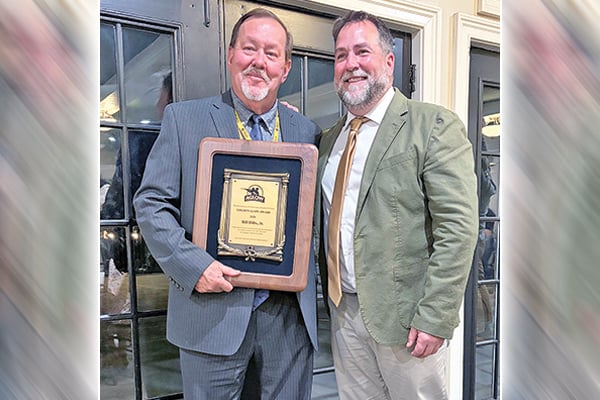
New York Outdoor News’ Bill Hilts honored by outdoor writers group
Long-time New York Outdoor News contributing writer Bill Hilts Jr. was recently honored by the Association of Great Lakes Outdoor
New York rut tracker: The hunter’s moon
The second of a four-part series in New York Outdoor News chronicling the whitetail rut.
Advisory group to youths rebrands as Outdoor Mentors
A mentoring group has unveiled a shorter name as part of a shift in identity that includes a new logo

1 thought on “Joint Finance Committee eliminates hunting, fishing license fee hikes in Wisconsin”
Getting tired of legislature thinking they know how departments of the government should be run. No CAFO funding?? Who’s checking on water quality around these facilities! Knowles/Nelson no funding. Up north we rely on the tourism dollar, that money keeps land open for folks to enjoy. It’s asbole bullshit