





Crete, Ill. — A swallow-tailed kite was reported in Crete, the latest rare-bird sighting in a string of them in the state this year.
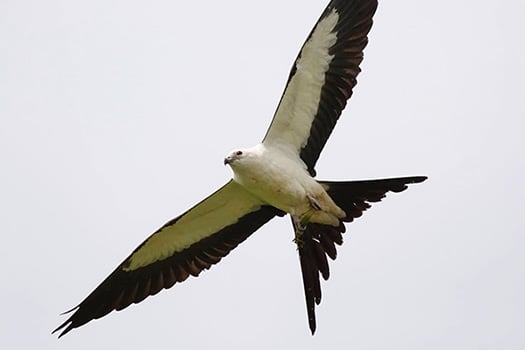
A photo of the swallow-tailed kite was posted to the Forest Preserve District of Will County’s Wildlife group on Facebook by Kara Senders Morales of Joliet. According to the Forest Preserve, eBird maps recognizes the sighting as only the second in Will County. The previous sighting came in 2024, when one was spotted in and around Hadley Valley.
“This bird is far outside of its normal range, considering swallow-tailed kites spend the summers in the southeastern United States, primarily in Florida, then migrate south to South America for the winter,” the Forest Preserve posted on its website. “These raptors have been described as ‘the coolest bird on the planet,’ and they are easy to identify due to their bold black-and-white plumage.”
Morales said in a post in the Will County Wildlife group that she can tell this is a juvenile swallow-tailed kite due to its shorter tail.
MORE COVERAGE FROM ILLINOIS OUTDOOR NEWS:
Illinois hunters anxious as report shows mallards drop
Midewin Opens Additional Acres to Deer, Turkey Hunting for 2026 Season
Wilmington, Ill. — Midewin National Tallgrass Prairie is opening additional areas to hunting, starting with the deer hunting seasonon Oct. 1. In previous years, hunters were restricted to an assigned zone. Starting with this fall’s deer hunting season hunters will no longer register for a zone with each visit but will have access to approximately 17,000 acres that are open to the public. Maps of the new areas will be available at the Welcome Center.
“We are happy to expand opportunities for the public to enjoy their public lands,” said Robert West, Midewin NTP’s Prairie Supervisor. “As with everything we do, safety is our top priority. Opening new areas to hunting don’t change hunters’ responsibility to hunt in a way that’s safe for everyone.” Deer archery season runs through Jan. 17 with breaks for firearm deer season.
All visitors, including hunters, are reminded to park at trailheads and designated areas without blocking gates or access points. All 30 miles of trails at the prairie are non-motorized, with 22 miles being multi-use for hiking, biking, and horseback riding and eight miles are pedestrian only. The Waubonsee Glacial Trail, which runs along the eastern edge of Midewin, is controlled by the Will County Forest Preserve which strictly prohibits firearms, bows, and hunting on its land. Midewin trails will remain open through all hunting seasons.
Group: USFWS Lost 36% of Staff Since 2024
Portland, Ore. — The Center for Biological Diversity issued a news release Sept. 2 declaring that the U.S. Fish & Wildlife Service has lost 36% of its staff under the Trump administration, dropping from 9,957 to 6,333 total staff between 2024 and 2026.
The center obtained staff rosters for the USFWS for 2024 to 2026 through the Freedom of Information Act. The 36% loss of staff is double what CBD reported last year. That increase likely reflects staff who accepted early retirement offers in spring 2025 but who were still paid through last September and thus still found on last year’s roster.
National wildlife refuges that were already understaffed are being neglected, harming wildlife and their habitats, the CBC said. Per the release, the agency lost more than 1,900 scientists, including fish and wildlife biologists, foresters and fire managers.
Court Blocks BLM Order to Remove American Prairie Bison from Public Lands
Great Falls, Mont. — A federal judge has granted American Prairie’s request for a preliminary injunction, blocking the Bureau of Land Management from enforcing its order requiring American Prairie to remove its bison from three federal grazing allotments in northeastern Montana while the organization’s lawsuit proceeds.
The Sept. 4 ruling by U.S. District Judge Brian Morris allows American Prairie’s 900-plus bison to remain on the three allotments in Phillips County, where they currently graze, while the court considers the underlying legal challenge. The injunction does not resolve the case on the merits, but Morris found that American Prairie has demonstrated a likelihood of success on its claims.
At the center of the case is whether the Taylor Grazing Act limits federal grazing permits to livestock operations focused on commercial production of food and fiber. BLM relied on that interpretation when it revoked American Prairie’s bison permits in May and ordered the nonprofit to remove its bison from federal public lands. The court rejected that interpretation at this stage, finding that American Prairie’s bison qualify as livestock under the Taylor Grazing Act.
EPA Floats More Rollbacks to Clean Water Act
Washington — The Environmental Protection Agency and the U.S. Army Corps of Engineers announced more potential changes to the definition of “waters of the United States” under the Clean Water Act, putting safeguards against pollution for a majority of America’s wetlands and streams on the chopping block and triggering a new 30-day public comment period.
The Supplementary Notice of Proposed Rulemaking expands on a hotly contested proposal from November 2025 that would significantly narrow which waters qualify as “WOTUS” under the CWA, a landmark bill that regulates pollution in America’s waters. If the administration’s new proposal goes through, millions of acres of wetlands would lose the CWA protections they have long enjoyed.
Some estimates put the portion of America’s wetlands that would lack safeguards under the new CWA at 94%, due to one part of the proposal that would limit CWA protections to wetlands with standing water during a “wet season,” a phrase that opponents say would introduce more uncertainty.

Illinois Letters to the Editor: Fishermen who care might want to chime in on live sonar issues
Reader-submitted letters to the editor published in the Sept. 18, 2026 edition of Illinois Outdoor News.

New York’s Saratoga Sand Plains WMA is Northern Zone hunting with a Southern Zone feel
Saratoga County, in eastern New York, is roughly 844 square miles in size. About half of the county’s acreage lies
New York’s Outdoor Calendar
A look at upcoming outdoors-related events from across New York published in the Sept. 18, 2026 edition of Outdoor News.
