




St. Paul. — One-third of Minnesota’s deer permit areas will receive increased harvest opportunities for the upcoming season, along with other changes to this year’s deer hunting regulations.
David Trauba, wildlife section manager for the DNR, told Outdoor News he’s optimistic for the 2026 season. Aside from the northeast Arrowhead Region, he said last winter was relatively mild and the DNR is hearing positive reports about deer productivity.
Looking ahead to the deer season structure, Trauba said hunters will have lots of opportunity to get their deer.
“We had areas that were formerly lottery that moved into a two deer type situation, and areas that moved from two to three deer. I think the deer herds are in good shape,” Trauba said. “Statewide, in broad brush, we’re providing more opportunity, but the far northern part of the state, I do think we still have some bucks-only areas.”
The northeast remains below its desired population goal. Trauba said deer numbers there are still recovering from a few harsh winters. The region also has a higher density of predators and forest-related challenges.
Trauba recommends hunters review the regulation changes before the season to ensure they are compliant and have a plan before heading into the woods.
“There’s going to be some bumps in the road. There’s going to be some new tools folks are going to have to learn,” Trauba said. “Take the time to do that well before the season, and not at 12 midnight before opening day.”
MORE COVERAGE FROM MINNESOTA OUTDOOR NEWS:
USFWS seeks public comment on setback rules for drain tile
Massive heat wave causes more fish kills across Minnesota
U.S. Forest Service reopening 41 Boundary Waters entry points on July 30
Increased harvest opportunity, lottery and special park hunts
The DNR increased harvest opportunities for hunters across the state, said Paul Burr, acting big game program leader. About two-thirds of the state’s deer permit areas will remain unchanged, while one-third, or 43 permit areas, received increased harvest opportunities.
Of those areas, 27 had an increased harvest designation, such as moving from one deer to two deer or from two deer to three deer.
“Then 15 of those DPAs have increased antlerless lottery permits,” Burr said. “We had no DPAs actually go down at all. Across the board, it’s either the same as last year or even increased opportunities throughout the state.”
Burr said the DNR uses a research model to monitor deer populations statewide.
The model shows an upward population trend, largely because of the mild winters experienced across most of Minnesota during the past few years.
Last year’s harvest totaled about 186,000 deer, Burr said, and surpassing 200,000 this season is not outside the realm of possibility.
Another change involves lottery permits and special park hunts. In previous years, hunters who applied for a lottery permit could not also apply for a special park hunt, and vice versa. This year, hunters may apply for both.
CWD changes, new reporting structure
Patrick Hagen, statewide disease response coordinator, said a couple of significant CWD changes will take effect this season.
Hagen said the DNR has confirmed the southeast has reached endemic status. The region surpassed the 5% threshold in DPAs 646, 647, and 648 two seasons ago.
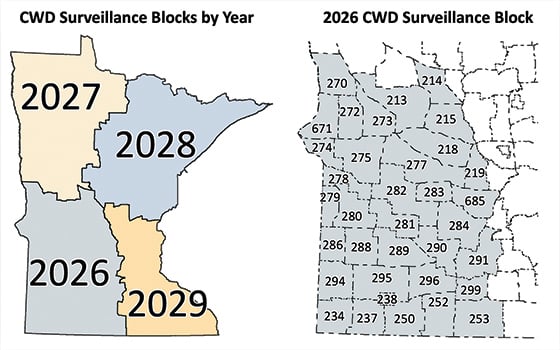
In response, the DNR will move to a rotational CWD surveillance strategy divided into four quadrants across the state. Each year, hunters in one quadrant will be required to have all deer they harvest during firearms opening weekend that are one year old or older tested for CWD.
“The southwest quadrant is where we’re going to start this year, and then we’re going to rotate every year until we get to that four-year mark and end up back in the southeast,” Hagen said. “We’re going to go clockwise around the state. We’re doing that for a number of reasons.”
First is the endemic status of the core southeast DPAs and the need for a more effective surveillance strategy. Hagen said the state also has not conducted a targeted surveillance effort in nearly 20 years in some areas. In addition, positive CWD findings have continued to appear outside existing management areas.
Under the new monitoring system, hunters within the surveillance quadrant will be required to submit samples from deer harvested in the opening weekend of the firearm season. Sampling elsewhere in the state will remain voluntary. Hagen encouraged hunters statewide to submit samples regardless of where they hunt.
The DNR also created one new CWD management zone for the upcoming season. DPA 285, west of the Twin Cities metro, will become DPA 685.
Carcass disposal
Hagen said the DNR is replacing carcass movement restrictions in CWD management zones with a carcass disposal rule. Hunters will be allowed to move carcasses from all deer harvested within a CWD management zone outside the zone under the condition that they must dispose of carcasses with their refuse hauler, at a local landfill or with a meat processor.
“What that does is it allows hunters to move carcasses outside of those management zones immediately, but every carcass, regardless of if it moves outside or not, has to be disposed of properly,” Hagen said. “There are several ways you can do that.”
Hagen said hunters may dispose of carcasses at a sanitary landfill, including through household trash collection, as long as the remains are bagged. Hunters also may take carcasses to a meat processor of their choice and are no longer restricted by CWD management zone boundaries.
Hunters also may transport deer heads to a taxidermist. However, because some portion of the spinal column remains attached, hunters are responsible for properly disposing of those remains.
Another option is to dispose of the carcass on the private property where the deer was harvested, provided the landowner allows it. If a deer tests negative for CWD, hunters may dispose of the carcass in any legal manner.
The DNR also is ending its CWD dumpster program in management zones.
“The decision that was made was multi-pronged. This change to the rule negates the need for that, but also that dumpster program was really climbing financially towards being not feasible to continue towards the future at the trend that it was going,” Hagen said. “We were looking for a way to be more fiscally responsible.”
Rifle vs. shotgun zones, crossbows
Two of the biggest changes this season involve statewide rifle and shotgun zones and the permanent expansion of crossbow use.
Minnesota counties voted on whether to allow rifle use or remain shotgun only during the deer season. Counties had until May 5 to submit their decisions to the DNR for inclusion in the hunting regulations handbook. Most counties approved rifle use, while some remained shotgun, and some split the county between rifle and shotgun zones. Hunters can review their local regulations in the hunting handbook or by contacting their county.
For the past three years, hunters of all ages and abilities have been allowed to use crossbows during the archery season. During the most recent legislative session, with bipartisan support, lawmakers removed the sunset clause, making crossbow use during the archery season permanent statewide.
Electronic Licensing System
The first phase of the new Electronic Licensing System launched this spring, replacing the legacy licensing system that had been in place for nearly three decades.
The initial phase has focused on licensing. Hunters may register deer in the field through the new ELS, even without cell service, or continue using a local license vendor.
“People have the option to validate and register using the mobile app, online, or still at a license vendor that we have,” Burr said. “They do have the option to print out their license, for those folks that might not be too tech savvy or have that capability, they can still go to their local vendor, buy the license, they’ll print it out.”
The MNDNR Licensing app is available in the app stores for both Android and iPhone devices.
Deer season dates for 2026
• Archery: Saturday Sept. 19, through Thursday, Dec. 31.
• Youth and Early Antlerless: Thursday Oct. 15, through Sunday, Oct. 18.
• Firearms: Saturday, Nov. 7, through Sunday, Nov. 29.
• Muzzleloader: Saturday, Nov. 28, through Sunday, Dec. 13.
Minnesota’s deer harvest trending well ahead of 2025
Wildlife managers from the Minnesota DNR expected hunters would shoot more deer this year, and early harvest numbers this fall
Commentary: The hardest shot in all of hunting
Wing shooting with a bow – taking flying game birds with arrows – is among the oldest and also the
Minnesota DNR seeks feedback for potential changes to winter trout season
The Minnesota DNR is seeking feedback on potential changes to winter trout season dates.
Currently, the season has two

1 thought on “Minnesota’s deer harvest opportunities to expand for 2026; regulation changes hunters need to know”
Will there be CWD physical testing stations