




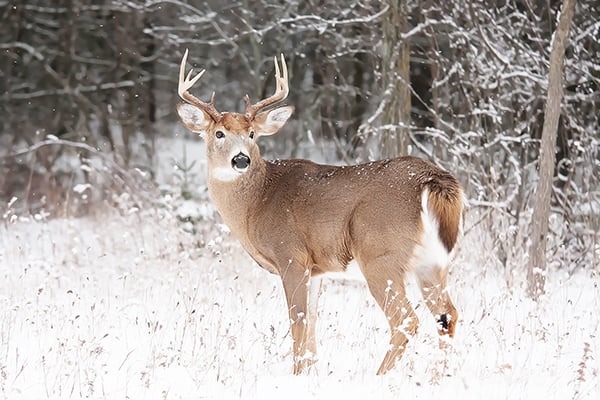
A graph compiled by Michigan DNR wildlife biologist David Jentoft that he shared with the Natural Resources Commission at their April meeting clearly shows why a one-buck bag limit won’t work in the UP.
The graph shows the direct relationship between the severity of UP winters and the number of bucks hunters in that region bag on an annual basis. After severe winters, the number of bucks taken by UP hunters goes down and it goes up after mild winters.
In other words, winter controls the number of bucks that are present on the landscape, not hunter harvest. That is why having mandatory antler point restrictions on both buck tags of UP combination deer licenses since 2008 has not produced more older age bucks during the 17 years those restrictions have been in place.
That’s also why a one-buck bag limit will not be successful in doing so either.
So changing the buck bag limit from two to one in the UP will not benefit the resource at all, as proponents of the change claim. What it will do is dramatically reduce recreational opportunity for UP hunters without changing the boom-and-bust cycle of deer abundance controlled by winter severity.
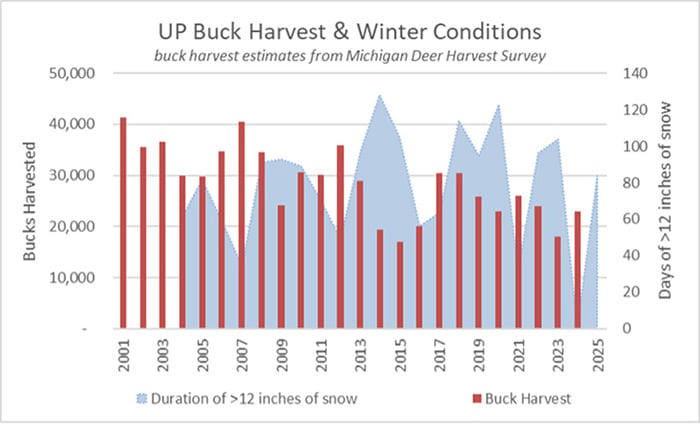
The connection between winter severity and the number of bucks available to UP hunters is undeniable from the graph produced by Jentoft. The severity of UP winters is determined by the number of days that snow depths average 12 inches or more. Winters in which those snow depths range between 60 and 90 days are considered moderate. Mild winters are less than 60 days and those with more 90 days of deep snow are considered severe.
The DNR graph shows the buck harvest from 2001 through 2024. The comparison between winter severity doesn’t start until 2004. It’s safe to assume, however, that the winter of 2003-2004 was severe because the buck kill declined to 30,000 during 2004 and 2005 from around 35,000 the previous two years. Since the number of bucks tagged by UP hunters exceeded 40,000 during 2001, it’s also safe to assume the previous winter or two were mild ones.
RELATED COVERAGE FROM OUTDOOR NEWS:
Late winter snows likely stressed Michigan’s whitetails
New amendments to deer season regulations get reviewed by Michigan NRC
2025 Deer Camp Survey sheds some light on hunter success in Michigan’s Upper Peninsula
Mild to moderate winters prior to the fall of 2007 resulted in the UP buck kill rebounding to 40,000. The region’s buck harvest has been on a downhill trajectory since mandatory antler point restrictions on UP combination licenses went into effect during 2008 seasons. A severe winter during 2008-2009 dropped the 2009 buck harvest to about 24,000.
Moderate to mild winters for several years bought the buck kill back up to about 36,000 in 2012. Then two or three severe winters in a row brought the number of bucks bagged by UP hunters to record lows to record lows between 2014 and 2016. So many deer were lost during those winters that it took four years for the herd to rebound.
Mild winters, of course, contributed to the increase in the number of antlered whitetails available to hunters by 2017 and 2018. More tough winters brought the population back down again.
Only about 18,000 bucks were bagged in the UP during 2023 seasons, according to DNR estimates, which is less than half the number of bucks shot by UP hunters during 2007 seasons. Making both buck tags restricted starting in 2008 obviously has not been beneficial in producing more older age bucks for UP hunters, according to this revealing graph. A one buck bag limit won’t do any better.
The winter that just ended was severe again, so the odds of UP hunters filling two buck tags this fall will be reduced. The one buck bag limit that is essentially already in effect will continue without any change in regulations.
Pennsylvania’s hunting license sales down so far this year
Hunting license sales are down nearly 4.5% at the end of August, although Pennsylvania Game Commission officials believe there is
Origin of road-killed armadillo in southwest Ohio a mystery
An armadillo found as roadkill in southwest Ohio has researchers scratching their collective heads wondering from where the non-native mammal
Bowhunt gets started in Ohio with additional opportunity in CWD surveillance area
Hunters in Ohio’s chronic wasting disease (CWD) surveillance area have additional dates this season to pursue white-tailed deer. The Ohio

5 thoughts on “Commentary: Why Michigan’s proposed one buck bag limit won’t work in the UP”
Numbers don’t lie. If 20 hunters take 2 bucks thats 20 less bucks. Mr Smith needs to sharpen his pencil.
If 20 hunters take 2 bucks that’s 20 extra deer that won’t end up dead on Michigan’s highways possibly injuring a child. Instead, it’s 20 deer that will feed a child. There’s a reluctance to go to deer camp in November if the buck tag is filled in early October. Big hit on the economy.
Shoot does
If buck numbers are so low, and they are, science says you should only harvest one buck at most. Why send a message that two bucks are OK with the sale of 2 buck tags. Very poor messaging and deer management..
Statistics aren’t able to measure social changes and the changes to a hunter’s mentality. Our herd ratio is was off, more does need to be harvested not bucks. If the culture and social norms aren’t able to change on their own, that’s when government has to step in, especially when the deer are more important than hunter satisfaction or needs. With that said, one buck tag makes it more precious, and the hunters will be more selective allowing more bucks to mature and reduce our success rate on buck harvest to a reasonable level as more bucks are allowed to walk away. Our state harvest success rate is in the mid 40% which is double that of other states like Iowa. Second, if a hunter wants to spend more time in the woods, then hunt does or other species and stop being so selfish.
If anyone doubts the social changes that a one buck tag brings, talk to anyone from Indiana or Pennsylvania.