




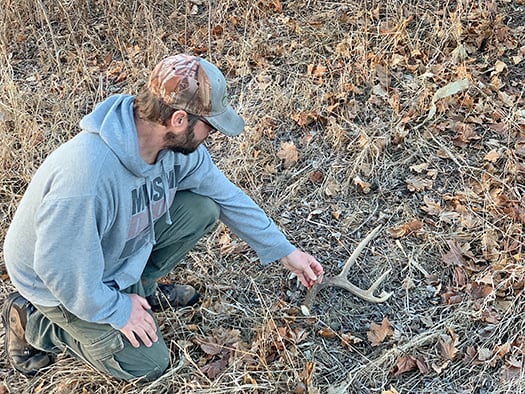
It’s been said before: Shed hunting is like looking for a needle in a haystack.
Think about it: Any given buck can literally travel for miles from when deer begin dropping antlers in December until the last buck has shed in April. How are you supposed to know where a given deer was at the exact moment he shed an antler? It’s a daunting task.
Here are five tips to point you in the right direction.
Start your search where there are bucks!
You’ve probably seen public hunting grounds that look like car dealerships during deer season. With that kind of hunting pressure, how many bucks will survive to shed their antlers in that area?
Not many. While I find the majority of my sheds on public ground, realize that searching where few deer survive can be futile.
You’re better off finding areas that have good deer numbers, and particularly, good buck numbers.
Private property is a good bet if you have access, especially if hunters pass up young bucks, letting them survive to shed their antlers. You’ll obviously want to look on your own hunting land if you have it. It’s getting harder to knock on a farmer’s door and get permission to go on his land, but it’s still possible, especially if you’re only there to shed hunt.
Lightly hunted public land can be productive as well, if you’re willing to put in some miles. Even city park land, where deer can’t be hunted, can be good. You’d be surprised how many deer live in urban settings.
Realize that deer may not winter in the same places you found them in fall. Stay on fresh sign. If you can drive around and scout deer in winter, you’ll have a leg up as the snow recedes.
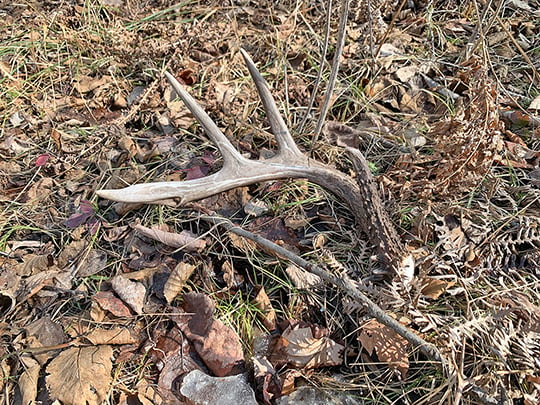
Find food sources
This is easier to do in farm country than in the big woods.
Pay attention to which fields deer prefer. Some fields will attract dozens of deer, while some won’t contain a track. If you have permission, search those fields and the adjacent cover, whether it’s trees, brush or tall grass.
Deer don’t usually travel far from feeding to bedding areas. Traveling wastes energy.
Outside of farm country, finding food sources gets tricky. Try clearcuts, where deer can feed on slash as well as newly emerging shoots. Deer also spend a lot of time in cedar swamps or patches of red osier dogwood, both of which provide both food and cover.
On a micro level, deer may come to a single tree, whether that’s a crabapple tree still dropping fruit or a recently fallen cedar, which puts browse within reach of hungry deer.
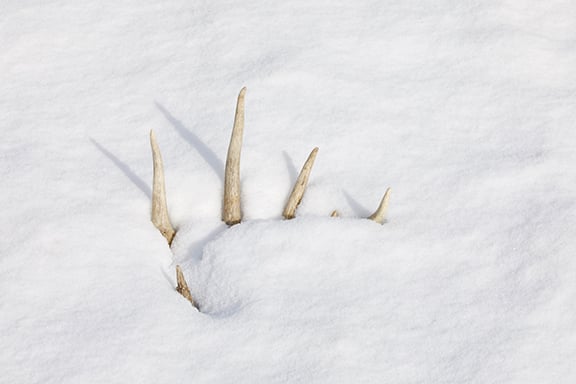
Find bedding areas
Although I like to shed hunt after the snow has receded so I don’t miss antlers, getting out while there’s still snow on the ground can help you find tracks and beds. Deer spend a lot of time bedded during cold weather, so bedding areas are productive shed spots.
A bedding area could be a brushy thicket along a farm field, CRP grass, a forest or just a hillside (more on this later). Deer are looking for places to hide from predators, and if it provides reduced snow levels, so much the better. That’s why coniferous forests are so appealing. Snow stays in the branches, meaning there’s less snow for deer to walk through.
Plus, the canopy blocks the wind and holds in heat, making coniferous forests just slightly warmer than the surrounding areas.
South-facing hillsides work in a similar way: the sun’s rays are most direct on the south face. Snow melts there first, making it easier for deer to travel and find food. Deer also like to bed there and soak up the sun like a cat in the window.
Still another prime bedding spot is a lone evergreen, whether it’s a single cedar in a fallow field or a pine tree in a deciduous forest.
Deer will go out of their way to bed under these oddities, which stand out from their surroundings. And it doesn’t have to be a single tree. If there are just a handful, I’ll check every single one.
Stay on the south side
I mentioned south-facing hillsides are ideal bedding spots, but that south orientation is key in any bedding area. Check out a winter deer bed and odds are it will be on the south side of a tree, a bush or some other type of cover.
Deer are that committed to being where the sun hits their dark bodies, which can warm in the sun. Therefore, stay on the south face.
That could be along a ridge line. Or it might be the south side of a grove of pine trees planted along a field. You’ll see that there’s more snow on the shady north side, while it may be bare ground under the southern exposure.
It’s like that all winter, so all season long, deer relate to that south face. They stay warmer and they have access to food that would be buried under snow on the north face. Walking south edges is a real key to my shed hunting success.
Don’t get discouraged
And if there’s one bit of advice I could give new shed hunters, it’s don’t get discouraged.
You’re looking for a needle in a haystack. Even the best shed hunters get skunked. Set yourself up for success. Go where there are bucks. Keep your eyes on the ground. Don’t get distracted from the task of finding sheds.
Put in your time. Check every suspicious branch or cornstalk. It might be a year or two before you find a shed. But once you do, it’s such a thrill. And after you get the first under your belt, something clicks in your head and the rest get easier.

WI Daily Update: State stamp contest winners announced
Three Wisconsin artists have earned a place on the 2027 turkey, pheasant and waterfowl stamps. Here are the winners and
Pennsylvania Game Commission’s chief of wildlife recovery glad to return to state
Forestry is very much a part of Scott Bearer’s family tree.
The Pennsylvania Game Commission’s new chief of wildlife

MN Daily Update: DNR prepares to move its headquarters to new location
After more than four decades at the same location, the Minnesota DNR is preparing to move its headquarters to a
