Outdoor News may earn revenue from products shown on this page by participating in affiliate programs. This comes at no extra cost to you. Click here to learn more.
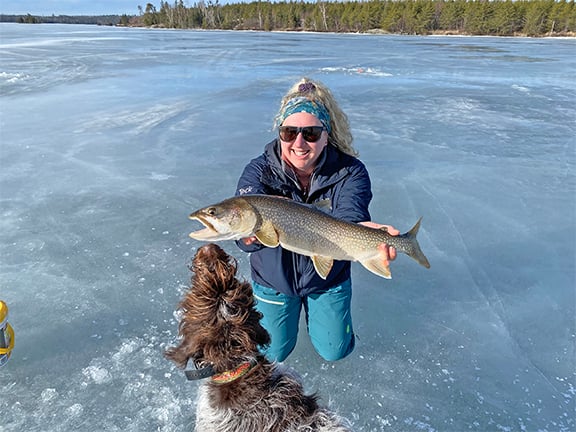
Ice fishing for lake trout can feel intimidating, even to the initiated. They can cover miles of water in a day, swim 100 feet vertically in seconds, inhabit some of the biggest, deepest lakes around, and often humble even the most reliable rod-and-reel combos.
That said, ice fishing for lakers is a pursuit that actually benefits the patient angler, and with a few basic adjustments to your existing ice-fishing system, can produce consistently.
Where to look
There are as many approaches to ice fishing, but generally if you can find shallow structure that borders a deep basin, you can find forage and, thus, lakers. Anywhere from 40 to 60 feet of water, adjacent to 80 to 120 feet is where I like to start on northeast Minnesota lakes.
Once you start drilling holes and checking them with your electronics, it’s important to not get discouraged right away if you don’t see swarms of fish. Unlike panfish and walleye, where it’s almost pointless to fish an area where you aren’t marking anything, lakers can swoop in at any second. Look for clouds of baitfish rather than the predators themselves.
MORE ICE FISHING COVERAGE FROM OUTDOOR NEWS:
Examining the finer details of tip-up fishing
Patrick Durkin: Homely, but tasty, burbot gaining respect
Jeremy Smith: Perch action thriving again this winter on Minnesota’s Lake Mille Lacs
Tackle
I’ve caught lake trout on a number of different rod-and-reel combinations. The key: Match your setup to the type of lures and presentations you’re using.
As a rule of thumb, I like to have at least one medium-heavy action ice rod with a spinning reel spooled with 20-pound braid and a wide selection of fluorocarbon leader available, as well as a few medium-action walleye rods with lighter line for more delicate presentations. The bigger the lure, the stronger the fluorocarbon leader I tend to use, though I never exceed 20-pound-test.
For example, I love jigging a 2-inch White VMC Hatchet Spoon when fish are more finicky. For this light set-up, I’ll run a medium-action walleye rod with an 8-pound mono ice line tied directly to the spoon.
When the trout are more responsive to bigger, aggressive presentations, I’ll break out the medium-heavy rod with a 12- to 16-pound fluorocarbon leader and a ¼- to ½-ounce hair jig like the VMC Moontail in white or chartreuse, often with a live minnow or piece of frozen smelt for a trailer.
There are a number of popular lake trout lures, but the most useful are ones you already own. Some of the most productive include bucktail jigs, spoons, lipless cranks, and the always reliable lake trout tube.
Colors range from region to region, but white, silver, blue, chartreuse, and red account for the most catches. Ask a bait-shop which colors have been hot.
On the ice
Now that you’ve found some good structure and baitfish, start fishing.
I like to set out a tip-up with a live minnow, usually a medium size creek chub, suspended somewhere between 2 feet off the bottom and the middle of the water column. This increases your odds of catching finicky fish and keeps a line in the water if you need to step away from your jigging rod.
Once your tip-up is set, start jigging your lure of choice using long, upward motions and returning your rod tip to the downward position so that your lure can fall naturally. Lake trout will often come cruising in to investigate your presentation without warning.
For hesitant fish, I’ll maintain a slow, methodical jigging motion to coax them. If the fish comes in fast and is responsive to jigging, I will start reeling the lure towards the surface for as long as the fish continues to chase, then open the bail and let it fall back down to the bottom, and repeat. This is when I’ve had the most bites, as lake trout seem to love the chase.
Although I generally opt to use the best electronics available to me for lake trout fishing, any old Vexilar flasher will do just fine. In fact, while fishing this past weekend with my friend Peter Konstantacos, the owner of Boundary Waters Outfitters, his used, 15-year-old flasher outfished my brand new, high-falutin’ unit.
“There are so many approaches chasing these things but you just can’t beat a 3-inch white and blue tube teamed with the patience to jig all day,” he said.
There are lots of great resources out there to learn more about catching lake trout, but the best way is to head north and start fishing.
Whether your plan is to drag sleds into the backcountry or drive on the ice and fish in comfort, there are lake options for everybody. There are also some incredible guiding and outfitting services available in the Ely area.
The winter lake trout season ends March 31 for lakes both inside and outside the Boundary Waters Canoe Area Wilderness. The daily possession limit for lake trout is two.