




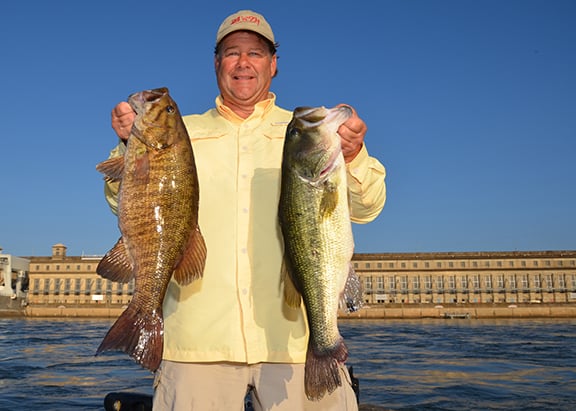
When northern lakes freeze, bassin’ turns hot in the South. For lunker largemouths in southern waters, fish late winter or early spring pre-spawn.
What gear should you bring?
In many southern waters, vegetation grows profusely. Nothing goes over matted grass like buzzing frogs. For a more subtle enticement, crawl unweighted soft plastics over matted tops or drop them into pockets.

A southern icon, cypress trees, grow in standing water and dot numerous reservoirs. Knees, those pyramid-like woody structures adjacent to the trunks of cypress trees, protrude above the ground or water. They rise from the roots of bald cypress trees and provide fine structure. Crayfish crawl on the trunks. Nothing imitates a crayfish like a jig with a crayfish trailer.
“If I only had one cover to fish for the rest of my life, it would be cypress trees,” said Greg Hackney, a Louisiana bass pro. “On a good tree, I can often catch more fish in the first hour of the morning than I can the rest of the day elsewhere.”
Most southern reservoirs hold 10-pound bass, but a few stand out. Here are some destinations to consider if you’re heading south for open-water bass.

Sam Rayburn, Texas
“Big Sam” spreads across 114,500 acres in Deep East Texas, 70 miles north of Beaumont.
The reservoir is fed by the Angelina River, the major tributary of the Neches River. The largest lake entirely within Texas regularly produces bass in the three- to eight-pound range and some 10- to 12-pounders. The lake record weighed 16.80 pounds. Big Sam also produces big spotted bass.

Toledo Bend, Texas-Louisiana
The sprawling reservoir of the Sabine River covers 181,600 acres spanning the Louisiana-Texas line. It lies due east of Alexandria, La., in the picturesque Sabine National Forest.
The lake record weighed 15.32 pounds. It came from Six Mile Creek, a major tributary on the Texas side.
“Toledo Bend has become a destination for people who want to catch a 10-pound bass,” said area guide Darold Gleason.

Caney Creek Reservoir, Louisiana
Commonly called Caney Lake, the 5,000-acre north Louisiana reservoir east-southeast of Shreveport produced five of the biggest bass ever caught in Louisiana. This includes the state record, a 15.97-pounder.
“Caney Lake has a history of producing huge bass,” said Tyler Stewart, a guide. “Some bass in the 13-pound range were caught recently. My personal best from the lake weighed 11.97 pounds. The bed fishing is good in the spring. I also try to get a reaction bite around the hydrilla with a Rat-L-Trap or a Chatterbait.
In the summer, some of the biggest bass get around deep brush piles. I throw big Texas-rigged worms in plum colors or a Strike King 6XD crankbait in shad colors.”
MORE FISHING FEATURES FROM OUTDOOR NEWS:
Spoons are a ‘golden ticket’ for bass through the ice
Repower your outboard or trolling motor: Here are top options for 2026
Strokes, cadence, adjustments needed for jigging up walleyes
Pickwick Lake, Ala.-Miss.-Tenn.

Pickwick Lake runs 53 miles along the Tennessee River from the Wilson Dam near Florence, Ala., through Mississippi to the Pickwick Dam near Counce, Tenn., and covers 47,500 acres across three states. The reservoir was created by Pickwick Landing Dam as part of the Tennessee Valley Authority.
Pickwick produces smallmouths exceeding 10 pounds and largemouths topping 14 pounds. Smallies like more current. The best smallmouth action occurs when water runs through the Wilson Dam.
Downstream, the riverine reservoir widens into a typical southern lake with less current. Anglers can catch smallmouths, spotted bass and largemouths from dam to dam, but the lower part of Pickwick traditionally holds more stout largemouths.
“In the spring, I throw something that looks like a crayfish, such as a small jig or a Ned rig,” said Roger Stegall, a professional bass angler and guide. “If bass are active, I throw square-bill crankbaits or spinnerbaits.
A 3⁄8- or 1⁄2-ounce jig in black and blue or green pumpkin with a craw trailer is always a good choice.”

Lake Guntersville, Alabama
The largest lake in Alabama spreads across 69,100 acres along the Tennessee River and tips into Tennessee. Located in northeast Alabama near Bridgeport, Guntersville produces copious bass in the five- to eight-pound range and bigger ones. Caught in February, the lake record largemouth weighed 14.50 pounds.
The lake also contains good numbers of spotted bass and some smallmouths.
The northern portion retains its riverine characteristics. The lower lake turns into a typical grassy southern reservoir.

Kissimmee Chain of Lakes, Florida
This chain of lakes spreads across more than 100,000 acres south of Orlando in central Florida. The Kissimmee River links several lakes until it flows into Lake Okeechobee.
Well-known for producing giant bass, these grassy lakes can deliver largemouth exceeding 15 pounds. Any artificial temptation might catch bass, but for monster bucketmouths, use big live baits. Native throughout Florida, wild shiners can exceed 12 inches.
“Fishing wild shiners is the best way to consistently catch giant bass in the Kissimmee Chain,” said guide Steve Niemoeller. “I use 8- to 12-inch shiners on bobbers. I throw them right against the hydrilla and let the bait work.”
All these techniques could work anywhere in the South, but don’t be afraid to experiment. What works in northern waters might tempt southern bass, especially if they’ve never seen anything like it before!

Patrick Durkin: Wisconsin’s Tom Tiffany can’t tell trivial from crucial on conservation issues
Unlike some politicians who pander to hunters when seeking their votes, Wisconsin gubernatorial candidate Tom Tiffany doesn’t pretend to be

Minnesota Mixed Bag: MN-Fish expands board to 20
At its October 8 board meeting, MN-FISH directors voted to add three new members, a move that aims to expand

Minnesota Letters to the Editor: Instead of ethanol, grow more wetlands-savvy cattle
Reader-submitted letters to the editor published in the Oct. 23, 2026 edition of Minnesota Outdoor News.
