




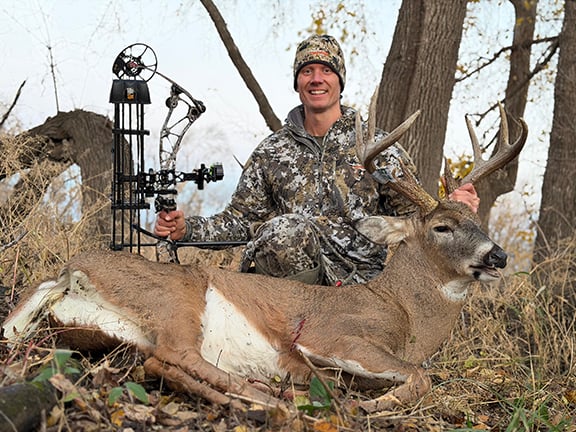
The month of November ushers in a mix of emotions for whitetail fanatics. Primarily, it’s excitement, sure. But at least for me, there’s also some added pressure.
It’s not external pressure.
Nobody else really cares if I shoot a buck. It’s the fact that so much mental and physical energy is exerted throughout the year, leading up to that two-week period.
I spend as many hours in a tree as I can during the first half of November. The goal is to soak up every ounce of an opportunity to bowhunt three different states in the Upper Midwest.
Spend too many days striking out on the first leg of this trip, and it’s easy to start wondering if the grass is greener across the border. I felt that last year after messing up a shot opportunity on Day 3 that set the whole experience back.
This November went much more to plan. There are always setbacks in bowhunting, but I was able to wrap tags on three good bucks for the second time in the past three seasons.
MORE WHITETAIL COVERAGE FROM OUTDOOR NEWS:
Whitetails are survival machines in winter; here’s how they do it
Ryan Rothstein: It’s back to the basics for last-call whitetails
For many, maximizing hunting time during the rut is about being efficient around work and family if you want to stretch your hunting across multiple states or get back home sooner rather than later.
A big part of that is making sure November does not sneak up on you. Analyze what went right and wrong this past rut while it’s still fresh in your mind right now.
Write things down as a reminder. Having a plan or set agenda in place will help you be more efficient with your scouting this winter or spring.
Here are three things that stand out from my 2025 rut. Maybe they can help you, too, as you think about what ideal setups might look like on properties you hunt.
Be prepared, trust the plan
Bowhunting success during the rut often comes by thinking days and months in advance.
Most hunters fill their tags in late-October and November. Embrace that reality and scout with it in mind. If that means getting down from the tree during a September opener to scout and be better prepared for a return two months later, so be it.
Find those rut funnels and think about what security cover might be available for deer during late fall when there is far less foliage and fewer crops on the landscape.
This past summer, a storm wreaked havoc on one of the areas I hunt. Uprooted trees were sure to change how the deer move, but I had no idea the extent of it until spending a weekend out there in August.
For two days, I cleared deadfall and opened up lanes, just trying to give deer a path to travel again. It was a bit daunting, but I left that weekend feeling ready for the rut.
On the afternoon of Nov. 2, I slipped up a river in my kayak to get into a funnel adjacent to a known bedding area. A mature 9-pointer gave me a great shot at 15 yards, a little after 4 p.m.
Do your homework, pile up spots you’re confident in for different winds, and answer the necessary questions: What’s the access route? Is this a morning or evening spot? Do I need certain conditions (maybe wet or windy days for better access) to hunt the area?
Once you’ve done this work, trust your scouting and keep executing the plan.
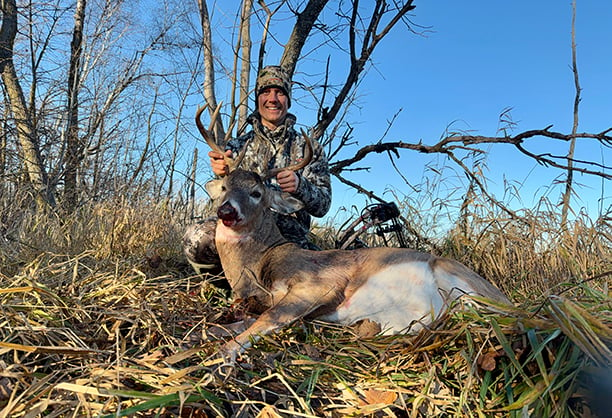
Finding the ‘spot within the spot’
There are certain locations where everything comes together for you as the hunter. They don’t exist on all properties, so if you find one, cherish it.
This is the tree where everything lines up. Your access is great, the wind performs as it should, and it’s in the kind of habitat deer naturally want to be in or move through.
I gained permission to a beautiful new property this past spring that has a mix of thick timber, crops and sloughs – all ideal deer habitat.
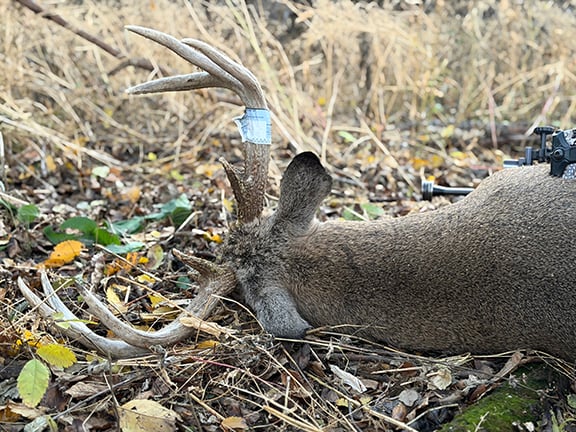
One spot in particular caught my eye in looking toward the rut. It’s an area where two sloughs come close to meeting, creating a land bridge within the timber. My access is along a cattle pasture and then the edge of a slough where cattails meet the woods.
The ground is uneven enough here that deer don’t seem to travel this edge much, preferring instead to stay higher up in the timber. I’m able to slip into a tree that is 20 yards off the cattails without crossing any deer trails. The pinch-point deer move through is full of thick cover.
There are high points in the woods to each side of me as I’m set up lower on the terrain. These low-ground areas can be a nightmare for swirling winds, but the terrain here creates a funnel that pushes my scent safely over the water if I wait for a west/northwest wind.
Scent-wise, it feels bulletproof for those conditions.
I hunted this tree for the first time Oct. 18. Multiple mature does came through the pinch point with no clue to my presence. Beat an old doe’s nose and you have a spot worth hunting.
I set up in that tree with confidence on the morning of Nov. 5 with 10-mph west/northwest winds. Fifteen minutes after first light, a doe brought a 10-pointer through the pinch point.
This type of ambush spot is worth your time and effort in trying to locate, even if it means hunting public land instead of a small private piece with limited options.
Security cover is your friend
When scouting for specific setups that look like this previous example, I often ask myself if a buck could disappear into security cover within a few bounds if need be.
If the answer is yes, I like my chances when good access, consistent wind, etc., all align. These types of areas are far and away the most consistent rut producers for me. Find a pinch point or intersection of trails within or directly adjacent to security cover and you’re onto something.
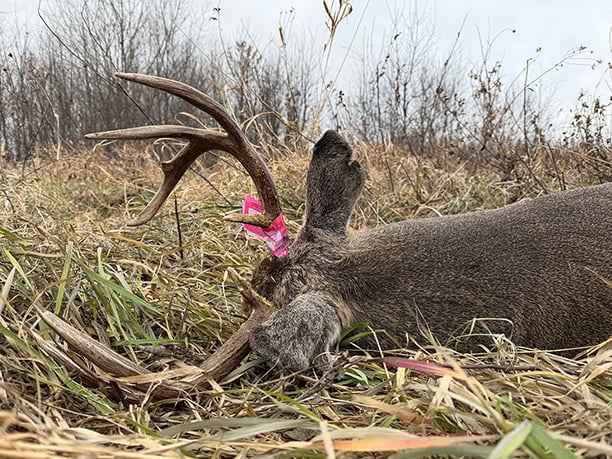
The buck I shot Nov. 15 came on a property I had never stepped foot on until that week. I gained permission on a Monday, devoted three hours to scouting it on that Wednesday, and waited for a northwest wind to hunt a great-looking spot on Saturday morning.
With so little time, I asked a simple question when map scouting: Where are areas of habitat diversity and potential security cover? That sometimes narrows things down considerably on a property, and certainty in this scenario where thick cover is quite limited in more open terrain.
This specific setup is in the middle of an agriculture field. My tree overlooks a series of trails that intersect near a worn-down creek crossing within thick cover.
To my right is timber, to my left is a willow thicket, behind me is open canary grass (if deer travel through here, they’ve likely winded me; I view this as the least likely path of travel), and 20 yards in front of me is the edge of cattails.
That’s food, water, and security cover all within a 50-yard radius.
This is a relatively low deer density area. But on that morning, I watched frequent movement within and on the edge of that thick cover.
A few hours into the sit, a 10-pointer bulldozed his way through the cattails, into the opening 15 yards from me. I had left my ground scent all over that area while preparing a tree three days earlier.
My point? Be smart – hunt the right winds, think about access, etc. – but don’t let fear of ruining a spot with your presence keep you from hunting where the deer are.
That’s especially true during the rut, when you can get away with more disturbance than during the early season.

Ohio Cuffs & Collars: Stolen black walnut tree from Wallace O’Dowd Wildlife Area
Ohio cuffs and collars are field reports from the Division of Wildlife. These reports are from the Sept. 25, 2026
H2Ohio wetland to benefit St. Marys
As part of Ohio Gov. Mike DeWine’s H2Ohio Initiative, the Ohio DNR (ODNR) and the city of St. Marys held

USFWS announces new duck season framework process
The Department of the Interior recently announced that the U.S. Fish and Wildlife Service (USFWS) is finalizing a streamlined process
