




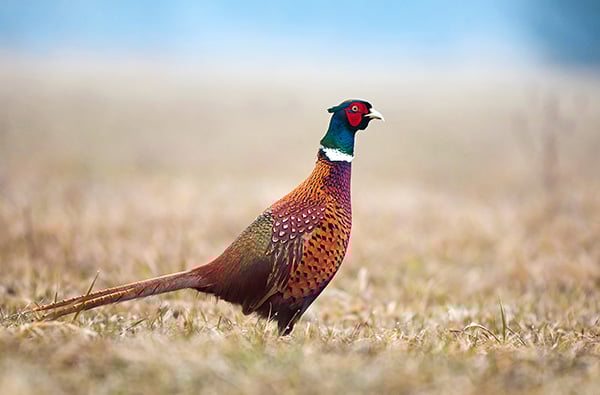
Madelia, Minn. — If you’ve hunted pheasants on a state wildlife management area in southwestern Minnesota during the past two years on or near the opener of the season, you may have happened upon a Minnesota DNR wildlife official with an odd request.
“We asked hunters if we could have one of their harvested birds,” said Steven Woodley, Minnesota DNR upland game research scientist, who works in the agency’s Madelia office. “We were looking for a donation.”
The pitch also came with an explanation. The DNR, the pheasant hunters were told, is attempting to determine whether a group of insecticides known neonicotinoids – commonly called “neonics” – are hurting pheasants and their habitats. The donated birds are being analyzed as one part of a three-year research project, which began in 2024.
“I think it’s gone well so far,” said Woodley, who is heading the study. “Most hunters have been receptive to what we’re doing. I think they see value in the research. We certainly do. Pheasants are a popular game species. They’re culturally and economically important in Minnesota.”
MORE UPLAND BIRD COVERAGE FROM OUTDOOR NEWS:
Late-season pheasants are fun to hunt, but be careful out there with your dogs
Minnesota pheasant opener largely typical with crops, heat playing a part
To err is human, but avoiding these mistakes will bag you more pheasants
Neonics use
According to Woodley, neonicotinoids are applied as coatings to corn and soybean seeds, among others, including small grains including barley. Such seeds are commonly used by farmers in Minnesota and across the U.S. and are known to be eaten by pheasants and other birds, especially during the spring planting season.

Woodley said neonics “bind and disrupt” an insect’s brain receptors, which causes them to “over-stimulate” and eventually die. That happens when insects consume the plants of neonic-coated seeds. Woodley said roughly 5% of the chemical is “taken up by the target plant.”
“Much of the remainder gets into the soil,” said Woodley, adding that the remaining insecticide could possibly leach into nearby water bodies – including wetlands on state WMAs. That’s worrisome to wildlife officials because neonics are water-soluble and remain in the environment for roughly three years.
During the past several years, researchers across the U.S. have conducted research on neonics in the environment as their use has increased since the early 2000s after they appeared safer for humans and mammals than previous insecticides.
Research done so far shows neonics are toxic to various pollinators, including honey bees and butterflies, and could be having negative effects on birds (migratory and non-migratory), mammals and other wildlife, as well as their associated habitats, state officials and other researchers say.
The European Union has banned neonics out of fear they contributed to significant die-offs of pollinators. Some states regulate their use for the same reasons.
The Minnesota DNR is also studying neonics in prairie chickens and white-tailed deer. The prairie chicken work is ongoing and the deer work is wrapping up, state officials say. According to one finding, state biologists found neonicotinoids in nearly all – roughly 94% – of deer spleens collected from road kills and sent in by hunters in 2021.
Pheasant study’s aim
Woodley said the aim of the pheasant research is to provide “baseline information on the prevalence of neonics in wild pheasants and their associated habitat components.”
That includes plants, soil, and insects, which, DNR officials say, complements existing work on prairie chickens and deer.
“More specifically, our study aims to sample across the spring, summer, and fall seasons over three years in southwestern Minnesota to better understand the extent and timing of exposure of pheasants and their habitats to neonics,” Woodley said.
“We will assess differences in neonic concentrations between environmental samples from the margins of our sites and those from interior areas to understand the potential for off-site movement better.”
In addition, Woodley said, the DNR is interested in “whether neonic concentrations in pheasants and their grassland habitats differ between smaller grassland parcels and larger grassland complexes.”

Study design
Woodley designed the DNR pheasant study, his first major project with the agency since he was hired in February of 2023.
The goal each year is to collect 60 rooster pheasants (30 in the fall and 30 in the spring) from six different WMAs (three large and three small). During the three-year study, 18 WMAs will be utilized – a way, Woodley said, to spread out the harvest of roosters at several different state properties. Each WMA has or will border a corn or soybean field.
In 2025, Woodley said, researchers collected 24 roosters in the spring and 30 in fall. In 2024, they fell well short of their collection goal, with 15 birds collected in the spring and 24 in the fall.
Of the pheasants collected and eventually analyzed from the 2024 sample, a small percentage – about 5% – tested positive for “detectable levels of neonics.”
“It’s a small sample,” said Woodley, adding that more analysis from the 2025 and 2026 field seasons will be needed before any conclusions, if any, are considered.
“We’re just going to continue to do the work and see where the scientific data leads,” he said.
Research importance
Woodley said the research is important to pheasant hunters in Minnesota and across the birds’ range, as well as everyone who enjoys the outdoors.
“Neonics are known to impact insects, the very things pheasant chicks rely on for food,” he said. “If neonics contaminate the insects that chicks eat, this can reduce chick survival and reduce the number of birds available for hunters to harvest in the fall.”
A study at South Dakota State University of captive pheasants found birds that were fed high levels of seeds treated with neonics hatched half the number of chicks as those that didn’t eat those seeds. The chicks that the infected birds did manage to hatch were also 20% less likely to survive.
Woodley said the study will also help determine whether neonics are present on public lands.
“If neonics are moving into public lands from surrounding areas, hunters and other stakeholders should be informed, as this is likely to affect habitat quality, insect abundance, and long-term pheasant production,” he said. “Furthermore, if neonic concentrations are higher in smaller grasslands, the study could support decisions to create larger grassland habitats to create better habitat for pheasant and many other wildlife species.”
Woodley said the study is “tied to how we manage and protect grasslands from neonics, benefiting not just pheasant hunters but all who enjoy viewing wildlife, big and small, on public lands.”
Study completion
Woodley said the pheasant research (including a paper documenting the results for the DNR) should be completed at some point in 2028.
He plans to submit multiple papers on the research to scientific journals for potential publication. He’s also preparing to give public presentations to stakeholder groups on the ongoing research.
The cost of the three-year pheasant study, Woodley said, is roughly $600,000. More than half of the cost is for laboratory analyses, which is being done at the USDA National Science Laboratory in North Carolina.
Most of the funding for the study comes from a special appropriation from the state Legislature to the DNR’s Section of Wildlife. Given the research’s habitat component (on soil, plants, and insects) and the potential impacts to the other wildlife beyond pheasants, the DNR’s Nongame Program has provided additional funding.

Why fall walleye fishing is a different game – video
Five tips for catching those fall walleyes, and now.
Mike Raykovicz: Add purslane to the list of nature’s bounty worth foraging for
Foraging goes back for as long as man has inhabited the earth. I’m a forager of sorts and I’ve searched

USA Bass Team hooks second straight title at World Championship
The USA Bass Team cruised to its second straight gold medal at the 20th World Black Bass Championship, which was

9 thoughts on “Pheasant study from Minnesota looks at prevalence of neonicotinoids”
Thank you!!….it’s long overdue….the results should be very telling …👍
This is probably a main reason freshwater shrimp have disappeared from MN sloughs. Pattern tile into the water to create larger wetlands… also then why bluebills disappeared in our flyway. Not enough protein to return to the disappearing prairies and lay eggs.
So many implications. Farmers after a few insects that harm crops, but the collateral damage is potentially wide. Migrating duck numbers, as well as many other bird species, just aren’t there in the past five years in west central Minnesota. It’s almost scary quiet out in the sloughs compared to what we always had in the past. I hope this study (or others?) provides answers. Then I hope farmers will respond in kind to help turn the situation around.
The neonics are a management tool used by farmers to protect the growing crop from several insects, not just a “few”. Farmer’s livelihoods depend upon the health and productivity of the soil and overall environment, ergo, most farmers are environmentally conscious.
If there were a more environmentally friendly alternatives, farmers would use them.
Also, the crop being protected from damage serves as human and animal food that keeps humans and animals alive. Pheasants are a sporting game bird, killed for fun with the license proceeds going to the government. Respectfully, which is more important?
Agreed on farmers’ intents. I’m not one of those that thinks they destroy the environment to make an extra dollar. But there does have to be a balance. And the bigger story is not about pheasants but the entire ecosystem, including pollinators that the crops depend upon. If the industry is challenged to find an alternative, if we find these pesticides are an issue, then it should come together to find one. It doesn’t need to be all or nothing.
I think a study on how neonics get into the birds should be tested. I suspect it less from environmental contamination and more so from the pheasants eating treated seed directly out of the ground. If I could keep a pet pheasant on a leash to find singularity on a planted crop in the field I would. I swear they can smell seed treatment because they dig them up precisely where they were planted and will go right down the row eating seed after seed.
That’s crazy! I guess if insect populations as a whole are being affected, the birds need to look for other food sources.
It’s been my observation that good pheasant habitats around corn fields still produce crops of pheasant but the same areas of habitat surrounded by soybeans are almost entirely void of pheasant. I think you should check what farmers are spraying soybeans to ger rid of aphids. Years ago they didn’t spray for them.
The U of MN Extension will be holding a Neonic forum on January 15 in Waseca and via Zoom. If you are interested in this topic, please sign up! https://learning.umn.edu/search/publicCourseSearchDetails.do?method=load&courseId=59530372