




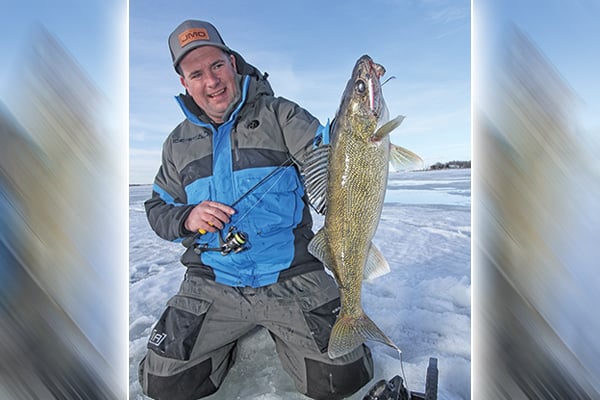
On many lakes and reservoirs, the early ice time frame provides one of the best periods for catching walleye through the ice. The early ice period in fact continues trends from fall fishing.
For simply connecting the dots and landing on walleyes right away at early ice, one of the best strategies is circling back to the best locations or lakes that were productive a few weeks ago.
Breaking down locations even further, some of our favorite early ice locations fall into a handful of characteristics. What follows is a “cheat code” for some of our favorite locations along with additional tips and strategy for catching more early ice walleyes.
Locations
Ice safety and ice thickness has a huge bearing on early ice locations.
Many of our favorite honey holes are simple logistics – locations that we can safely reach particularly when required to walk out and pull gear on foot. Because of logistics, many of these spots are simply shoreline related that we can reach on foot.
Big points and shoreline flats
There is usually no shortage of flats or points that protrude off a typical shoreline.
At early ice, look for the big pieces of obvious structure. The most prominent point or largest flat is often prime before the crowds at early ice.
On large shallow flats, look for the first mid-depth stair step or break line that drops off into deeper water.
After dark, don’t be afraid to look shallow on the flat itself in closer proximity to the deeper water. Large prominent points offer a lot of options as you can follow fish from deep to shallow as the day progresses.

Hard edges
On lakes that are prominently a soft bottom or sand, rock locations in the shallow to mid-depth range can hold a lot of walleyes at early ice.
On many lakes we fish, these rocks might be in five to 22 feet of water. Sometimes these rocks might coincide with a piece of structure like a small hump connected to the shoreline via a saddle. Could be a point. Might be a patch of rock on a flat.
When rocks are relatively scarce, look for these rock locations at early ice. Fine-tuning these locations even further, the edges or transitions are often the spot on the spot. The outside edge or deep edge of rocks are often the sweet spot.
MORE ICE FISHING COVERAGE FROM OUTDOOR NEWS:
Advances in mapping, mobility, and teamwork help today’s ice anglers cover more (hard) water
Strikemaster Lazer Mag: An ice auger’s rise – or decline? – to stardom
Top new gear for your 2025-26 ice-angling campaign
Secondary points
On larger reservoirs that have different arms and tributaries, these secondary points that occur near the mouth of the tributary up to halfway back into the tributary often hold a lot of walleye at early ice. That’s not to say that there are not walleye on primary points or relating to the primary channel on larger walleye at early ice, but ice thickness often takes longer to develop there.
The tributaries typically freeze over first and these secondary points within these tributaries are often important for catching fish.
RELATED COVERAGE:
Looking for current ice conditions? Read the latest fishing reports from Minnesota Outdoor News
Break lines in front of light current
On many natural lakes, one of the top locations is in front of an incoming small creek or inflow.
Typically, there is often a large sand flat in front of these small creeks or inflow that connects to another lake. The first sharp break in front of this flat adjacent to this trickle of current is a prime location at early ice. Of course any place that has current demands utmost respect for safety – all winter.
Tactics
Most notable is that these fish haven’t been touched by fishing pressure for a significant period of time and the fish are fresh. These early ice walleye are typically much more aggressive.

Aggressively jigging glide baits and spoons often becomes extremely productive. On many fisheries, there is a natural progression where fish respond well to jigging hard baits and spoons particularly at low light or during prime-time windows. As the winter progresses, we often have to tone down the progression into midwinter where we have to fish with more subtle presentations by using more dead sticks and downsizing.
Favorite lures include classic spoons or glide baits like Jigging Raps, Tikka Minnows or Psycho Shads or Ripping Raps. Flutter spoons are often deadly in clear and shallow water. Rattle spoons get the nod in stained water or after dark.
While aggressively working lures is important, remember that walleyes are often much spookier at early ice. Walking and noise scatters fish. Setting tip-ups gets more lines in the water and can become extremely productive when walleyes are simply spooky.
In states and provinces where we can use multiple lines, extra rods spread in an area are beneficial because our activity above the ice will often move fish around us; that often means these remote extra lines encounter more fish.
For big shiners or small to medium-size sucker minnows (which are extremely deadly) I lean towards tip-ups. Typically, I like a tip up with an indicator light when fishing after dark and also like to use hole covers to prohibit freeze up.
Spreading tip-ups across shallow shoreline structure is one of the deadliest ways to simply catch walleyes on many fisheries after dark at early ice.
Spook factor
I cannot stress enough how spooky walleye can be on four to seven inches of ice. Especially clear ice over clear water, these fish will move from your presence.
On many fisheries, prime time is around sunset or shortly after dark. Get out ahead of time and drill your holes so the spot can settle down.
Drill as few holes as possible.
We often wear ice cleats for walking on the ice and dragging our sleds and cleats are an important safety item, but they make a lot more noise. I often remove my ice cleats when I get to the spot and start fishing.
Dragging anything on the ice also creates a lot of noise. Get to your spot early and wait and sit. In extremely shallow water, light can also spook fish and that might be part of the reason tip-ups can be so deadly at early ice in shallow water after dark.
Way less land for hunting spurs action from Pennsylvania Game Commission
The Pennsylvania Game Commission has overhauled its Hunter Access Program this year in an effort to boost declining landowner participation
Where do big bucks go when they vanish?
Over the course of our three-months-plus bowhunting season, seeing just one wall-hanger buck can be cause for celebration. Trophy proportioned
WI Daily Update: Tips for catching cohos on river mouths of Superior
This is a great time of year to chase coho salmon on the river mouths on Lake Superior. Tim Lesmeister
