




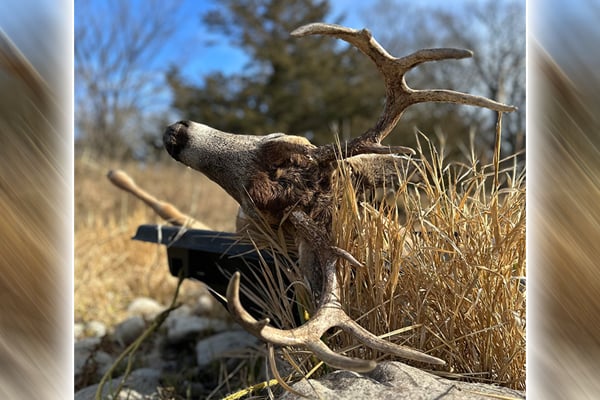
Few things capture the imagination of deer hunters like a set of whitetail antlers. Beyond their beauty and character, antlers tell a story – one we can measure and compare via the Boone and Crockett Club’s scoring system.

Scoring isn’t just for record books; it’s a way for any hunter to deepen his understanding of America’s most popular big-game animal.
With patience and the right tools, anyone can measure a rack accurately. Following the B&C protocol ensures that your score reflects the same precision and fairness used by official measurers. The system accounts for tine length, beam mass, spread, and balance – turning raw antler into a set of meaningful numbers that help tell the buck’s story.
Use this guide and accompanying graphic to follow each step of the process. Follow this basic formula using the form below.
MORE WHITETAIL COVERAGE FROM OUTDOOR NEWS:
Minnesota’s youth, antlerless hunts boost 2025 deer harvest
Target staging areas in late October for better bowhunting; here’s what they look like
Dealing with hunting pressure is often inevitable during a gun opener; here’s how to deal with it
 First, Add These Up:
1. Length of each main beam (M).
2. Inside spread of main beams (S). Measurement may equal but not exceed the length of the longest main beam.
3. Length of all normal points (G1-G4). To be counted as a point it must be at least 1-inch long with length exceeding width at 1-inch or more of length.
4. Circumference at smallest place between burr and first point (H1).
5. Circumference at smallest place between first and second point (H2).
6. Circumference at smallest place between second and third point (H3).
7. Circumference at smallest place between third and fourth point or halfway between third and beam tip if the fourth point is missing (H4).
Then Subtract:
A. Total length between inside spread of main beams and length of longest beam, if inside spread is greater.
B. Total length of all abnormal points on each antler. Abnormal points are those that originate from the sides or bottom of the main beam, or extra points beyond the normal pattern of up to eight normal points, including the beam tip, per antler. To calculate a non-typical score, add instead of subtract the total length of all abnormal points.
C. Total of differences between lengths of all points on left and right beams.
D. Total of differences in all circumferences measurements between left and right beams.
E. Difference in length of right and left beams.
Subtract the total of A-E from the total of 1-7 to obtain the final score for a typical rack.
Created in consultation with Carey Ferrell, Minnesota Official Measurers
Ohio’s Outdoor Calendar
A look at upcoming outdoor-related events from across Ohio published in the Oct. 9, 2026 edition of Outdoor News.

Ohio Cuffs & Collars: K-9 Scout helps bust suspect accused of transporting marijuana for planting
Ohio cuffs and collars are field reports from the Division of Wildlife. These reports are from the Oct. 9, 2026

Seven inducted into Ohio Bass Fishing Hall of Fame
At a ceremony on Sept. 28 at Fisherman’s Central in New Franklin, Ohio, the Ohio Bass Fishing Hall of Fame
