




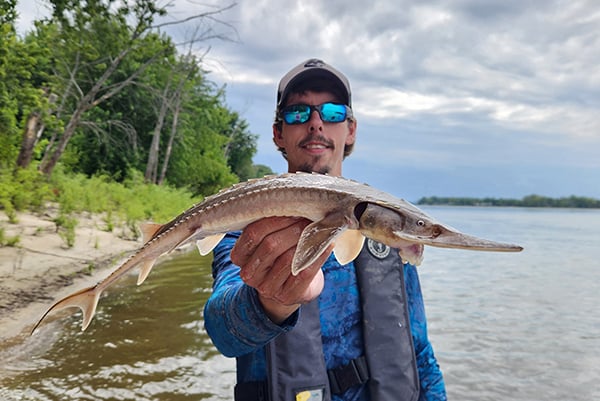
Springfield — When anglers began regularly pulling hefty-sized shovelnose sturgeon from the Rock River – catching fish weighing up to 10 pounds – the Illinois DNR made sturgeon throughout the river a research priority. In 2022, the agency tapped Stefan Tucker, a sturgeon specialist and fisheries ecologist at the Illinois Natural History Survey, to investigate the shovelnose.
Tucker co-published his first results this summer, revealing that of the 1,324 shovelnoses he and his team caught from 2022 to 2024, a whopping 22% were 31.8 inches or longer. Usually, just 1% of shovelnose sturgeon populations hit that size.
Tucker continues fishing for reasons why the population is so robust.
“If we can study a healthy sturgeon population and really understand these population dynamics,” Tucker said, “we can then look at other river systems, and identify differences and potential problems, then propose solutions on how to mitigate those problems and enhance that specific population.”
MORE COVERAGE FROM ILLINOIS OUTDOOR NEWS:
Youth deer hunters in Illinois set harvest record
Four thoughts on spring habitat work to benefit fish and wildlife
A deer hunting formula that works in Illinois
Most days, Tucker is on his boat looking for sturgeon in the Rock – a nearly 300-mile waterway that winds through Illinois’ northwest corner, at depths between 15 to 50 feet, flowing and gurgling from Wisconsin down to the Iowa border, where it joins the Mississippi River.
Of the more than two dozen sturgeon species, the shovelnose is certainly not the most abundant. It also happens to be the smallest.
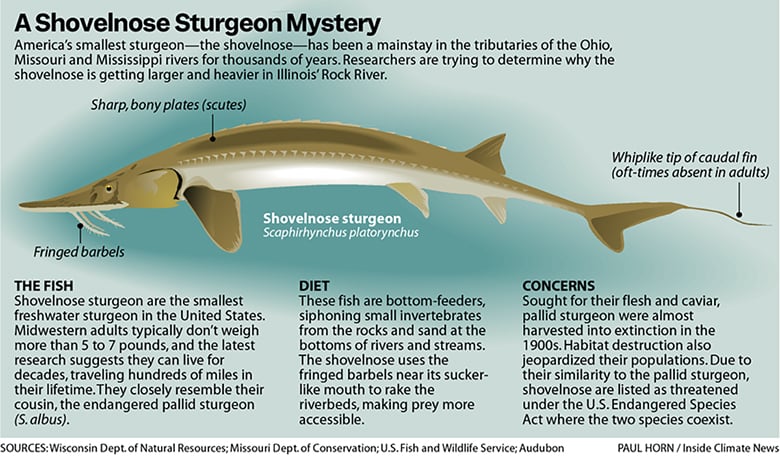
A species that lived with dinosaurs, the fish has a large nose, bony scoops instead of scales that can destroy fishing gear and fringed whisker-like structures near its mouth. Shovelnose typically tip the scale at about seven pounds, but the Rock River fish are surprisingly sturdy, hauled in at record weights year after year. That’s what drew Tucker and the INHS to spend years gauging the fish’s unusual vitality.
“The population here is pretty novel,” Tucker said. “And it’s understudied.”
Sturgeon across the globe are the most endangered group of fish, according to the International Union for Conservation of Nature. Fishing, manmade dams and pollution have contributed to falling populations across all 27 sturgeon species. Warming waters from climate change also threaten some species, research shows.
And sturgeon species are among the most prized of catches. Fishermen harvest shovelnoses for their roe, one of the top three species of wild-sourced caviar. The global market was valued at $97 million in 2022 and is expected to grow to $160 million by 2032, according to Allied Market Research.
Fishing industry concerns about shovelnose sustainability in the Midwest in the early 2000s prompted state agencies in Minnesota, Iowa, and Indiana to embark on studies. Researchers found that fishermen could harvest shovelnose sustainably, but commercial operations meant that the shovelnose sturgeon in those areas would likely grow more slowly.
Research now focuses on the ecology and environmental conditions that affect shovelnose populations and how to protect the fish, said Jeff Koch, assistant director of fisheries research at the Kansas Department of Wildlife, a participant in previous studies.
“Of the 20-some sturgeon species worldwide, the majority of them have decreased to a level where they’re listed at some level of conservation status,” Koch said. “We didn’t want to see that happen with the shovelnose.”
In Illinois, what Tucker has found so far in the Rock hints to some factors that keep their populations going strong. The fish in his study area seem to thrive despite the physical barriers like dams. Notably, commercial fishing is not permitted on the Rock River, which may allow the fish to mature, reproduce more often and build bulk, scientists say. But figuring out how long it takes for a population to mature poses a challenge because it’s difficult, generally, to determine growth rates and ages for sturgeon. Recapture is one fishing method to measure growth. But when researchers catch, tag, release and then recatch fish, recapture rates in some places are only about 10%.
Otoliths, or inner ear bones, grow each year in fish and are marked by rings, much like a tree trunk. Scientists studying samples collected from captured shovelnose believed the bone rings showed the fish live for about 15 years. But the aging estimates are tricky because shovelnose ear bones are made of different material than most other fish.
Then, three years ago, Ryan Hupfeld of the Iowa Department of Natural Resources, used evidence from atomic bomb testing to produce a more accurate estimate.
Nuclear bomb testing conducted all over the world in the 1950s and 1960s caused a steep rise in carbon-14, a radioactive isotope in Earth’s atmosphere that slowly declines over time. It turns out that fish absorb carbon-14 into their ear bones, which researchers can compare to the atmospheric carbon-14 levels in the atmosphere over the same period.
Scientists have calculated the age of other fish, such as Greenland sharks and bigmouth buffalo, using the radioactive signature. Hupfeld experimented in 2022 with shovelnoses caught in Iowa’s Cedar River and saw a surprising result: Some of the fish were as old as 40.
“We’re underestimating the age by potentially double, especially on the older fish,” said Hupfeld, who is now the Mississippi River habitat coordinator for the Iowa Department of Natural Resources. The method is accurate within a few years, he said.
Hupfeld’s aging research and Tucker’s population and gender ratio information could help conservation efforts across several states – or at least help fisheries biologists determine the best way to manage the populations in the upper Mississippi. State agencies across the region are working to harmonize harvest regulations, which could affect other shovelnose populations.
In Iowa, for example, the minimum size limit for commercial fishermen fishing for shovelnose is 27 inches. In some Illinois rivers, it’s 24. Scientists estimate that shovelnoses grow 0.12 inches a year, so a difference of three inches could mean that fish in one state could live 25 years longer than in another – making for a mature population that could readily and repeatedly spawn.
Tucker said the work, over the years, should offer insight into population dynamics and the environment needed for the highly valued fish. All of these small variables, and how they work together, he said, play into the larger story of population stability and persistence in the Rock River.
“We’re letting the science guide the next steps of our research.”
Susan Cosier is an award-winning freelance journalist who writes about science and the environment from Chicago. This article originally appeared in Inside Climate News.

Minnesota artist Bob Hautman wins federal duck stamp contest for fourth time
Minnesota’s own Bob Hautman, from Delano, won the 2026 Federal Duck Stamp Art Contest today with his acrylic painting of
Confirmed cougar makes an even dozen sightings over 25 years
A mountain lion was spotted moving through southern Illinois, and this time wildlife officials believe the big cat crossed west
Illinois bow season opens Oct. 1 with few changes
The DNR has floated the idea of establishing additional Restricted Archery Zones in other parts of the state, but this
