





Most hunters do not need crutches, but they can shoot more precisely if they use them.
We’re not talking about crutches under your arm pits, but your rifle’s stock. Crutches, better known as “shooting sticks” are the best compromise between a sandbag on a concrete shooting bench and nothing at all. But which shooting sticks are best? Let’s investigate some options and figure it out.
Experienced shooters know that a short bipod affixed to the rifle’s fore-end provides a rock-solid rest for prone shooting. Unfortunately, shooting while flat on the ground rarely works in woods, brush, or even short grass.
An attached bipod also adds weight and bulk to a rifle, unbalancing it. Various quick-detach bipods solve most of that. Those can be carried on your belt or in a pack, and some extend long enough for sitting and kneeling shots.
Check these out if you think most of your hunting will give you time to dig one out and attach it. Some clip on the front sling stud, some pop into holes on a mounted stud attachment, and some use magnets to hang in place.

Handheld tripods are another option. You can use them as a walking stick until needed under the rifle. Then just adjust leg height as required, spread those legs, and use the steady support. Tripods are usually slower than a quick detach bipod, but are also slightly steadier when sitting or kneeling. Tall models, most often seen in Africa, work well for standing shots, but few North American hunters carry them here.
If you are more comfortable shooting while standing, work with a tall tripod and figure out how to best use it. Standing squared up to the target with legs spread wide seems to control side-to-side movements best. Leaning into the rifle and tripod minimized fore and aft movement. Tall tripod technique takes some practice and training, but once mastered can suffice for shots as far as 400 yards.
HUNTING FEATURES FROM OUTDOOR NEWS:
Patrick Durkin: Long hours in a treestand pays off on Idaho elk hunt
Make sure your muzzleloader is ready before the season starts
How to kill a buck when the temperatures rise
Handheld bipods are my favorite for all-round, general purpose use in virtually all terrain and habitats. I prefer the simple Steady Sticks style, slim aluminum tubes joined near the ends by a rubber joint or strip of old bicycle innertube. Models about 32 inches long can be spread to various spans to accommodate kneeling, sitting and even prone shots. Versatility is unprecedented. You can lean the sticks fore and aft to align your rifle downhill or uphill. Spread them wide to shoot lower, pull them close to reach higher.
Sit with your back against a solid support, steady the bipod near the rifle’s fore-end, get your trigger arm on your knee or pack, and you’re almost as steady as on sand bags and bench. The sticks weigh just 6 or 8 ounces. Folding models can be carried in a belt sheath or assembled and shoved behind your waist belt. I usually carry mine assembled in my left hand as I hike, still-hunt or stalk.
When I spot shootable game, I spread the legs with my lefthand fingers while bringing my rifle up with my right as I cross my legs to sit. Sitting, unlike prone, usually positions me above most ground cover. If I have time I sit against a tree, post, boulder or cut bank. If none are handy, I prop my backpack behind me or under my trigger hand armpit. That adds significant stability. With my leading hand I grasp the sticks and/or rifle fore-end, often tweaking the bipod position slightly to fine tune my aim. Exhale, squeeze. Break out the skinning knife.
Most shooters struggle with hand-carried, lightweight sticks at first. So did I. But I stuck with it until I discovered the subtle moves and positions that worked.
 Eventually I could shoot steadily enough with these sticks to confidently engage targets and game as distant as 450 yards, though such long shots have rarely been needed.
I’ve tried other handheld bipods, most of which had some kind of block that limited their spread. These are solid, but less versatile than the full range spread of the Steady Sticks. They’re heavier, too.
A key to effective shooting sticks is a balance between weight, height, convenience and speed. You don’t want them so heavy that you’re tempted to leave them in the truck, nor too light that they can’t stabilize your rifle.
You can build such a balanced and inexpensive bipod out of oak dowels. Join them about four inches from their tips with wraps of innertube rubber or a slim bolt through each. Wrap rubber around the bolt to guard against stock scratches. Paint them orange or chartreuse or even pink so you’re less likely to lose them.
I’ve walked away from my camouflage and black sticks more times than I care to admit. Now that they’re dressed in blaze orange and blue, I’m remembering them. Or more easily finding them when I hike back to search!
If you’re thinking a simple walking staff, a monopod, might make a fine rifle support, think again. Maybe it’s just me, but try though I might, I cannot stop a monopod from wobbling side to side. A walking staff like this is certainly handy and quick, since it’s always in your hand, but if you can hold a rifle unwaveringly against one, you’re a steadier man than I.
Many, if not most, woodland hunters eschew shooting sticks as unnecessary, and many times they are. But then comes that big meadow or field in which stands the buck of your dreams at 200 yards and for some reason your usually dead-steady hold shimmies and shakes. A handy bipod could stop that. The dream could become your reality instead of your “one that got away” story.
Shooting sticks are often worth their weight in gold. Or at least worth their length in antlers!
Hunt honest and shoot straight.
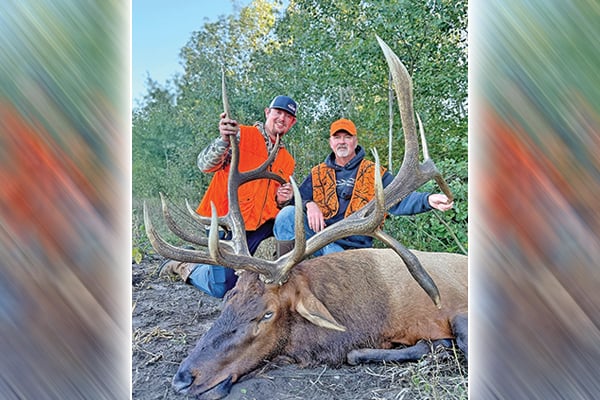
Minnesota’s 2026 elk harvest reaches nearly half of allocated tags during early season
As the first half of the elk season winds down in northwestern Minnesota, nearly half the tags have been filled

Upper Herring Lake offers western Michigan bass anglers a legitimate fall option
Bass can be widely distributed through the vegetation, but cooling water often triggers more active feeding.
Michigan’s Outdoor Calendar
A look at upcoming outdoor-related events from across Michigan published in the Sept. 25, 2026 edition of Outdoor News.
