





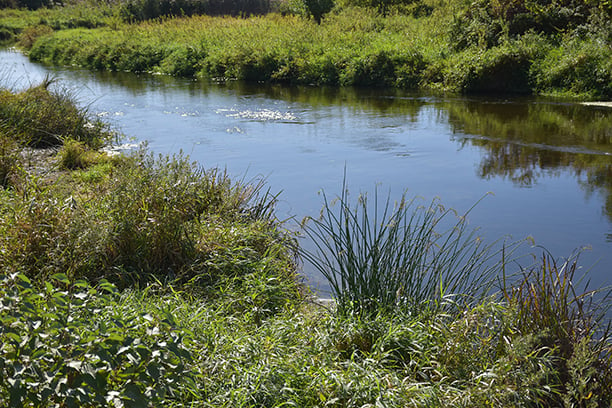
Hoffman, Minn. — Situated a half mile from the Pomme de Terre River, one of the largest erosion-control projects in Grant County resulted in the installation of 19 water- and sediment-control basins to help keep topsoil in the fields and pollution out of the nutrient-impaired river and Perkins Lake, downstream in Stevens County, Minn.
Cooperating landowners and two rounds of Watershed-Based Implementation Funding from the Minnesota Board of Water and Soil Resources made the $360,000 project possible. The Grant County Soil and Water Conservation District coordinated the effort and received the funding – which covered 75% of landowners’ costs – through the Pomme de Terre River Association.
The project was a top priority for the watershed, which spans about 875 square miles across six counties.
“The erosion … (has) created extremely deep gullies and valleys. That not only causes problems for the farmer, because it limits the amount of field they can farm, but it also affects the river because as those valleys and gullies are formed, you have the risk of (sediment and the pollution it carries) getting into the watershed,” said Sophia Maruska, PDTRA watershed coordinator.
MORE COVERAGE FROM MINNESOTA OUTDOOR NEWS:
Streams of Thought: Will audit of Minnesota timber harvest spur the DNR to emphasize wildlife again?
Better things yet to come for Minnesota bowhunters after hot opening weekend
Continuous bass season in Minnesota could begin on March 1
The largest of the gullies measured 10 feet deep and 25 feet wide. Two others measured 7 feet or deeper and up to 15 feet wide.
Contractors hauled in 30,000 cubic yards of fill to fix the gullies and construct the berms that will temporarily hold water back for up to 24 hours, allowing sediment to settle out.
“There are multiple benefits for both the farmers and conservation. These gullies … they’re getting bigger and bigger each year,” said Brent Gulbrandson, Grant County SWCD manager. “Now they’ll be able to farm straight through them, for the most part. Some of the embankments are farmable. Some of them (are) grassed just due to the steepness of the terrain, but then they can farm around (the basins), which is much easier than (working around) the gullies.”
Vernon Haack raises about 500 acres of corn and soybeans in Roseville Township. Twelve water- and sediment-control basins – sometimes referred to as dikes – were installed in his 180-acre field. Seven more were installed in a neighbor’s 40-acre field.
“We put most of the water underground before it hits the hilly areas where it washes out,” Haack said. “The dikes should take care of most of the over-land running of the water that we get with the big rain events.”
Gulbrandson described why this site was a priority and how the WBIF-supported work would help to improve water quality.
“The heavy rains they’ve been getting – exceeding 2, 3, 4 inches of rain in 24 hours – have caused a lot of sediment to wash across the fields, through a culvert, and into the Pomme de Terre River, a high-priority resource for the county,” he said. “With these sed(iment) basins, we’re going to eliminate or minimize any sediment from washing in as well as the fertilizers and chemicals.”
Kensington-based Red Rock Tiling & Excavating completed the work in October 2024. The SWCD also tapped West Otter Tail SWCD engineering technician Mike Yrjo to survey, design, and help oversee construction of the water- and sediment-control basins.
“The biggest challenge on this project has been the design work, with just its scope and how large it is,” Yrjo said. “It’s the largest project I’ve worked on in my 18 years.”
The project had been in the discussion stages for about 10 years. Working out the design and securing funds took about two years.
“We’ve been wanting to do this for a long time, but now it worked out with the financing,” Haack said. “My daughter is looking at taking over the farm, so it’ll be a good project for her to move on with. … My daughter will have a better time of it.”
The Minnesota Board of Water and Soil Resources’ mission is to work with partners to improve and protect Minnesota’s land and water resources. Visit here for more information.

Minnesota artist Bob Hautman wins federal duck stamp contest for fourth time
Minnesota’s own Bob Hautman, from Delano, won the 2026 Federal Duck Stamp Art Contest today with his acrylic painting of

Confirmed cougar makes an even dozen sightings over 25 years
A mountain lion was spotted moving through southern Illinois, and this time wildlife officials believe the big cat crossed west

Illinois bow season opens Oct. 1 with few changes
The DNR has floated the idea of establishing additional Restricted Archery Zones in other parts of the state, but this
