




Madison — The Wisconsin Department of Natural Resources (DNR) 2025-27 budget is enough to keep current operations running, but without major additions.
Maggie Hutter, DNR budget director, reported to the Natural Resources Board (NRB) Aug. 13 that in the new budget the DNR lost 20 full-time equivalent positions, which had been vacant in the Environmental Management Division.
In the previous state budget the DNR lost 40 positions, and compared to the DNR budget back in 2003 the DNR now has 500 fewer staff positions.
NRB member Patty Schacter said the reduction in positions is bound to reduce service to the public. The result is that damage is being done.
Bill Smith, NRB chair, noted that the “flat” funding and steady loss of positions will result in an insidious reduction to the public resources of the state.
“People need to be warned,” Smith said.
Some of the other proposals that were not included in the new budget were:
• Renewal of the Knowles/Nelson Stewardship Program. The governor had proposed renewal of the program, but legislators did not include it in their budget. The program will expire in July 2026, unless separate legislation is passed by then to initiate a new program.
• A trust fund with $125 million for PFAS remediation funding was created in the previous budget, but the DNR did not receive access to the money to help communities address PFAS pollution.
• Increases in hunting, fishing and trapping license fees. Legislators are waiting for the audit of the DNR Fish and Wildlife Account to be completed. The hope is that then separate legislation can be proposed to provide more permanent funding for the DNR Fish and Wildlife Account.
• Pay increases for limited-term employees.
MORE COVERAGE FROM WISCONSIN OUTDOOR NEWS:
Wisconsin volunteers get crash course on importance of Karner blue butterflies
Larry Slagoski, longtime president of Musky Clubs Alliance of Wisconsin, set to retire
Wisconsin DNR can begin drafting ‘housekeeping’ regulations for wildlife and fish rule changes
As far as improvements in the budget, the general wage adjustment for permanent state employees is 3% in 2026 and 2% in 2027.

Since there was no license fee increase, the legislature transferred $30 million from the DNR Forestry Account into the DNR Fish and Wildlife Account. Hutter characterized this as a “band-aid” solution to help with funding, in hopes a long-term solution will eventually be found.
There has been no general increase in hunting, trapping and fishing license fees since 2005, other than a recent increase on some nonresident licenses. Prior to that the legislature included general license fee increases every 10 years to help keep up with rising costs.
“Fish and wildlife funding is just staying flat for the next two years,” she said.
State park fee increases were included for nonresidents for admission, camping and campsites with electricity. State parks also received $1.4 million in operational funds for supplies, as well as one-time funding for technology upgrades and medical training and $3.8 million for capital expenditures.
The forestry budget received $2.2 million over the biennium for wildfire suppression costs, $460,000 for invasive pest treatments, $150,000 for software licensing, and $1 million for a grant for an industry-wide strategic plan written by forestry groups that should help identify new markets for forest products.
Hutter noted that forestry funding is only a one-time hit, whereas usually the DNR receives funding that continues in future years.
The DNR’s Public Safety and Resource Protection Division (formerly the Bureau of Law Enforcement – game wardens) received overtime cost increases, and $1 million for providing ATV/UTV trail maps.
Requests by conservation wardens for more body cameras, laptops, radios, Wi-Fi routers and patrol boats were not included in the new budget.
Areas that did receive funding include environmental management upgrades for information technologies for high capacity well applications and $1 million for new information technology to run the Wisconsin Pollution Discharge Elimination System.
The DNR also received $500,000 for air permit system upgrades.
The new budget included $500,000 for one-time general purpose revenue (tax receipts) for building demolition.
The DNR received $730 million in revenue bonding authority for revolving loan funds that will be used for clean water and safe drinking water upgrades for communities.
The budget included “earmarks” for funding specific projects, including:
• $6 million for Kenosha Dunes restoration (Kenosha County);
• $4 million for Amcast Superfund PCB contamination cleanup (Cedarburg);
• $10 million for the Echo Lake dam (Burlington);
• $2.2 million for Lake Vista shoreline stabilization (Oak Creek);
• $5 million for dredging Browns Lake (Racine County);
• $2 million for Kewaunee Marsh remediation of arsenic contamination (Kewaunee County);
• $250,000 for Green Lake phosphorus mitigation (Green Lake County);
• $42 million to repair the Rothschild dam (Marathon County).
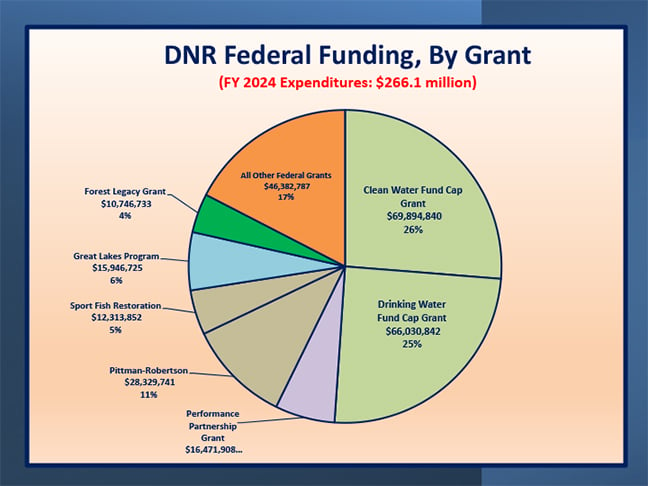
There also are concerns over the federal budget. Hutter said the DNR does not know what money it will receive from the federal government.
At the beginning, President Donald Trump “zeroed out a lot of our grants,” Hutter said, and 30% of the DNR budget has come from the federal budget.
At this point, Hutter said the DNR does not know what its final budget will look like.
Minnesota’s Lessard-Sams Outdoor Heritage Council advances 57 projects looking for funding
Members of Minnesota’s Lessard-Sams Outdoor Heritage Council recently discussed and took action on recommendations and allocations for the next cycle

Outdoor Insights: Beast of a marathoner runs 26.2 miles (8,390 rods) with a canoe
On Monday, Oct. 5, Travis Meier, 38, of Minneapolis, was fielding calls from Twin Cities media as well as the
Minnesota’s pheasant season opens with high expectations
Buckle up, Minnesota pheasant hunters: Saturday’s 9 a.m. opener could be the start of one of the best seasons in

1 thought on “With concerns over Federal money, Wisconsin DNR budget remains a mystery”
This should be a major concern for Wisconsin sportsmen and women. Especially since the legislature is dragging their feet with fee increases for the past two decades!! The federal funding is most likely going to be zero since the current administration really has no plans for protection of our natural resources except for trying to sell off our lands. Its time to hold our legislatures accountable for their lack of actually taking care of Wisconsin’s natural resources and it people in general. Would love to hear the response from Vos and the rest of the crew their reasoning.