




When summer settles in and the weather turns sunny and balmy here in upstate New York, my wife and I often load the canoe or the semi-vee in the back of the truck, then head for the water.
Sometimes we head to the Hudson River, other times we head to a small lake we know that holds plenty of bluegills, pumpkinseed, or rock bass.
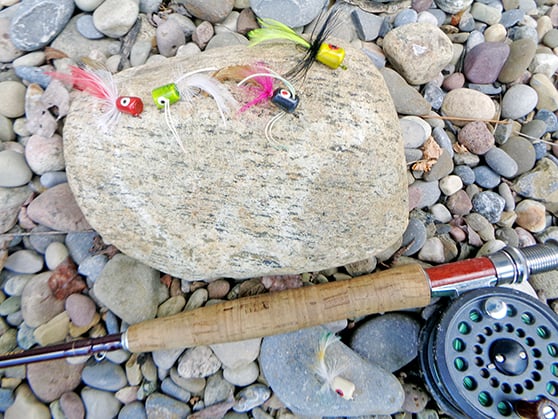
Either way, I’ll make it a point to stow my fly rod and small tackle box stuffed with numbers 6, 8 and 10 cork or balsa wood poppers into the boat while my wife fills a cooler with snacks and bottles of water, along with some sunscreen and of course, the current novel she is reading.
Casting
The nice thing about popping for panfish is that you do not have to be an experienced fly fisherman capable of tying fancy knots or cast a fly 60 yards or more. A simple clinch knot, palomar knot or slip knot will do nicely to hold a lightweight popper on the terminal end of the tippet.
To get the popper over to where the fish congregate, I simply make two or three false cast while stripping out about 15-20 feet of line before allowing it to settle quietly on the water. That is the nice thing about popping for panfish, they are in the shallows not too far from the shoreline.
Even if my popper does not hit where I intended it to land, rather than retrieve it, I allow it to sit there unmoving until the ringlets of water it caused when it landed on its surface disappear. When the ringlets disappear, that is my cue to twitch the rod tip lightly, which in turn makes the popper wiggle, animating it so it sends out more tiny ringlets on the water surface.
MORE FISHING FEATURES FROM OUTDOOR NEWS:
James Lindner: Mapping the modern weedline for summer bass
Chasing New York’s smallmouth bass record? Your odds might be better than ever
How do you catch a limit of Minnesota’s wild brook trout? Search in wild places
Any panfish that happens to be close won’t be able to ignore the lifelike movement and most often can be duped into striking what they see as an easy meal.
It is important that the pan fisherman approach a spot where panfish congregate as quietly as possible and keep from making any loud noise in the boat. Any loud, unnatural nose such as banging an oar or paddle against the boat gunnel or scrapping a tackle box along the bottom of the boat will alert fish, resulting in their reluctance to be lured into biting your floating bugs.
At the same time, I try not to allow the shadow of whatever watercraft we are using to move over the area where the fish hang out. It’s a fact that the sudden appearance of a large shadow moving over a structure will cause fish to spook.
Also keep in mind whenever fishing in clear water, fish can easily see the outline of your watercraft. Therefore, it is best to stay as far away as possible from their underwater liar.
Whenever we fish the Hudson River, I rely on the river current to carry my popper to where the fish are congregating, however, I do rely on casting when fishing a small pond or lake to get my popper to where the fish are hanging out.
If I need to get closer to where the fish are, I paddle or row my watercraft to my targeted area as carefully as I can, hoping to cause as little disturbance as possible.

Finding them
Now that I mentioned it, where do panfish hangout? One of the first things to know is the temperature of the water. That will often indicate where the fish are suspended, in deep water or in the shallows.
If fishing a pond or lake, the next task is to find where the structure is. That will be where you will find the fish. Once you know where the fish are congregating, it’s time to figure out how to approach the spot.
When approaching the area you intend to fish, if possible, keep the sun to the opposite side of where you intend to cast your popper to prevent your shadow from alerting the fish.
At the same time, pay attention to wind direction. There is nothing more aggravating than having a slight breeze or wind push the watercraft over to where the fish are hanging out and then spook them into hiding.
There are two ways to fish water that is flowing. The one I prefer is to position my canoe or rowboat about 25-35 yards off the shoreline, then simply allow the current to move it downstream while I cast my popper toward likely cover.
If my popper elicits a strike on the first pass over a particular bit of structure, I make a mental note of where the strike occurred whether I hooked the fish or not, then later, head back to that spot, anchor the boat, then fish it more thoroughly.
Which popper?
Whether I’m fishing still water or the slow current of the Hudson River, when it comes to choosing a popper, my first choice is to choose one with rubber band legs. If it also has a few feathers attached over the hook, all the better to give it life-like action when the rod tip is lightly twitched.
As far as color goes, my go-to color is white. If that does not do the trick, I’ll change to a bright yellow popper or a yellow one with black rings resembling a small bee.
When fishing the river, or any big body of water, I’ll usually opt to take the semi-vee along with an electric trolling motor. Though not as fast as a gas-driven outboard motor, the trolling motor still allows us to move to different locations much faster than rowing. It also allows us to quietly move to those points we have discovered have the underwater structure pan fish like to congregate in a much more stealthy mode.
Still, I do turn off the trolling motor before we actually reach the area I intend to fish, preferring instead, to paddle to it in hopes of creating less disturbance and not spooking fish.
If all goes well, I’ll soon be catching panfish.
Wisconsin NRB OKs all three fisheries items on Sept. 23 docket
The Wisconsin Natural Resources Board (NRB) approved three rules involving fishing regulations, plus a Lake Superior scope statement, at its

Fall forest fungi: When the woods go quiet – look down
There are days when the forest feels so still that a single falling leaf is enough to grab a hunter’s
Minnesota artist Bob Hautman wins federal duck stamp contest for fourth time
Minnesota’s own Bob Hautman, from Delano, won the 2026 Federal Duck Stamp Art Contest today with his acrylic painting of
