Commentary by Marshall Helmberger/The Timberjay (Ely, Minn.)
The Timberjay has received considerable comment this fall in response to a two-part series examining the causes of the decline in the deer population in our (northeastern Minnesota) region. I was surprised that it was mostly positive, because I recognized that the stories I wrote were challenging some pretty deeply-entrenched views.
The one major factor that I did not address in the series was the effect of winter on deer, which I believe indisputably is the single-most critical factor in white-tailed deer survival in our area. In part, I didn’t address it because I had done so in the past, and because I think most people already recognize that winter conditions play a major role in deer mortality.
I recognize, however, that many see a direct connection between winter conditions and wolves, and they believe that in the absence of wolves, most deer would survive even harsh winter conditions.
That’s why I thought it would be worthwhile to note an interesting story that appeared last year in the state-published North Dakota Game and Fish Department’s magazine, North Dakota Outdoors.
MORE COVERAGE FROM MINNESOTA OUTDOOR NEWS:
Will new aquaculture plan fix minnow shortage issues in Minnesota? Public asked to comment
‘Hundreds’ of geese found dead or dying on Fairmont chain of lakes in southern Minnesota
From mines to the metro, here are some hard-water opportunities for inland trout in Minnesota
Titled “Toll of a Tough Winter,” the story reported on the devastating effects of the winter of 2022-23 on deer populations in south-central and southeast North Dakota. It’s a prairie region, and with lots of snow on the landscape that winter, biologists flew hundreds of hours to monitor populations of both white-tailed and mule deer, which they could see quite easily from the air because of the open landscape.
The researcher who wrote about it was observing in two management areas, and the biologists flew regularly from Jan. 10 to April 7.
During that period, they documented a decline of 51% in the white-tailed deer population and 84% in the mule deer population. And the report’s author noted that even some of the deer that were still alive as of their last flight didn’t appear able to stand and were almost certain to succumb to starvation being experienced.
And keep in mind this important fact: All of this happened in a region completely lacking in wolves.
Quoting one of the biologists who monitored the deer numbers, the story states: “As difficult as something like this is to watch, (Jason) Smith said with little quality winter wildlife habitat on the landscape, the reality, especially during a winter like the last, is oftentimes staggering.”
Compounding the problem, according to the story, was that deer in the region had gone into winter in relatively poor condition because of drought that began in 2001 and didn’t ease until late 2022. Drought affects the nutritional content of deer browse and forage, and that’s not just the case in North Dakota.
We’ve experienced drought with increasing frequency in recent years, and that undoubtedly means deer in our region have been going into winter without the fat reserves they might have in a year with more rain.
And a bad winter, such as we experienced here in 2022-23 as well, has an effect that compounds, as the North Dakota story relates.
“In a winter like we just had, generally what you lose first are the young-of-the-year and then reproduction. So, you’re losing that recruitment cohort and then you’re probably going to lose some of the reproduction side of things because those does are in poor health and aren’t going to probably carry fawns to full term,” Smith said. “And then, depending on how our summer season goes, if we head right into a drought, what’s their condition going to be like going into the breeding season?”
As this story relates, there are critical factors that have major effects on deer survival with or without wolves. There’s an issue with winter cover in North Dakota because open, snow-covered fields offer poor habitat for deer.
And while we certainly have better cover here in northeastern Minnesota, as I noted in the first installment of my series, the quality of our winter cover has diminished, particularly on the public lands that dominate our area. That’s a point that DNR biologists in our region have been making for several years.
While we have better cover compared with the North Dakota plains, we also tend to have significantly deeper snowpack, and our snow often lingers later into spring. And when the snow melts in North Dakota, it typically exposes waste grains left behind from the fall harvest. Here, it can take weeks after the snow leaves until we start seeing new herbaceous growth that provides any nutritional boost.
What this demonstrates is that the issues we’ve been experiencing – declining habitat quality, more frequent drought, and denser snowpacks because we now see more rain during winter storms than we ever used to, is all playing a role in slowing the recovery of our deer population.
In our region we’ve always had wolves and we’ve had a high wolf population for decades. Yet, at the same time, we enjoyed record-high deer populations when we had a beneficial mix of good habitat along with more benign weather conditions. These are the factors that make the biggest difference for deer, and that’s as true in an area like ours, with a high wolf population, as it is on the plains of North Dakota, where wolves were wiped out long ago.
If you’d like to read the entire story from North Dakota Game and Fish, you can find it here. This commentary first ran in the Nov. 14 edition of The Timberjay. It is reprinted here with permission. For more from The Timberjay, including Helmberger’s earlier series on deer in northeastern Minnesota, visit www.timberjay.com.






11 thoughts on “Commentary: North Dakota study shows effects of winter without wolves on whitetails”
Last I knew, mule deer are and have pretty much been non existent in SE North Dakota.
There must be more facts that are missing from this article.
Terrible assumptions made in this article. Why wouldn’t the author relate SW MN, with it’s perennially low deer populations as being more comparable to SE and SC ND?
Winter in North Dakota is going to kill a lot more deer than in NE MN. Deer in ND die mainly from exposure, coupled with lacking food availability. In MN forests, exposure isn’t an issue, neither is food availability….since the browse deer eat in MN isn’t on the ground. It’s above the ground on trees and shrubs. So unlike in ND when there’s a lot of snow, deer still have access to their food source in MN.
In ND mule deer are rarely seen East of the river. Also, blue-tongue wiped out essentially all the whitetails within 50 miles of either side of the Missouri River in ND in 2021-22.
Very poor article.
The author should try to answer this question….why does SW MN have such perennially low numbers since there’s no wolves and winters are significantly milder than in ND?
NE MN used to have the highest deer concentrations in the state. Comparing NE MN to SE ND and assuming there’s only one factor (wolves) that plays a significant role other than the one of winter is a ludicrous assumption to make and absolutely not true. There are countless factors besides winter that contribute to deer mortality in winter in ND that aren’t present for deer in NE MN. In short, this article is a Joke.
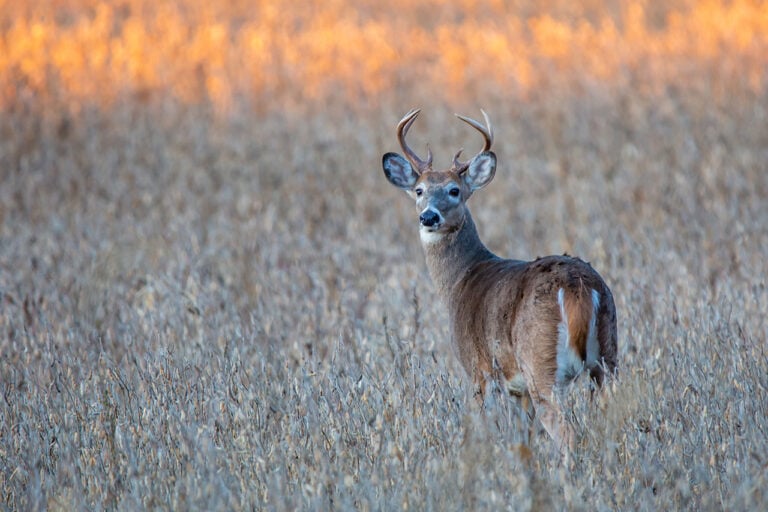
I lost interest in this one from the start. When reading the tittle, it speaks of white-tail deer. But, you don’t have a picture of that species. The picture is of a mule deer.
Credibility kind of went out the window.
This article is very ill prepared. For those of us that have spent 40+ years hunting public land in northern Wisconsin or Minnesota fully understand the impact predators are having on the deere herd. Unfortunately, the people making policy for all of the above factors affecting deer are not wanting the quality deer herd we had through the late 90’s and early 2000’s. The deer left in those regions have concentrated in areas protected from predators such as municipalities and lake regions where predators are less likely to impact fawn production. There is absolutely no question that weather is by far the greatest factor. That being said predators are most effective in those same times as winter severity increases. Bottom line.
1. Better predator control
2. Decreased killing of antlerless deer.
3. Need for responsible people involved in deer management not biased special interests.
If wolves are having an impact on deer in N. Minnesota as numerous hunters claim, then please explain the following. When the deer population was at its highest in the 90’s and early 2000’s so was the Minnesota wolf population at an all-time high and today it’s lower. In addition, some of the most severe winters N. Minnesota had experienced since the 1950s occurred during that same period. Hunters are by far and away one of the most biased of special interest groups and they influence deer management. Then why can’t other special interest groups like Howling for Wolves, farmers and insurance companies be involved since they have a stake in deer management too?
That’s an easy one. The DNR is underestimating the wolf population.
That is false. Learn statistics then read up on MN DNR population survey methods andthey are well within the ball park.
I can’t understand any of the three states mentioned DNR’s not looking further into this issue when considering the income generated by high quality deer hunting. Hard winters take a toll on all wildlife. That should be a given in the upper midwest. The one issue that has changed since the quality of deer hunting has gone down is an increase in the wolf population.
Another issue in WI that is seldom addressed is the increase in bear population. With the difficulty in obtaining a bear permit one would have to wonder why the WI DNR wants to increase the bear population? Any biologist knows that bears kill fawns.
Hunters need to take a look at themselves though. WI and MN have large tracts of public land. Some of it is tough to traverse. With an aging hunter population and fewer of us, deer simply find an area where they are not being bothered. This is especially true of older bucks. If they can find food, water, and shelter they will go where they are not bothered. That is most likely much further into these public land areas than hunter venture. I have no proof of this other than observation that older hunter seldom venture more than a half mile into these areas.
Obviously given that deer will find an area where they are not bothered a private section of land with only a few hunters on it or an owner who doesn’t hunt or let others hunt on the land offers the perfect sanctuary.
Bottom line though is there are fewer deer on the side of the road during the rut than there used to be. In WI the DOT doesn’t pick these carcasses up. So are there fewer deer? Are the deer that exist living in areas further from populated areas? Or have deer learned to exist in populated areas where they can’t be hunted.
I cannot speak of WI but in MN the deer population has decreased from an all-time high in the 90’s and early 2000’s but so has the wolf population. Since you are thinking outside of-the-box I will throw out another factor in possible N. MN deer population decrease. Aging Forests. N. MN was originally covered with conifers and white tail deer were virtually nonexistent. Then logging and uncontrolled wildfires in early 1900s changed the habitat to Aspen/hardwoods. Recent forestry articles have pointed out that N. MN forests are reverting back to conifers. Reasons: shut down of wood producing plants so less logging. The other is fragmentation of woodlands to private small tracts 10-40 acre size) where landowners are not pursuing forest management where the primary tool is logging. There are multiple factors affecting white tail deer population in N. MN and I agree weather has by far the biggest influence. But I think loss of quality habitat is a close second and that appears to be impacted by aging forests, conversion to conifers along with ownership fragmentation.
I tend to agree with your assessment. Being from an area with rather high deer populations and mild winters. When I was in the Superior NF in the fall of 2023 I was trying to figure out how you all had any whitetail at all. I did notice a good bit of sign when I was in areas that had aspen and other broadleaf trees as opposed to conifers, but there were huge stretches of conifers where I saw little, if any sign. I talked to a number of locals and they all wanted to blame wolves, but I simply did not see that as a major influence. Being a landowner that manages my land for wildlife it was immediately apparent to me there was little, if any browse for deer nor mast producing trees. Plus I would notice distinct browse lines in areas with decent browse and this told me that there were more deer than the land could easily support.
To start off: the frickin’ picture is of a mule deer!
Why read any futher.