





This guy I know has always looked smart and talked intelligently, so I listened closely when he said I shouldn’t dismiss rumors that turkeys suppress southwestern Wisconsin’s ruffed grouse.
Later, though, he still hadn’t explained how turkeys do that. He simply noted that turkeys have increased in number and range statewide since their introduction in 1976, while grouse in southern Wisconsin declined.
Therefore, turkeys caused the plummet.
But what about the habitat changes? Haven’t woodlands in that region matured and poplar stands shrunk? Those changes favor turkeys, not grouse, right?
He assured me habitat wasn’t the whole story. His proof? He said male turkeys destroy not only the nests and eggs of hens, but also those of grouse and pheasants. “We aren’t seeing many pheasants anymore, either, so it makes sense,” he said.
Hmm. I hadn’t heard that about gobblers. Why would a gobbler trash a hen’s nest and destroy her eggs?
“Once a hen starts incubating her eggs, she quits breeding,” he said. “So, the gobbler trashes her nest and eggs, and she starts breeding again.”
Fascinating.
So, we’ve been blaming raccoons, possums, foxes, skunks, and coyotes for destroying turkey, grouse and pheasant nests, when the real problem is sexually frustrated gobblers?
“I’m not saying that,” he said. “It’s just another factor those biologists never mention.”
Ah, yes. Biologists are trouble. They like facts. Do you have any evidence, trail-cam photos, or research verifying that gobblers destroy nests? I’m sure they’d look at it.
“Pfft! No! All my trail cams are watching deer trails and my waterholes.”
Fair enough. But just one thing: If gobblers are pillaging all those nests, why isn’t the turkey population as bad as it is for grouse and pheasants?
Our discussion ended.
“We’ll just have to agree to disagree,” he said.
I’ve long wondered why people have so many odd beliefs about turkeys. Myths about them are nearly as stubborn and pervasive as those about whitetails. Prof. Mike Chamberlain, at the University of Georgia, addressed this topic recently in his popular weekly column “Turkey Tuesday” on Instagram.
Chamberlain noted, for example, that even John James Audubon – yes, that Audubon – used to believe gobblers are so logical, cunning, and plotting that they trampled nests and eggs to force hens to resume mating.
Chamberlain, being a biologist, said the claim has no factual backing. “With tens of thousands of nests monitored through decades of research, not a single instance of toms destroying nests has ever been documented or observed,” Chamberlain wrote.
As turkey myths go, however, my favorite was the tale 20 years ago that the DNR was stocking rattlesnakes to reduce Wisconsin’s turkey population. Why? Maybe because the agency secretly believed turkeys were reducing grouse numbers. If you believe that, you must also believe turkeys sometimes drown during downpours by standing in a field with their mouths open to the clouds.
Yes, that’s a myth, too. But imagine that: A bird that’s dumb enough to drown itself could somehow figure out how to stoke hens’ sexual desires by destroying nests.
As with some folklore, the rattlesnake/turkey myth probably sprouted from a smidgen of fact. On Sept. 1, 1999, the U.S. Fish and Wildlife Service – not the DNR – released 15 captive-raised massasauga rattlesnakes at the Necedah National Wildlife Refuge in west-central Wisconsin.
Why? The eastern massasauga, or swamp rattlesnake, was a candidate for listing under the federal Endangered Species Act. Biologists from the USFWS, DNR, and Milwaukee County Zoo believed human intervention was the only way to save this native species from extinction.
Therefore, the first step was determining whether these snakes could be helped through a “head-start” program, which meant raising them to a size that makes them less vulnerable to predators, such as – get this – wild turkeys!
While massasaugas can grow to 2 or 3 feet at maturity in two to three years, they’re often killed long before by raccoons, hogs, skunks, foxes, hawks or eagles. And yes, turkeys.
Before the 15 immature massasaugas were released, the researchers implanted each with radio-telemetry transmitters. The researchers then located them daily that year until they hibernated. Presumably, predators killed four of them before they entered hibernation. In spring 2000, only two of the massasaugas emerged, and one was killed that day by a predator.
One-for-11. Obviously, the experiment didn’t go well. But true believers don’t let facts hamper theories. Can you imagine what they would have said had all 15 little snakes lived? Then again, how would a reptilian strike force of any size control a turkey population that was nearly doubling its size annually during the 1990s and early 2000s?
Had any of these conspiracy folks seen a turkey egg?
No massasauga could swallow one. Besides, massasaugas prey primarily on mice, rats, and ground squirrels. And science finds turkeys are more a threat to snakes than vice versa. Turkeys have never been documented as part of the rattlesnake’s diet, but researchers have documented turkeys eating young timber rattlesnakes.
Meanwhile, the massasauga remains endangered today in Wisconsin.
But why would the DNR have wanted to ax wild turkeys? Contrary to rumors, turkeys don’t cause crop depredation problems comparable to deer, raccoons or Canada geese.
And do the math: In fall 1999, while the feds were releasing 15 massasaugas, the DNR was releasing 55,479 turkey hunters who killed 10,825 turkeys of both sexes and all ages that autumn. And in fall 2000, the agency licensed 69,566 hunters who shot 11,263 turkeys. Meanwhile hunters shot a combined 71,854 spring toms those two years.
Consider, too, that southern states have far more venomous snakes than Wisconsin, and yet they’ve had healthy turkey populations for centuries.
Texas, for example, is crawling with huge rattlesnakes. If those big reptiles can’t control turkeys, how could our smattering of little massasaugas threaten them?
Those are the facts, folks, and you might even find them on Facebook.
Contact Patrick Durkin at patrickdurkin56@gmail.com.

Finding balance in a crowded fishery within northern Minnesota’s Balm Lake
Is it possible for a lake to have too many bluegills and largemouth bass in it? When it comes to
Minnesota’s Outdoor Calendar
A look at upcoming outdoor-related events from across Minnesota published in the Sept. 11, 2026 edition of Outdoor News.
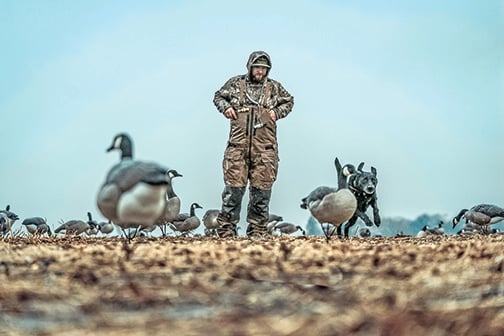
Pro Tip of the Week: Watch long-range forecasts for waterfowl migration tips
Ducks will always have my heart, but chasing Canada geese gets me fired up. There is nothing like big Canadas
