Nine turkeys are released in Vilas County

Posted on March 23, 2006

By Kurt Krueger Correspondent

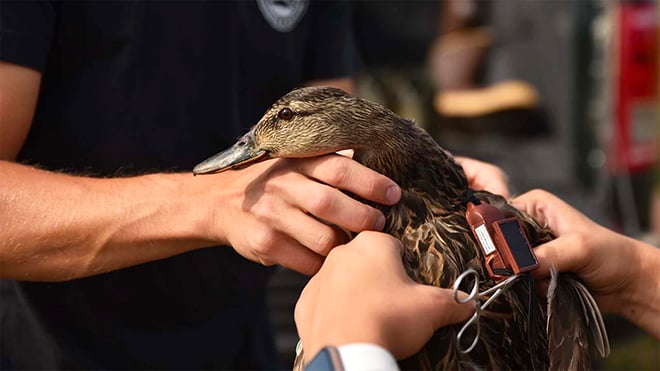
Eagle River, Wis. — Under the watchful eye of students and local turkey chapter volunteers, eight radio-collared wild turkeys were released north of Eagle River on March 9 as part of a study on turkey survival and habitat use.

A total of nine birds were released, but the ninth turkey was not wearing a transmitter.

Biology students at Northland Pines, Phelps, and Conserve School will be monitoring the movements of the turkeys during the next year or more, depending on how long the radio batteries last.

“It’s a pretty small sample size, only eight birds. But that’s all we were allowed,” said Dave Neu, regional wildlife biologist for the National Wild Turkey Federation. “Hopefully, enough will survive through the winter and into nesting season and hopefully as long as the radios last.”

Neu said they hope to learn about mortality, survival techniques, and what types of habitat the turkeys are using at different times of the year.

“It’s pretty unique in the north, and we don’t know a whole lot about turkey survival and habitat use in the north,” he said, noting a similar study with 50 collared birds is being conducted in northwestern Minnesota.

Neu acknowledged there is not a lot of agriculture in the area, but said turkeys have been known to survive in other areas of the country where there isn’t much agriculture.

He said turkeys can eat just about anything, including seeds, insects, acorns, and pine nuts in winter if they can find them. He said food plots, corn, and leftover crops also attract turkeys.

“Pine nuts are a highly nutritious food that is high in oil and calories,” he said. “(Turkeys) could follow deer around and feed where they are pawing things up. They also can go into cedar swamps and eat spagnum moss. They’ll eat lichens off the sides of cedar trees.”

He said turkeys can eat buds, like ruffed grouse do, but it’s not one of their preferred foods and would only be for survival.

“They can sit on the roost for two weeks if it’s bad weather. That’s when they start dying, at the two-week point,” he said, adding that the “book is rewritten” every year on where turkeys can survive, including portions of Ontario, Manitoba, and Minnesota.

The educational study area is as far as DNR biologists were willing to go with a release of the turkeys in Vilas County.

Linda Wynn, the DNR’s game manager for Vilas County, said the lack of natural turkey habitat is her main reason for opposing any general turkey releases at this time.

“Maybe we’ll learn through this study that turkeys will do great here, but that would be a surprise,” she said. “We don’t have the active grain farms and mast crops that make up good turkey range.

“My biggest problem is the fear that turkeys will survive here, but only because of bird feeders and deer feeders. And that is not good wildlife management,” Wynn said. “I prefer that we have wild, natural turkeys that are living off the land.”

She said the benefit of having wild turkeys migrate here from other areas is the higher probability that they will establish themselves naturally in the limited areas of the county that offer the right habitat.

Both Wynn and Neu, a former DNR biologist, stressed the importance of not releasing game farm-raised turkeys into the wild, as they suspect some property owners have done in northern Wisconsin.

“These game farm turkeys do not have the feeding instincts, survival capabilities, or disease resistance of wild turkeys,” Wynn said. “And if they breed with wild turkeys, it could hurt the genetics and general survival of wild turkeys in the Northwoods. It’s a bad idea.”

Neu said 53 of the 62 turkeys trapped two weeks ago in Marathon County went to Iron County, where the local wildlife manager approved releases at two active dairy farms.

Steve Lucareli, committee chairman of the Eagle River Long Spurs Chapter of the NWTF, noted that a limited number of turkey tags were now available to hunters in northern Wisconsin for the first time this spring.

Lucareli urged hunters to refrain from hunting in the area surrounding the release on Hwy. 17 north of Eagle River. He said the five jakes (1-year-old toms) are wearing yellow neck ribbons, and the four hens were fitted with red neck ribbons.

“The study will provide important information on the movements and survival of turkeys here, and obviously any hunting of these birds would be counterproductive to what we are trying to do,” he said.

DNR game manager Ron Eckstein, who oversees Oneida and Forest counties, said he concurred with Wynn’s decision.

“In my counties, we have turkeys now, so I don’t know if we really need releases,” Eckstein said. “In Vilas and other far-north areas, I favor letting the turkey population progress naturally. If they are going to come here, they will.”

Lucareli said he was frustrated that they couldn’t get an extra three turkeys that were trapped last week in Marathon County for release in Vilas.

“They trapped three more than the 50 they needed for Iron County, but they wouldn’t give them to us. They went to Iron County instead,” he said.

Officials say the mortality rate on released turkeys can be as high as 50 percent due to the stress of being handled and predation.

Related media