




We hunters have a certain fondness for tooting our own horns. Whenever there is criticism of hunting, our response almost universally invokes hunters’ role in recovery of wildlife species and the funding our equipment purchases and license dollars generate for wildlife management.
That’s a valid statement.
 Hunters have always, and likely always will, be the ones most willing to pony up for wildlife. I don’t see PETA or the Center for Biological Diversity donating money to state wildlife agencies.
But that shouldn’t let us off the hook. If we’re honest with ourselves, the recoveries we celebrate really aren’t as spectacular as we like to imagine.
Consider this: Before European settlers began slashing and burning their way through this continent, it’s estimated that elk numbered around 10 million strong, ranging from sea to shining sea.
That dropped to under 100,000 by the turn of the 20th Century, and still today, elk estimates sit around 1 to 1.1 million. That’s barely 10% of what was.
Mule deer and black-tailed deer also numbered around 10 million prior to settlement. It’s thought that fewer than 50,000 remained in 1900, and numbers rebounded (and peaked) at about 9 million animals in the 1950s and 1960s. Today, those numbers are more like 3.5 million, a more than 60% decrease in the past 60 years.
Pronghorn are their own entity – their numbers were so great that total population was estimated to contain between 30 million and 60 million animals before Europeans arrived. I consider myself both a student of wildlife and of history, but even I was shocked by that number.
They may have been the most abundant ungulate on the continent at one time. By the 1920s, their numbers had plummeted to 13,000. Today, estimates sit between 800,000 to 1,000,000 speed goats across the continent, barely 3% of their most conservative peak number.
MORE COVERAGE FROM MINNESOTA OUTDOOR NEWS:
Game Fair forum questions Amy Klobuchar on Minnesota outdoors topics
Minnesota’s Lake Mille Lacs reaches 71% of state’s walleye harvest quota
Minnesota DNR using time stamp data to distribute remaining surplus bear tags after ELS disruption
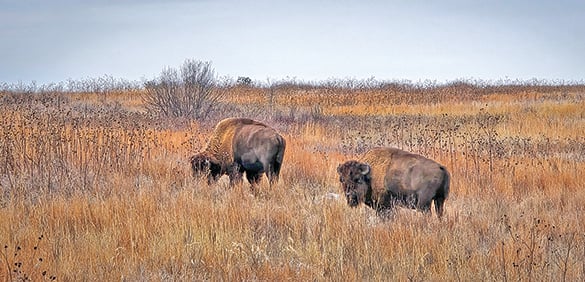
Which of course leads me to bison. It’s widely known that their numbers ranged between 30 million and 60 million before European settlement. It’s also well known that the population cratered to under 1,000 individuals before 1900. Today, the highest estimates center around 500,000 animals, which includes those raised for livestock. That hardly counts at all, if you ask me.
If we’re only counting those animals in conservation herds, we have about 21,000 legitimately wild-type bison left. That’s less than one-tenth of 1% of their most conservative peak number.
Before ol’ Eeyore here continues down the path of doom and gloom, let’s pause and recognize that, were it not for hunters, each of these species would likely be extinct today.
That we still have them at all is nothing short of miraculous, and it took a lot of moxie and bullheadedness from many people to keep them here. We will never be able to repay the courage, hard work, and foresight that early conservationists had to preserve these species so we could see them in person rather than a museum.
But this is where my positivity stops, because too many hunters for too long have felt comfortable sitting on these minor successes and resting on those laurels. Most of us act like these are settled matters, and our work here is done. To me, that sounds like a great way to lose most of the progress achieved and leave future generations with a far worse situation than we’ve inherited.
In fact, I’d argue the only species we’ve truly recovered on this continent are whitetails and maybe, maybe, black bears. Beyond that, not a single ungulate or large species is close to the numbers that would have existed before this continent saw “progress.” Worse still, most of the ungulates occupy a fraction of their historic range.
I cannot stress how much this bothers me, because if hunters can’t even see this as a problem, I guarantee that less than 1% of the rest of society gives two shakes about it. We need to wake up.
I can already hear rebuttals from the lazy segment of hunters who either don’t care or aren’t willing to put any effort in. “We don’t have room for those animals anymore.” “We’ll never recover them all, it’s impossible.”
Sounds like excuses coupled with a lack of imagination and creativity to me.
I’m not naïve. I’m fully aware that we’ll never have 30 million pronghorn or bison in my lifetime. We’ll probably never get back to 10 million elk while I’m alive. But that doesn’t absolve us from trying for the benefit of our children’s children.
It’s simply unacceptable to me that we’re happy to call 1% or 10% recovery a success story. While those are important milestones that should be recognized, we should call them what they are – steppingstones on the way to more robust populations.
When anyone tells me we don’t have room for these critters, all I need is one simple number: 35% of the corn grown in this state goes towards ethanol production. That means roughly 3 to 4 million or so acres in Minnesota alone are being completely wasted every year on a commodity crop that our vehicles absolutely do not need to run. Can you fathom what this state could look like with 3 million more acres of diverse native prairie on the landscape? I can. And I can envision elk roaming them.
But this brings up another important consideration: social tolerance. It’s a huge reason why elk and bison, in particular, have never recovered. And it’s not that mainstream society won’t tolerate them – it’s that farmers and ranchers won’t. Until we find a way to circumvent the huge power of the Big Ag lobby, we will never meaningfully recover these species.
Andrew McKean, hunting and conservation editor for Outdoor Life, has documented these issues extensively, particularly around bison. If you haven’t seen his work, I’d recommend it. He gives a very honest look at why we aren’t as great as we say we are. In the same vein, I maintain that we shouldn’t allow the minority that the Big Ag lobby represents to completely railroad wildlife conservation in this country.
Apart from game species, grassland birds, and pollinator populations have been cratering for the past 30 years. They may not be game species, but these proverbial canaries in the coal mine are telling us something about the health of our landscape. We sure as hell should be listening to them, because the way they go, so does the wild turkey, and the pheasant, and the waterfowl.
This is actively happening on our watch, and I cannot accept that we’ll just stand by and let it happen. We’re facing perhaps a similar scale of challenges that our forefathers faced. Our words and actions will dictate what’s left for our children and their children.
Nobody else is going to do the hard work for us, and rest assured, it will be a hard row to hoe. But I’m up for it. If I can pack out a deer for five miles, I damn sure can speak up for wildlife and the places they call home. I just hope there are enough hunters that feel the same way.
Wisconsin NRB OKs all three fisheries items on Sept. 23 docket
The Wisconsin Natural Resources Board (NRB) approved three rules involving fishing regulations, plus a Lake Superior scope statement, at its
Fall forest fungi: When the woods go quiet – look down
There are days when the forest feels so still that a single falling leaf is enough to grab a hunter’s

Minnesota artist Bob Hautman wins federal duck stamp contest for fourth time
Minnesota’s own Bob Hautman, from Delano, won the 2026 Federal Duck Stamp Art Contest today with his acrylic painting of

2 thoughts on “Ryan Rothstein: Assessing America’s wildlife recovery journey”
If you had taken the time to look at the CBD website, you would have seen that the action alerts there are topped by a call to arms to support the pending legislation to reverse the Gasbag’s attack on the habitat protection enshrined under the Endangered Species Act:
https://act.biologicaldiversity.org/KTRqBI7nc0-uSrW6a-tqDg2?sourceid=1011174&oa_ad_referrer=action-alerts&utm_source=website&utm_medium=web&utm_campaign=action-alerts&_gl=1*1942gnu*_gcl_au*MTk4OTAxOTIxOS4xNzg2NzUwNTc1
And:
” Appeal Aims to Keep Dunes Sagebrush Lizards Protected in Texas, New Mexico
MIDLAND, Texas— The Center for Biological Diversity today appealed a federal court’s decision that allowed the Trump administration and the state of Texas to strip dunes sagebrush lizards of their federal Endangered Species Act protections.
“We’re tired of the Trump administration putting politics and polluters over science at the expense of struggling wildlife like dunes sagebrush lizards,” said Jason Rylander, a senior attorney at the Center. “These lizards are clearly endangered and need federal protection to survive, so we’re appealing to prevent their extinction. We need to make sure the federal government follows the law and does its job or these critters won’t have a fighting chance.”
https://biologicaldiversity.org/w/news/press-releases/appeal-aims-to-keep-dunes-sagebrush-lizards-protected-in-texas-new-mexico-2026-08-14/