




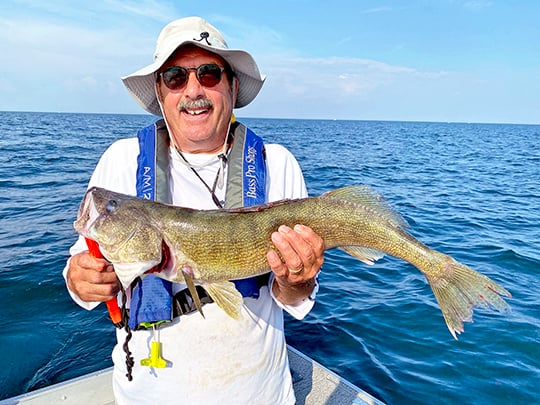
New York’s portion of Lake Erie was unbelievable in 2025 when it came to walleye catching.
It set the all-time mark for catch rates in the history of record keeping conducted by the state’s Department of Environmental Conservation DEC. Anglers pursuing old marble eye were left chuckling and shaking their heads as many filled their six-fish limits in record time on the water, day after day.
Capt. Jim Steel, of Dream Catcher Sportfishing, offered up the best quote to recap last year on the lake: “You could go out on the lake and do everything wrong and still catch a limit of fish.”
“The walleye catch rate 11 walleye/trip-was the best in the 38-year survey, with 2 in 5 anglers getting their 6-fish limits,” Dr. Jason Robinson, leader of the Lake Erie Fisheries Research Unit out of Dunkirk, said. “The overall daytime harvest in the New York waters of Lake Erie was 173,236 walleyes, with over 230,000 walleyes caught.”
An estimated additional 6,000 walleyes were harvested during the spring nighttime fishery.
MORE FISHING COVERAGE FROM OUTDOOR NEWS:
New York Outdoor News’ Great Lakes preview: Amazing fisheries continue to produce
Five big-bass sweetspots in the Great Lakes
Mastering muskie fishing’s art of the figure eight
So, how many fish are out there? That’s always a subject for debate and impossible to determine an exact number. Last year, resource managers estimated that there were about 77 million walleyes in Lake Erie.
“There are an estimated 58 million age-2 and older walleye in the lake in 2026,” Robinson said. “However, this population estimate does not include the eastern basin walleye stocks, which are important to the local fisheries. The eastern basin stocks are estimated to contribute an additional few million walleye to the population.”
Last year was like a perfect storm when it came to walleye fishing. Why was it so good?
“A few factors came together to produce stellar walleye fishing in 2025,” insists Robinson. “The run of excellent walleye year classes in the west basin are now old enough to fully contribute to the eastward summer migration. East basin populations are also thriving and contributing to our local fisheries.
Additionally, prey fish populations were down in 2025, creating competition and aggressive feeding behavior for predators like walleye, making them more vulnerable to fishing.”
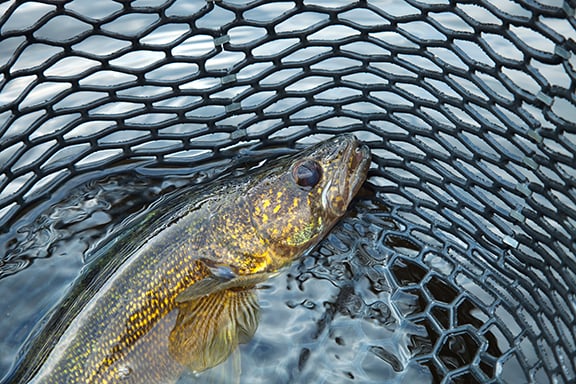
Looking at 2026
Will fishing be as good in 2026? So many factors come into play for the fishing season, many of them are weather driven. Water and air temperatures, wind velocity and direction, and forage base are all considerations: keep that in mind.
“Walleye fishing is expected to be well above-average in 2026,” continued Robinson. “However, the decline in the number of adult walleyes over the last few years may cause angler catch rates to be lower than the all-time highs seen in 2025.”
There is one big positive that is well above the curve for public access to the lake this year: Sturgeon Point. The popular Lake Erie access site is at the mercy of springtime dredging that is conducted through a bidding process by the Town of Evans.
Last year, the work wasn’t completed until May 15: losing the early yellow perch fishing and the first couple weeks of walleye season. Those DEC creel numbers could have been higher. Heading into 2026, though, the dredging work was completed earlier, and the docks were installed by April 8: great news for fishermen and women.
Walleye dominated 71%-the fishing effort in 2025, followed by bass 16%-in 2025. The smallmouth bass catch rate 15 bass/trip-was slightly above average. The yellow perch catch rate 35 perch/trip-was the fifth best in the 38-year survey.
“Overall, New York Lake Erie anglers experienced an excellent year of fishing regardless of what species they were targeting.”
Lake Erie gold
There is a golden piscatorial treasure sought after by anglers in Lake Erie: yellow perch. It was another great year for perch pursuers in 2025. The average size for a New York harvested yellow perch was over 11.5 inches, which remains the highest in the lake. Will it continue?
“Yellow perch fishing quality in 2026 should be average,” predicts Robinson. “The 2020–2022-year classes 8–12 inches-are average to above average and will likely dominate the catch in 2026. Anglers may still catch some of the strong 2016-year class 12+ inches), but the frequency of encountering these jumbo perch is expected to dwindle as this year class ages out of the population. The last three years have produced below average hatches for yellow perch. While recent perch fishing has been very steady, the lack of recruitment in the last several years will likely lead to lower catch rates in the next few years.”
It’s important to note that the early season perch fishery is becoming increasingly popular in recent years as spring ice cover has decreased. Last spring was no exception, with April accounting for 69% of the entire 2025 yellow perch harvest. Perch action was taking off like Artemis II at the time of this writing in 2026 with many limit catches being reported. However, storms and strong winds kept boats at home many days.
The number two sought-after species in the lake is black bass, thanks to another Top 10 ranking from Bassmasters in 2025 as one of the top bass fishing destinations in the country.
“Based on DEC’s warm-water gill net survey, age-6 and age-10 bass will dominate the catch in New York waters of Lake Erie in 2026,” forecast Robinson. “Predicting bass fishing quality is difficult compared to perch or walleye. Even though DEC’s warmwater survey indicates a below average bass population in Lake Erie, the angler survey continues to show high catch rates exceeding 1.0 fish per hour, among the best in the nation. While there are noted overall declines in the bass population, there has been a shift towards Buffalo in both the bass population and in angler effort, and Buffalo continues to produce the highest catch rates. This trend is expected to continue with the highest quality angling occurring out of Buffalo in 2026.”
One change in 2025 was the creation of a new permitting process for anyone holding bass tournaments with 10 or more participants.
“The new bass tournament permit process has had support from most tournament groups around the state. However, DEC is still working with some local angling groups to get permits for their Erie-based tournaments. Only one permit was issued for Lake Erie in 2025. That number is expected to increase in 2026 as tournament organizers become aware and get better acquainted with the process. Applications for tournament permits are free and must be submitted 45 days prior to the tournament.”
Lake trout updates
Lake trout, part of a federal restoration effort with the U.S. Fish and Wildlife Service, continues to be a success story in Lake Erie.
“Lake trout fry was documented again in 2025, collecting fry at four new reef locations,” recapped Robinson.
“DEC anticipates placing fry traps in additional areas this spring to examine the level of production occurring in these other locations.
“There is currently an abundant and older population of lake trout in Lake Erie, with the average fish measuring over 29 inches and weighing 11.8 pounds,” he continued. “Anglers may even encounter 20-plus pound lake trout and fish approaching the state record are not out of the question.”
The current state record laker is 41-1⁄2 pounds, caught by Jesse Wykstra in 2003 in Lake Erie out of Chautauqua County.
Speaking of lake trout, DEC fisheries biologists could use a little help from anglers in Cattaraugus Creek. Biologists stocked lake trout in the creek from 2018 to 2020 to establish a run/return into New York’s largest tributary of Lake Erie. The agency would like to document any returns.
“DEC received multiple angler reports of lake trout in Cattaraugus Creek this past fall, marking the first sign of potential success from the experimental Cattaraugus Creek lake trout stocking,” said Robinson. “Unfortunately, we couldn’t obtain any of the creek run lake trout that were caught to confirm if they were from the creek stocking. DEC will continue to monitor this stocking effort and are relying on anglers to let us know if they catch a lake trout in Cattaraugus Creek, or any other Lake Erie stream.”
In the tribs
This is a perfect segue into the tributaries off Lake Erie and how things are going with the steelhead stocking program that DEC is involved with.
In 2025, 140,900 steelhead and 50,250 domestic rainbow trout were stocked, which was roughly 1,500 fish below target. The 2026 stocking target remains at 142,500 steelhead and 50,000 domestic rainbow trout.
“Steelhead fishing was slow in Sept. until midway through October when precipitation created high enough flows to bring fish in,” reported Robinson. “This winter was tough, and many of the tributaries were frozen over from the end of January through February, limiting fishing opportunities.”
The spring season looks promising, with fish already running with the warm temperatures and high flows we’ve had. The recent 2024-25 creel survey results will be available in the 2025 Lake Erie Unit annual report, and the next tributary creel survey is scheduled for the 2027-28 angling season.
Steelhead stocking numbers were reduced in 2020 to accommodate an experimental rearing approach to grow larger fish at the Salmon River Fish Hatchery SRFH. Stocking size has increased but is variable from year to year due to infrastructure limitations such as water availability and temperature-at the hatchery.
However, the recent round of steelhead rearing research at SRFH has been very promising. The staff at the hatchery have done some great work and it looks like they will be able to raise steelhead to their 6-inch target in the future.
“The Lake Erie Unit is also working with SUNY Brockport to assess the adult returns of our domestic rainbows/steelhead and the contributions of steelhead stocked in other jurisdictions to New York Lake Erie tributaries,” he said.
There is still hope that the Scoby Dam at Springville will allow for fish movement into the upper reaches of Cattaraugus Creek, but there is a delay in moving forward.
“The Springville Dam Ecosystem Restoration Project has been on indefinite hold since March 2020 due to funding and real estate issues to be addressed before proceeding,” says Robinson.” DEC continues to engage in discussions with Army Corps of Engineers and Erie County.
Should this project ever become a reality, there are several benefits to allow for fish passage. One is that it would open 30-plus miles of additional public access. Another is the possibility of increased natural reproduction.
“Chautauqua and Cattaraugus Creek have some of the highest quality steelhead spawning and rearing habitat in Lake Erie,” Robinson said. “However, natural recruitment remains relatively low. Approximately 10% of Lake Erie adult steelhead are of wild origin, which is insufficient to maintain a viable fishery without annual stocking.”
While we are talking steelhead, there was a new pen rearing project in Dunkirk Harbor that was implemented in 2026, joining Bison City Rod and Gun Club’s project in the Buffalo River as a second pen site.
The Buffalo River steelhead pen-rearing project, in partnership with the Bison City Rod and Gun Club, continued in 2025: the 19th year of the project. A total of 7,500 unmarked yearling steelhead were stocked into two net pens to improve post-stocking survival and imprinting. Fish were held for 22 days and had a 34% increase in weight with almost no mortality.”
The project is scheduled to continue in 2026.
“In 2026, a new steelhead pen-rearing project began in partnership with the Northern Chautauqua Conservation Club in Dunkirk Harbor. A total of 3,000 unmarked yearling steelhead will be stocked into one net pen. As with the Buffalo River project, the goal will be to improve post-stocking survival by growing the fish larger in the net pen before release. It is still unclear if the fish from this project will imprint on the harbor or return to a nearby tributary, but their improved size will undoubtedly increase survival,” said Robinson.
More species
There are other fish species that became part of the Lake Erie management process last year, including lake sturgeon and cisco.
“Nearly 1,000 lake sturgeon were stocked into Cattaraugus Creek in October 2025, marking the first year of a 25-year stocking plan for Cattaraugus Creek,” reported Robinson. “The goal of this stocking effort is to re-establish a self-sustaining lake sturgeon population of 750 individuals in Cattaraugus Creek by 2049. Sturgeons stocked in 2025 were PIT tagged to aid in evaluating the presence of wild juvenile sturgeons. This new sturgeon stocking is a cooperative effort involving the Seneca Nation of Indians, DEC, and the U.S. Fish and Wildlife Service.”
When asked about the acoustic telemetry tags placed into Buffalo Harbor Lake sturgeon several years ago, Robinson noted that those tags are almost all past their expected battery life. However, the agency is still monitoring the health of that population on a periodic basis in cooperation with U.S. Fish and Wildlife staff. The next sampling event is scheduled for this May.
Last year, DEC also began a 10-year experimental cisco stocking program in New York waters of Lake Erie. DEC stocked 86,000 yearling cisco off Dunkirk, and plan to stock 150,000 cisco in May 2026. Fish are being raised at the Allegheny National Fish Hatchery.
“The plan goal is to see if stocked cisco will survive to adulthood in today’s Lake Erie,” said Robinson.
According to Robinson, cisco was historically the primary target for commercial fishers in Lake Erie, yielding as much as 40 million pounds of fish a year in the late 1800s, peaking at 48 million pounds of cisco harvested in 1918. Cisco were also native forage for predators such as lake trout and walleye.
Forage base
While we are on the topic of forage for predator fish, what is the status of the forage base? That must be crossing the mind of anglers as they experience the wealth of game fish species available in this Great Lake.
“Low forage numbers are being seen across the lake, likely driven by the high number of predators over the last decade,” recapped Robinson. “Alewife numbers had been a concern, but following last year’s cold winter, the alewife numbers have plummeted. Another cold winter in 2025–26 should keep the alewife numbers down for the next several years. Due to the low forage, we have seen shifts in prey selection for some of our predator fish species.”
Of course, we are just scratching the surface of what is going on in Lake Erie. Join a fishing club like Southtowns Walleye Association of Western NY or the Western NY Walleye group. The WNY Chapter of Trout Unlimited and the Lake Erie Chapter of Fly Fishers International are also pro-active groups dedicated to fishing and habitat improvement.
And if you want to hire a charter captain to take you out fishing, look no further than the Eastern Lake Erie Charter Boat Association. Do everything you can to enjoy this incredible resource.
Ralph Loos: Illinois Outdoor Hall of Fame class has common interest: being useful
You could make a pretty long list of reasons why people get involved in outdoor conservation. Some love hunting. Some
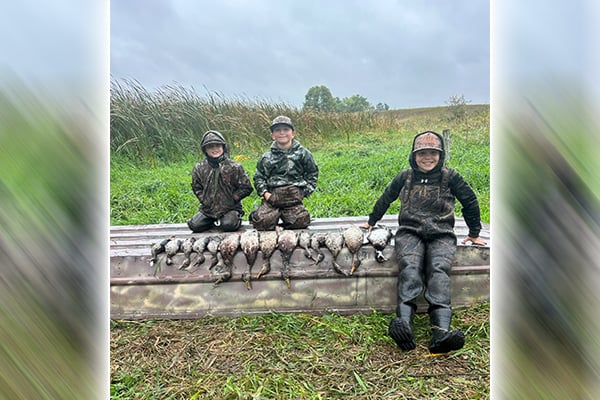
Mixed bag of success as many Minnesota hunters face a wet waterfowl opener
It felt like a “ducky day” in Minnesota for Saturday’s waterfowl opener.
Many hunters shot through rain and strong
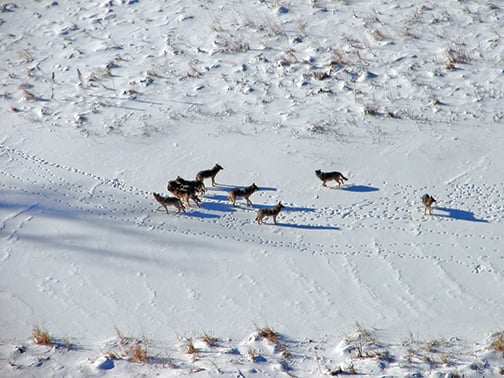
Minnesota’s wolf population remains stable, DNR considers new monitoring
Minnesota’s wolf population remained statistically stable within confidence intervals from 2025 across nearly 26,000 square miles of wolf range, but
