




Home » Home Page News » Commentary: Theodore Roosevelt’s descendants urge U.S. senators to protect the Boundary Waters
Commentary: Theodore Roosevelt’s descendants urge U.S. senators to protect the Boundary Waters
Dear United States Senators:
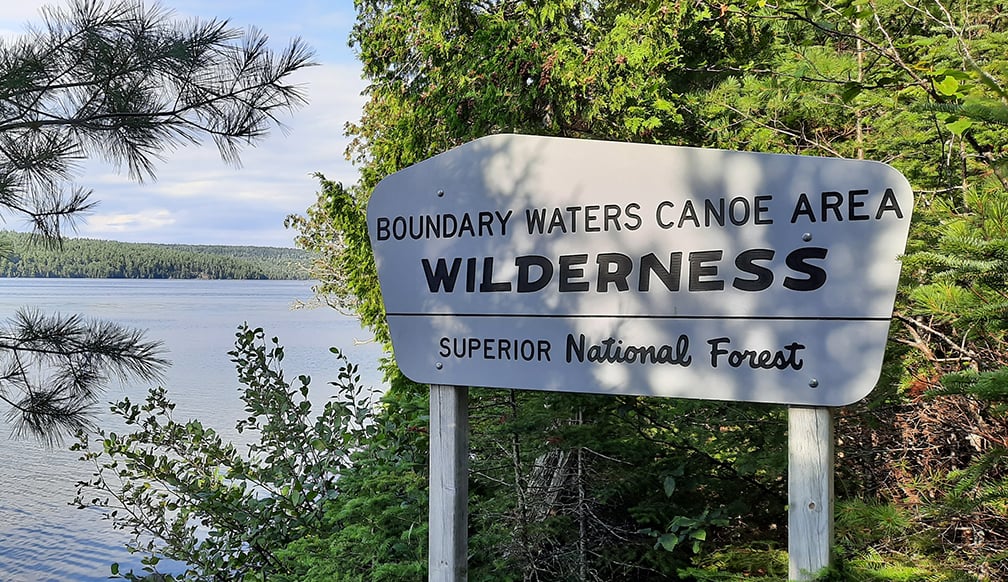
The purpose of this letter is to strongly recommend all senators vote against H.J. Res. 140, to ask you to work with President Trump to seek ways to permanently protect the Boundary Waters, and to send a unified message that America is still a land that relentlessly protects its greatest wilderness terrain.
The House resolution erroneously uses the Congressional Review Act (CRA) to disallow the current withdrawal of over 225,000 acres in the headwaters of the Boundary Waters and would greenlight exposure of this national treasure to the highly toxic and destructive effects of sulfide-ore copper mining. It is faulty on several key fronts:
• It’s the opposite of America First: The mining company in question is foreign owned, will use Chinese state-owned smelters, and will then sell the extracted metals on the open market.
• It removes the American public from public land decision-making: A key priority of American public land policy always has been to have a strong bias toward obtaining robust public input. Hundreds of thousands of Americans have already weighed in on the Boundary Waters – and they overwhelmingly want it protected forever.
MORE COVERAGE FROM MINNESOTA OUTDOOR NEWS:
Spring light goose orders kicking off in the Upper Midwest; here’s what conditions look like
Ice cave enthusiasts flock to Lake Superior’s Apostle Islands for first time since 2015
So you want to own a quality fly rod? Here’s what to consider
• It disregards sound science: A detailed Environmental Assessment already has documented the substantial risk sulfide-ore mining poses to this highly valued ecosystem.
• It sets a bad precedent for other public lands: Using the CRA in this fashion, which has never been done before, would put at risk other public land withdrawals across America to similarly irresponsible actions.
Finally, the proposed resolution is diametrically at odds with the conservation legacy of President Theodore Roosevelt. For all these reasons we feel a deep obligation to TR to speak loudly in support of this exceptional American wilderness area. As TR said at the Grand Canyon in 1903, we now reiterate with the Boundary Waters today: “Leave it as it is.”
Vote no on H.J. Res. 140, or any other similar legislation, and seek creative ways to protect the Boundary Waters forever. Frankly, TR would be appalled at H.J. Res. 140 and the misguided and harmful effort to revoke a sound and necessary mineral withdrawal in the headwaters of the Boundary Waters.
To understand TR’s perspective on all this, it’s important to review a little of his history, starting with Minnesota.
TR had a strong affinity for Minnesota
TR’s love of Minnesota emanated directly from Lincoln and Grant’s leadership during the Civil War.
Minnesota immediately stepped up to support the dire cause. TR had a huge amount of respect for the First Minnesota Regiment, who literally saved the Union at Gettysburg. It’s perhaps why, shortly after the Civil War as a 10-year-old sitting in Germany, TR dreamed of proudly going to Minnesota someday.
He hoped to get there when he was 14 and cheered in his diary about the prospects: “hip, hip, hurrahhhh!” In 1880, TR’s first extended hunting trip to the West brought him as far as the Red River in Moorhead, when he also briefly ducked into the Dakota Territory for the first time.
From then on, TR’s strong historical connections and interest in Minnesota accelerated exponentially – in 1883 he signed his first cattle ranching contract in St. Paul; in the rest of 1880s and into the 1890s he crossed through the state on many memorable occasions; in 1900, he launched his vice-presidential campaign in Minnesota; and in 1901, he gave his famous Big Stick speech at the Minnesota State Fair.
These are just a small sampling of TR’s oversized affections for Minnesota.
TR worked to protect Minn.’s forests and water
It should come as no surprise that TR’s appreciations for Minnesota translated into an aggressive pursuit of protecting the state’s favored forests and water. In 1902, shortly after taking office, TR used scientific forestry to establish the Minnesota Forest Reserve, which was later renamed the Chippewa National Forest. It was the first national forest reserve in America east of the Mississippi and the first one set aside through an Act of Congress rather than by presidential proclamation.
Around that same time, closer to America’s northern border, TR’s administration withdrew hundreds of thousands of acres in Lake and Cook counties (in the vicinity of the Boundary Waters) to get a jumpstart on protecting this even more pristine source of water. Finally, in 1909, for “the public good,” TR formally established the much broader Superior National Forest, where the Boundary Waters Canoe Wilderness Area resides.
Based on all of these proactive measures, there’s no doubt TR wanted Minnesota’s greatest natural resource, its most beloved boundary waters ecosystem, protected in perpetuity for all future generations to enjoy – it was a central tenant of his balanced approach to conservationism.
Saving the BWs makes common, bipartisan sense
Because of the foresight of America’s early Republican leaders, the Boundary Waters has risen (as per the Department of the Interior) to become America’s most heavily visited wilderness area. Its greatness goes way beyond Minnesota, it is the fourth pillar of all of America’s greatest continental wilderness terrain (Yosemite – Lincoln/Harrison, Yellowstone – Grant, the Grand Canyon – Roosevelt, and the Boundary Waters). Saving it from the devastating effects of sulfide ore mining is therefore the conservation imperative of our time and should be bipartisan in nature.
It is bipartisan in Minnesota, as evidenced by the fact 70% of Minnesotans want the Boundary Waters permanently protected. Minnesotans know, aside from the devastating impact on the environment, copper mining in the Boundary Waters would deal a crushing blow to a great rural American economy – it would kill jobs, dampen growth, decrease affordability, and erase any meaningful prospects for future economic prosperity in the region. For all these reasons, we are positive TR would want the Boundary Waters protected – in a bipartisan fashion – but sadly the passage of H.J. Res 140 in the House puts all of this in grave jeopardy.
Our specific ask
To America’s senators, please do all you can to protect this national treasure. On both sides of the political aisle, we strongly ask you to vote no on this resolution and any other similar legislation proposed in the future.
TR was active in preserving our greatest wilderness terrain on both the East and West coasts – it became one of the greatest enduring legacies of his life. It is now time for all of you to get in the arena with him.
We implore you to do your own parts to ensure TR’s common sense approach to conservationism is as strong today as it was more than a century ago. There is no better way to do this than to preserve the greatest wilderness terrain in the middle of America’s Heartland – the Boundary Waters.
Protecting the Fourth Pillar
In conjunction with America’s 250 birthday, we ask you to honor President Theodore Roosevelt’s conservation legacy. As TR’s Presidential Library formally opens in Medora, North Dakota on Independence Day, three pillars of TR’s life will take central stage: Leadership, Conservation, and Citizenship. It’s one thing for politicians to say they believe in these three pillars, and it’s quite another thing to act that way. We humbly submit it would be hard to gift America a more meaningful fourth pillar – one that better unites these three aspects of his legacy – than a huge enduring present in the form of a permanently protected Boundary Waters.
Finally, it should be noted the signatories below represent the three branches of Theodore Roosevelt’s family emanating directly from his three sons who all served in both World War I and World War II. Quentin Roosevelt was sadly killed in action in World War I, or he certainly would have also risen to the call of service a second time.
The four of us below have never collectively co-signed a letter together, which should give an indication of how strongly we support voting no on this resolution – and then voting yes on permanent Boundary Waters protection.
We greatly appreciate your time and attention to this request.
Theodore Roosevelt IV TR’s Great Grandson
Co-Signers (Relationship to TR) – Branch of Family
Tweed Roosevelt (Great Grandson) – Archie Roosevelt branch
Kermit Roosevelt III (Great Great Grandson) – Kermit Roosevelt branch
Mark Roosevelt (Great Grandson) – Kermit Roosevelt branch
SUBSCRIBER CONTENT
Read this article now.
Create a free Outdoor News account.
Create a free account below to get instant access to this article, thousands of Outdoor News stories, and our digital editions. Your 1-month trial starts the moment you sign up.
No credit card required
No credit card required
Subscriber? Login Here.
Share on Social
Hand-Picked For You
New York Fishing Report – September 18, 2026
Lake of the Woods Fishing Report – September 22, 2026
Minnesota’s 2026 elk harvest reaches nearly half of allocated tags during early season
Northern Wisconsin Fishing Report – September 17, 2026 – video
Have a game plan – video
Metro Area Fishing Report – September 20, 2026
Related Articles

Minnesota’s 2026 elk harvest reaches nearly half of allocated tags during early season
As the first half of the elk season winds down in northwestern Minnesota, nearly half the tags have been filled

Upper Herring Lake offers western Michigan bass anglers a legitimate fall option
Bass can be widely distributed through the vegetation, but cooling water often triggers more active feeding.
Michigan’s Outdoor Calendar
A look at upcoming outdoor-related events from across Michigan published in the Sept. 25, 2026 edition of Outdoor News.

3 thoughts on “Commentary: Theodore Roosevelt’s descendants urge U.S. senators to protect the Boundary Waters”
I totally agree with the letter submitted by the Roosevelt family. Wilderness is a precious resource that MUST be protected and preserved. Once it is damaged or destroyed it is gone forever.
Fantastic letter on behalf on the BWCAW!
Well spoken and persuasive, TR would be proud to have young Roosevelts on his Bully Pulpit!
I went there with my brother when I got out of the Air Force in the 70’s What a remarkable place to feel at peace with the surroundings.Please don’t ruin it.Let other people experience it.