Minnesota is well known for frigid cold and lots of snow, and this winter is no different.
According to climate data, average 24-hour temperatures for December through February in the state are around 10 degrees Fahrenheit in the north and 18 degrees Fahrenheit in the south. But temperatures can plunge well below zero, as much of the state will experience over the next few days.
How do trees survive such cold? Like Minnesota’s wildlife (and Minnesotans themselves!) trees have adapted to survive this cold. Here are four ways the forests survive those deep winter days and nights.
Trees’ cells have natural “antifreeze”
Living trees are full of water – but since water expands when it freezes, what keeps trees from bursting open in winter?
The water inside their cells contains dissolved substances, like sugar and other compounds, that lower the freezing point and prevent damage. This helps native trees like quaking aspen, which can survive temperatures colder than 50 below zero.
Despite this natural protection, trees can get “frost cracks,” which are vertical cracks in the wood caused by rapid temperature drops when the water and sap inside the tree freeze and expand. Those cracks tend to happen at a weak spot in the bark.
Native trees can get frost cracks, but non-native trees are more susceptible if they’re not adapted to the weather. Frost cracks aren’t fatal, but they make a tree more prone to decay, insects, and disease.
MORE COVERAGE FROM MINNESOTA OUTDOOR NEWS:
Management plan for Minnesota’s Keystone Woods Wildlife Management Area near completion
Legislation to open mining near Minnesota’s Boundary Waters moves to Senate after House vote
The story of a Minnesota lynx who came to visit
Winter dormancy conserves energy
Hibernation isn’t unique to animal species.
As day length shortens in fall, many tree species such as birch and maple enter dormancy, a resting state similar to hibernation. Their metabolism slows, above-ground growth stops, and energy use drops, allowing them to conserve resources until spring.
Trees drop or keep their leaves
Deciduous trees, like maples, birches and aspen, have leaves that aren’t very cold hardy.
To conserve energy and water contained in their leaves, deciduous trees move nutrients from leaves into their hardier woody tissues in the fall, then drop their leaves.
Coniferous trees, on the other hand, hold less water in their leaves (or needles), which also have a protective wax-like coating that reduces their risk of freezing. By keeping their leaves through the winter, coniferous trees also continue to produce energy through photosynthesis.
Trees are shaped for shedding snow and maximizing sunlight
Conifer species dominate the coldest forests on the globe. There are a few reasons, but one is their shape.
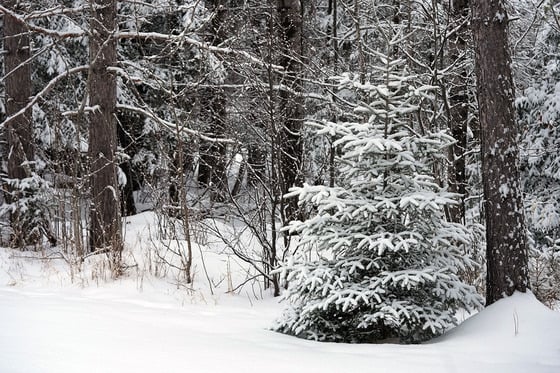
The traditional, conical shape of a pine or spruce helps the snow slide off their branches, and their limbs are shorter and more flexible, reducing risk of breaking. The relatively longer lower branches of conifers, as compared to the more umbrella-like shape of some deciduous trees, also help the tree absorb more sunlight and photosynthesize when the sun is lower on the horizon, as it is during Minnesota winters.
Minnesota’s native trees have evolved strategies like these to survive and thrive in harsh winter conditions. These adaptations set them up for success come spring and highlight the importance of native species in building resilient ecosystems.
The DNR offers resources, seedlings and forestry services to help landowners learn more about trees, forests, and what species would grow well on their land through the DNR Woodland Landowner Handbooks or by working with a professional forester to develop a woodland stewardship plan.
The DNR also offers native conifer seedlings through the Minnesota State Forest Nursery.