




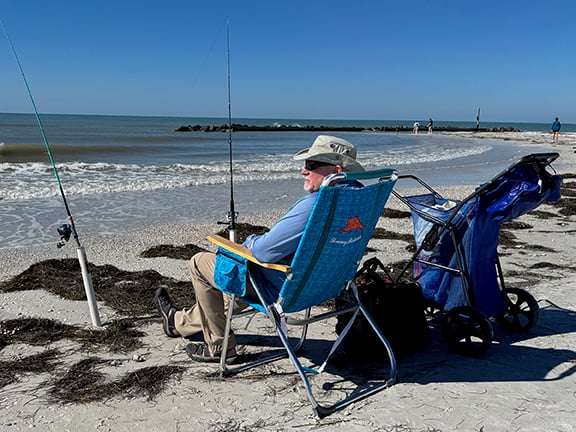
Florida is blessed with 825 miles of sandy beaches. The southernmost state in the Lower 48 is a vacation destination for tourists searching for some wave riding, sun soaking, shell hunting and, of course, surfcasting.
There is always something biting in the surf off the beach. And it just requires a simple setup and some patience.
Most of us avid surfcasters use long rods to get the bait some distance from shore. Longer rods means more leverage for longer casts. I also incorporate a 7-foot rod for those times when I spot a school of fish cruising by closer to shore. I can get a precision cast to fish I’ve spotted that don’t require making a long cast.
Want to know what I consider the most important piece of equipment for the surfcaster? It’s a comfortable chair!
You can only stand for so long with the water lapping over your sandals waiting for that bite. It’s much easier to be patient when you can just sit back and watch the rod tips while waiting for a fish to show you that sign that they’ve grabbed the bait.
Surfcasters rarely hold our rods, preferring to use sand spikes driven into the beach right next to the waterline.
Sand spikes aren’t foolproof for holding rods solidly, especially when chasing bigger species. This is why after you position your chair, drive in the sand spikes, cast out your baits, you use a lighter drag to just keep a slight bend on the rod. Now when a fish grabs the bait it can easily peel some line off the reel and not pull the spike over and drag the rod and reel off into the ocean.
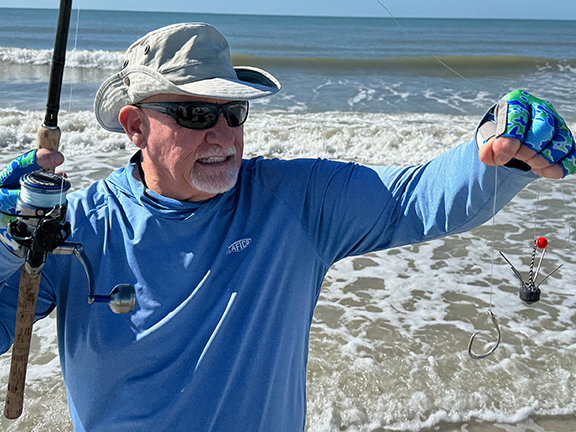
After years of observing novice surfcasters, I believe their greatest mistake is choosing the wrong weights for the job at hand. Nearly every form of sinker gets easily picked up by the current produced by the waves and this pulls the hook and bait back to shore. It’s imperative the sinker falls quickly to the bottom and sticks in place.
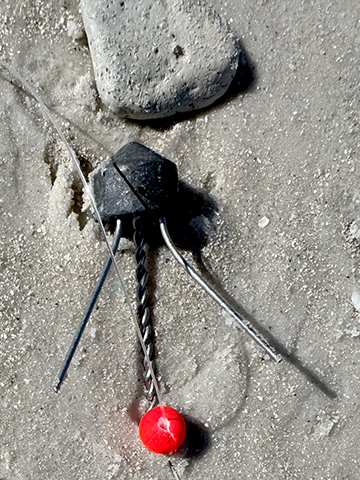
There are two kinds of sinkers that perform exceptionally well for the surfcaster. One is the Spider Sinker and the other is the Sputnik Sinker. Both have heavy wire arms that extend from the lead body that will dig into the sand and bury, so the sinker hits the bottom and there it stays.
Both styles of sinker have a single eye so I rig them by sliding the braided line from the reel through the eye and tie on a barrel swivel that is bigger than the eye so it won’t slip through and become useless.
I tie on a short piece of fluoro carbon line – about eight to 10 inches – to the barrel swivel and to that a circle hook.
You rarely see the bite when surfcasting. The fish sucks in the bait and swims off with it. You won’t see anything telegraphed to the rod until the fish is pulling hard and by then the circle hook should be firmly wrapped around the fish’s jaw.
When the rod tip starts bouncing you just pick up the rod, tighten the drag and start reeling. You never set the hook with a circle hook. You just reel them in.
On my short rod I tie on a 3⁄4-ounce jig and I tip it with a piece of shrimp-flavor Fishbites. All the flavors of these scented strips work well, I just favor the shrimp for no good reason.
I always have a couple dozen live shrimp for bait to add to the jig. This is my ready-rig. I don’t cast it out until I spot some fish swimming by, then I pitch a jig right into the middle of the school.
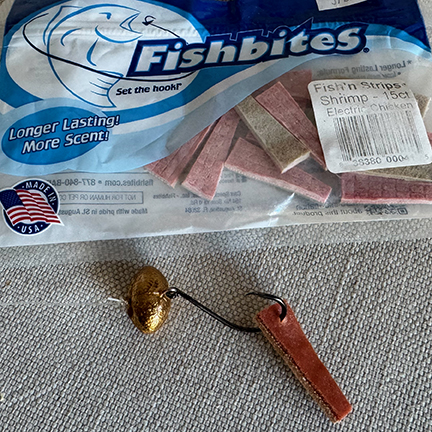
On my longer rod with the circle hook I prefer live minnows for bait. Bait shops almost always have a variety sizes of pinfish, whitebait, and greenbacks. The bigger the bait, the bigger the hook.
On my biggest circle hooks I grind off the barbs to make them easier to remove. This is especially valuable when you land a shark. I have discovered with circle hooks that if you keep the pressure on, not having barbs doesn’t seem to matter. They stay on well even without the barb.
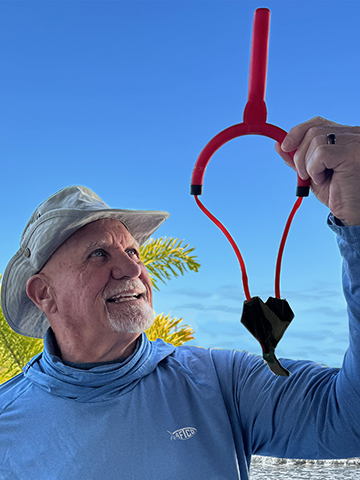
I’ve seen guys sit in one spot all day waiting for a bite. I’m not that guy. My program is 45 minutes max in one location then I move.
That’s why it’s important to travel light. You don’t have to move far. Sometimes just 100 feet is far enough. It’s amazing that fish will prefer a small diameter patch of bottom on a big sand flat, but there must be something holding them there. You just have to find that spot.
One last trick I use: It’s a slingshot. I shoot chum pellets out to the zone where I’m casting and this gets any fish in the vicinity to go on a feeding frenzy. Some surfcasters use chum-bats to distribute chum, but I think they use up the pellets much faster so I go sparingly with a slingshot to conserve and feed just enough chum to get their attention.
The beauty of surfcasting is you never know what is tugging on the end of the line. When you start reeling it could be any one of a dozen different species, and they all fight like world-class athletes.
Saltwater fish fight tides, serious currents, and an ocean environment where every thing is trying to eat them.
These fish are seriously tough and great fun to catch. If you get to Florida, give it a try.

Minnesota Mixed Bag: New state parks license plate contest accepting entries through Oct. 31
The Minnesota DNR reminds Minnesotans that they may submit designs for the next state parks and trails license plate through

Minnesota Letters to the Editor: The circle of life doesn’t bode well for young waterfowl
Reader-submitted letters to the editor published in the Sept. 25, 2026 edition of Minnesota Outdoor News.
Another View: Time to reimagine firearms safety programs
I grew up in Brainerd, Minn., in the 1980s, counting down the days until I earned my firearms safety certification,
