





The problem with identifying the best bullet for white-tailed deer hunting is … getting everyone to agree on it!
One man’s best is another’s worst. I’ve heard just about every bullet ever flung at whitetails described as the best ever and the worst ever. So how does a new deer hunter make a choice?
The usual method is to use whatever your mentor recommends. Dad, brother, grandma, Aunt Sarah, your best friend. They’ll insist they have the answer because they’ve killed all their deer with that bullet.
Unfortunately, “all their deer” might be one or two. And the only bullet they ever tried was that one. Hardly an exhaustive test. So, take friendly advice, but with a shaker of salt.
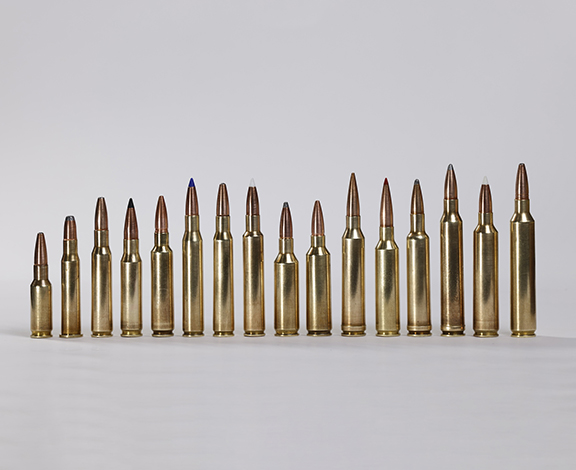
Another thing to consider is the velocity of that bullet as well as it’s diameter/weight. Most whitetails have been shot with old standards like .30-30, .30-06, .308, .270 Win., or perhaps some .257 Roberts and .243 Winchesters. But plenty come to the table courtesy of 7mm-08, .35 Rem., 7mm Rem. Mag. and even .223 Rem. and .22-250 Rem. And don’t forget the old .45-70.
The right materials and design in a 22-caliber bullet at 3,600 fps is not right in a .45-70 at 1,800 fps. Nor a .300 Win. Mag. at 3,200 fps. But there are some basic designs that’ll get us in the ballpark.
MORE WHITETAIL COVERAGE FROM OUTDOOR NEWS:
Gear items that will add to your efficiency this bowhunting season
Hunting in comfort: Is a box blind the best option for your top deer spot?
Want to hunt big game from a ground blind? Pay attention to the finer details

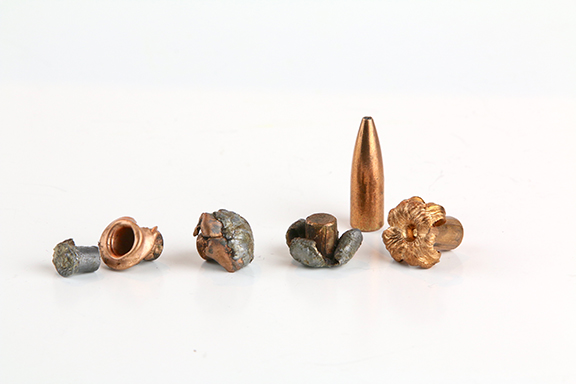
In general, the faster the impact velocity and the smaller the bullet, the more likely it will be to “explode,” meaning break apart on impact. If it does this before getting inside the chest cavity, you could end up with a flesh wound and escaped deer.
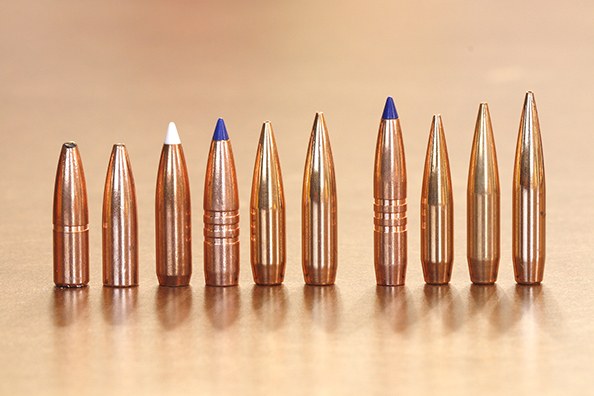
So either place your shots perfectly behind the shoulder, broadside, or use a tougher bullet, something like a bonded core bullet, an expanding all-copper bullet, or a partition bullet with the shank locked in a separate compartment from the lead nose. These usually have sufficient strength and integrity to stay in one piece and penetrate to the vitals.
With larger calibers and heavier bullets and/or lower impact speeds, penetration is more reliable with “standard” cup-core bullets. These cup-cores are the traditional Remington Core-Lokt, Federal Soft Point, Winchester Power Point, Hornady SST and Interlock, Nosler Flat Base, Speer Hot Core, Sierra Game Kings and others.
These may have polymer tips, but usually exposed lead tips. A few might wear hollow points, meaning the lead core sits a bit behind the open jacket tip. But all have the potential to break apart on impact because the lead core is merely slipped inside the copper or gilding metal jacket tube (or cup.)
Cup-core bullets were standard from about 1906 through the 1980s. Nosler’s Partition began the “controlled expansion” trend in 1948, but that didn’t catch on among deer hunters until the mid- to late-1970s. Nor did it necessarily need to because whitetails are relatively small, thin-skinned, and lightly muscled animals.
A cup-core launched at less than 3,000 fps will usually terminate even the biggest buck if parked in the chest. Yes, they could break apart on the shoulder, but in my long experience usually do not. They might ruin a lot of shoulder meat, but large chunks of them and or broken bone will almost always reach the lungs/heart and terminate the animal.
At muzzle velocities above 3,000 fps, cup-cores can really break apart. Here a controlled expansion bullet becomes the better option. They’ll likely shoot through, especially the heavier ones.
A big improvement in modern bullets is their shape. Long, sleek, sharply pointed slugs with high B.C. ratings launch no faster than traditional bullets, but because of their aerodynamically efficient shapes, they retain more energy downrange. This means they hit harder, drop less, and deflect less in the wind. This makes it easier to hit at unknown distances. Field accuracy improves.
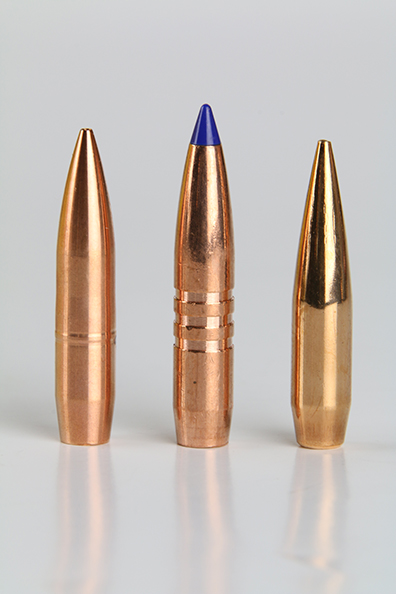
Understand, however, that a “modern” shape can be applied to cup-core construction as well as partitioned and copper constructions. All bullets can be toughened with thicker jackets, weakened with thinner jackets, and also fine-tuned with tapered and skived jackets.
By now you’re probably as confused as I am! How the heck do you choose? Here’s what I recommend: start with a basic style matching your muzzle velocity and caliber. Slow and heavy/wide favors cup-core. Fast and light/narrow favors bonded, partitioned, or various “controlled expansion” hybrids like the Federal Terminal Ascent. But if you can precisely park a frangible bullet behind the shoulder and into the chest cavity, a frangible cup-core will kill quickly. If you hope to tumble a buck with a raking or quartering shot, stick with a tougher bullet. I once hit a fleeing buck in the butt with a cup-core from a 6mm Remington and merely ruined a chuck roast. (My initial hit to the chest is what did him in.)
For more details, watch my You Tube video below for a deep dive into various bullets inside and out.
Finally, don’t judge bullet performance by one example or cursory investigation. A small exit wound does not mean the bullet failed to do its hemorrhaging job internally.
Examine the vital organs and wound channel. I’ve seen exit holes that looked no larger than entrance holes, yet the heart/lungs were minced. Also, a buck that runs 100 yards after a solid chest hit does not condemn the bullet. Deer can run that far with their hearts destroyed.
Dead-right-there reactions are rare unless you strike the central nervous system. A well-rounded hunter knows how to track and trail as well as shoot. Hunt honest and shoot straight.
Outdoor Insights: Time to raise Minnesota fishing license fees for nonresidents? And more election season thoughts
Quick comments on a few stories that have appeared in the news recently.
A buddy’s post on social media
Pro Fishing Tip of the Week: Catching fall giants on Mississippi River waters in Minnesota
We guide exclusively on the Mississippi River and the tributaries. The Mississippi is my favorite water body, and choosing between
Minnesota’s deer harvest trending well ahead of 2025
Wildlife managers from the Minnesota DNR expected hunters would shoot more deer this year, and early harvest numbers this fall
