




Outdoor News may earn revenue from products shown on this page by participating in affiliate programs. This comes at no extra cost to you. Click here to learn more.
One thing that helps get me through the heart of a bowhunting offseason is analyzing gear for my mobile hunting style.
I whitetail hunt almost entirely from the ground or a saddle. That means packing gear in each time over the course of countless hunts every season between late August through the end of the calendar year. In Minnesota and surrounding Upper Midwest states, the conditions faced during that time period can range from 95 degrees and mosquitoes in the early season to 20-below zero temperatures in December.
This mobile approach has helped me shoot a lot more deer, but there’s no doubt it can become a mental grind at times. It helps to have an efficient system dialed in to effectively hunt this way during the worst of conditions through a long season.
That’s what I focused on this past January when the 2024 bowhunting season was still fresh in my mind. What could I do to become even more efficient, and ultimately, effective?
Here are a few gear switches I made over the past handful of months that I believe will make a difference during the upcoming season.
Ranger 22 pack
A good pack is one of the most important pieces of gear for the mobile hunter.
I used the Sitka Tool Bucket for many years. It was a great pack with a ton of storage space, but the focus for my next pack was finding one that could store all my necessary gear in a low-profile package that fit my specific needs as a saddle hunter.
That’s the best way to describe the Ranger 22 pack from Latitude Outdoors.

Some may want more storage space, and for those hunters, Latitude just released the larger Ranger 33 pack. The smaller Ranger 22 was exactly the right fit for me – and I believe for most whitetail hunters unless you really pack in a lot of gear with larger camera equipment.
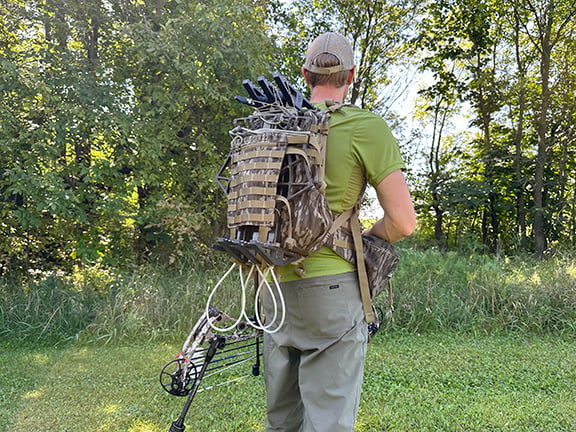
I have loaded this down with all of my typical gear — three sticks and a platform (strapped to the outside with the help of a compression sleeve you can use or remove), a grunt tube, hand saw, rattle bag, headlamp, bow hoist, gear strap and bow hanger, as well as camera equipment used to film hunts with a phone. There is still space to work with.
I’m able to place gear exactly how I want it on the outside with items I need to get at while setting up. Larger gear goes in the main pouch on the inside that I’ll get at once I’m in the tree.
The pack is comfortable with well-placed foam padding. Adjustable shoulder straps, a wide removable hip belt, and a lightweight internal frame (also removable) fit the pack to your individual body, as well as distribute the weight evenly.
Both the Sitka Fanatic bibs and jacket I use during cold winter hunts strap down nicely to the outside of the pack in addition to all my aforementioned gear I’m bringing in. The pack should work well through the entire season.
There are additional little things on the pack that add up to big conveniences. Grommet holes in the side pouches and bottom allow you to feed the rope of a bow hoist through so it’s ready at the base of the tree.
The chest strap is also adjustable vertically so you can set it at the exact right position. That is handy when wearing a pack in combination with a bino harness.
There’s also molle loops all over the exterior of the pack to add items as you wish. I attach my dump pouches utilizing the molle on the hip belt in order to take the weight off my saddle.
Dump pouches

I had gone without dump pouches in prior years, but they are a small price to pay for added convenience.
Two classic dump pouches from Latitude easily fit my tether, lineman’s rope and gear strap so they are right at my side while getting in and out of the tree.
Take the time to think about how you place your gear in the pack and pouches so you are utilizing them most effectively for your individual setup. Then place the gear in the exact same spots within the pack and pouches every time so you know exactly where it is.
You’ll quickly develop a faster system.
Utilizing a well-thought out pack with a couple of dump pouches has you well on your way to maximizing your efficiency in the woods.

Kifaru Mesa deluxe bino harness
For many years I did not use a harness to carry my binoculars anywhere. Cheap harnesses I had tried were cumbersome and sloppy to the point where they were more of a hassle than help.
I have recently started hunting more properties for turkeys and whitetails that are more conducive to glassing. That’s a bigger part of my scouting and hunting strategy now, so a good harness was needed.
I use the B.3 binocular and B.6 binocular from Maven, and the deluxe Mesa bino harness from Kifaru worked great all turkey season and during summer scouting. This is a comfortable, low-profile, form-fitting harness and bino bucket that holds the binoculars secure to your chest.
The bino bucket has six pockets, including pouches for a range finder and extra accessories.
Both the bino bucket and rangefinder pouch come with one-hand operation hoods, meaning it’s quick and easy access to both.

One extra item: Plano Field Locker Bow Case
Living in the heart of lakes country in Minnesota, Plano becomes synonymous with storage options for anglers. They also have a lot of products for archers.

Plano offers a nice mix of bow cases at a wide range of prices. I went with the Field Locker Element Compound Bow Case because I wanted a case that offers maximum protection while traveling to different states each season.
The Field Locker has customizable foam to fit your specific gear. Place your bow, stabilizers, etc., on the foam when you get it, trace the outline with a silver sharpie and then remove the top layer of foam to create a perfect fit for your gear.
The watertight and dust-proof seals are noticeable with how tight the case closes. It’s made of high-quality material and you get a very secure fit during transit.
This case may be overkill if you are a hunter who sticks to short drives around home. It’s not lightweight. It’s a heavy-duty construction (with wheels if you need them during transit), but that offers great protection for those who want to throw their bow in the back of the truck on long trips.
A bow case doesn’t add to your efficiency, but it’s nice having the peace of mind knowing your bow is protected if traveling long distances or over rough terrain on the way to a hunt.

Disqualification reconfigures Minnesota youth trap league’s spring ’26 leaderboard
The Minnesota State High School Clay Target League is starting its fall season, but a disqualification recently reshuffled the list

Minnesota Mixed Bag: Teach a kids to hunt small game during Take a Kid Hunting Weekend
Getting kids outdoors in pursuit of squirrels, rabbits and other small game is the focus of Take a Kid Hunting

Minnesota Letters to the Editor: In defense of the yearling buck
Reader-submitted letters to the editor published in the Sept. 18, 2026 edition of Minnesota Outdoor News.
