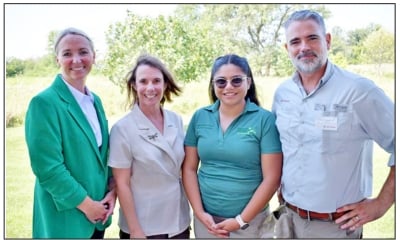
Joliet, Ill. — Officials from the Forest Preserve District of Will County and Openlands gathered Aug. 8 to celebrate two decades of wetland and habitat restoration funded by money set aside for the loss of wetlands caused by O’Hare Airport expansion.
The O’Hare Modernization Mitigation Account created in 2005 to offset the loss of 280 acres of wetlands from an $8 billion airport expansion, was funded with $26 million from the City of Chicago. The Forest Preserve District received $6 million from the account for restoration work at Hadley Valley and Messenger Woods Nature Preserve in Homer Glen.
Over two decades, OMMA funds overseen by Openlands have restored 530 acres of wetlands – almost double what was lost at O’Hare – and 1,620 acres of protected natural space at Hadley Valley, Messenger Woods, two Cook County preserves and Midewin National Tallgrass Prairie. The restoration work and maintenance officially concluded in January.
MORE COVERAGE FROM ILLINOIS OUTDOOR NEWS:
Ralph Loos: Making deer hunting ‘easier’ strategy is missing a vital piece in Illinois
Challenges facing lesser scaup show restoration needs in Pool 19 of the Mississippi River
Endowment seen as source for Illinois state park funding needs
“Thanks to the $50 million bond approved by our Board in 2024, we’re just getting started,” said Tracy Chapman, the Forest Preserve’s executive director. “This investment will preserve more land, restore more habitat and connect more people to nature across Will County.”
The celebration was held at Hadley Valley, the largest restoration in Forest Preserve history, where 193 acres were restored, including 60 acres of wetlands.
The five OMMA-funded sites are “gold standard landscapes,” said Michael Davidson, president and CEO of Openlands.
“This project shows what’s possible when you pair significant investment with long-term stewardship,” he added.
Juli Mason, the Forest Preserve’s director of conservation, said more than 1,000 people helped transform Hadley Valley from farmland into prairie and wetland. One highlight was re-wilding Spring Creek, which had been straightened into an agricultural ditch.
“We had the opportunity to reconstruct it into a healthier, more natural meandering configuration,” Mason said. “So, it provides better habitat for an array of mussels, aquatic insects, and fish.”
She thanked agency partners, funders, staff and board members for making the work possible.